
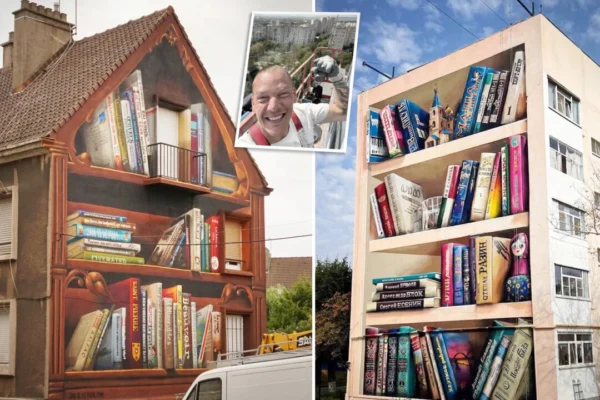
Dutch artist Jan Heinsbroek was trembling as he stood on the scaffolding for the first time, painting a giant nine-story-tall cabinet. He nervously wielded his artistry with cans of colorful paint, casting his magic on the cold, imposing side wall of a concrete apartment building. Displayed in his hometown of Utrecht, Netherlands, this massive mural project showcases his talents.
“I used to be afraid of heights,” the 42-year-old Heinsbroek told Epoch Times, reflecting on his experience. “But after a few days, I got used to it.”
Once a rebellious youth, frequently creating graffiti where he probably shouldn’t have, Heinsbroek has now evolved into a professional mural artist, adding splashes of color in places that need it the most. While his earlier works expressed hip-hop themes in shadows, his current pieces resonate with visual illusions and artistic humor – including his signature “moving eyes” that bring ordinary objects to life in a whimsical manner. His goal has shifted – he aims to bring people together through urban art, hoping to see smiles on their faces.
“At times, I felt like I couldn’t change this crazy world, but if I can make some people smile, then they will smile, and that might make more people smile, and that’s how I change a bit,” he said.
Frequently commissioned by communities or city councils for urban beautification projects, Heinsbroek’s murals range from oversized jewelry displays to giant sharks in faux aquariums. He has been invited to neighborhoods near and far, from somber Soviet-era high-rises in Georgia to reviving towns in Michigan. Upon entering a building, he engages with residents, unearthing stories and building bridges between individuals.
“What’s your favorite book?” he might ask them, seeking to fill a giant bookshelf in Solnechnodolsk, Russia, with books beloved by locals. The responses often foster communication among residents and strengthen their connections.
“Then they see (their favorite book) is also someone else’s favorite next door, and eventually you find common ground between you,” Heinsbroek said. “Everyone comes together.”
Recently, Heinsbroek completed a playful piece: a three-story-tall teapot breaking through the two-dimensional wall into the viewer’s three-dimensional space. Inspired by cozy gatherings where he shared coffee and cookies with community members, he chose a similarly warm teapot as the subject.
Hidden within the reflective plain weave cotton surface of this teapot artwork is the artist’s message. Not only does the artist appear in the arc of the gigantic spout, looking back at viewers standing on the sidewalk, but the surrounding cityscape is also reflected in it.
“I think it’s a good reminder for people to sometimes look in the mirror,” he said. “Everyone needs more self-reflection.”
Heinsbroek remarks on the severe societal divisions today, emphasizing the need for self-examination before accusing others. Politics, power, money, and media – negativity is widespread, tearing apart the social fabric instead of uniting people and making the world a better place.
“Now, it seems if you don’t agree with someone, you can’t just be friends,” he said. “You have to pick a side. There are actually no camps.” Nevertheless, most people concur that what he paints is visually intriguing or funny.
Skillfully utilizing perspective, Heinsbroek encourages people to see the world from new angles – both literally and symbolically. Starting from the streets, he views buildings or walls from the perspective of the viewer. Illusions typically only work from a specific viewpoint.
“It’s important to look at the building and the surrounding environment and ask yourself, what does this place need, or what is possible?” he said. “Does it already look like something that doesn’t exist yet?”
By using “subtraction,” he creates false openings and architectural structures on building walls, followed by adding oversized creations limited only by his imagination. This could be a rocket, a bird the size of a car, or a seven-story-tall giraffe. Sometimes, the interactions between spaces and juxtaposed objects are truly awe-inspiring.
In Schalkwijk, Netherlands, an ordinary tennis court for children now looks much more perilous – viewers come face to face with a fierce shark, separated by only a cracked organic glass panel. A stray tennis ball caught in the crack shatters the barrier between the world of depths and the flat plane.
Interaction between spaces also bridges the past and the present. Visiting an ancient textile mill in Eindhoven and a renowned tailor shop in Holtenheim prompted Heinsbroek to depict a bizarre mechanical aesthetic. Spindles, cranks, and the oldest sewing machine in the Netherlands soar high, piercing through different spaces and eras.
Heinsbroek initially found inspiration as a youth from graffiti artists. He describes his artistic journey as a tree growing from a seed. Initially, it was his parents who had him paint on a backyard wall to keep him out of trouble. Eventually, this tree of art blossomed, with admirers hiring him to add color to their homes, branching out his career.
Thirty years later, he stands on towering scaffolding, adding visual flavor to monotonous, gray communities. However, the fruit of this tree – the soul of his works – is the stories of the people living there.
“It makes people proud because it’s their own story,” he said.