
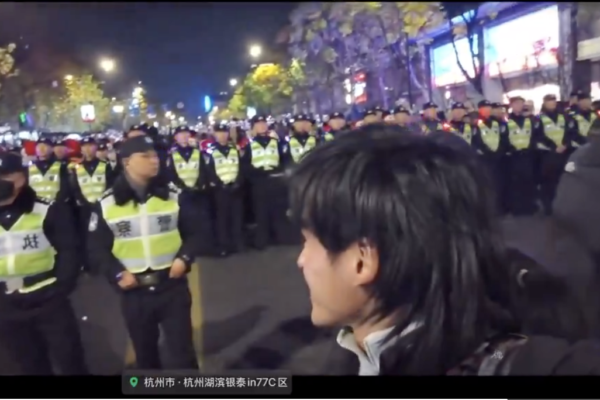
On December 31, 2025, New Year’s Eve celebrations were held around the world to welcome 2026. However, in China, authorities seemed on high alert as many places canceled celebrations and even arrested some individuals for setting off fireworks. Coinciding with large-scale protests in Iran before and after New Year’s Eve, the iron-fisted control by the Chinese Communist Party over the New Year’s activities raises concerns about the underlying crisis and fear depths.
On the evening of December 31, 2025, while New Year’s Eve events were being held globally, the Chinese Communist authorities deployed large numbers of police and security forces across the country to prevent public gatherings to welcome the new year. Many places directly canceled New Year’s Eve light shows, countdown ceremonies, fireworks displays, and cleared public squares early. Some cities significantly closed subway and bus services early on New Year’s Eve. Some universities required students to stay on campus or report their whereabouts during the New Year holiday. In certain areas, malls, pedestrian streets even suggested citizens celebrate New Year’s right where they were.
However, on New Year’s Eve, spontaneous gatherings of people occurred in many places to celebrate the arrival of the new year, resulting in confrontations with a large number of police.
A video taken by a young person at InTime shopping center in Hangzhou showed the police standing guard in an aggressive manner on the street. However, the authorities seemed helpless when faced with the young people celebrating the new year.
A video from a netizen in Shanghai showing New Year’s Eve activities depicted it as a gathering with a countdown but lacked fireworks and lights, leaving the scene in silence. Similar situations were observed in Hangzhou, Zhejiang province.
In Suzhou, despite a large number of citizens coming to celebrate New Year’s at the “Oriental Gate,” the site was dark with only police lights flashing. At the Shilaoren Beach Scenic Area in Qingdao on New Year’s Eve, special police were on high alert with the entire 1.7 km coastline lined with guardrails and police patrolling every five steps.
These situations contrast sharply with the lively crowds in other parts of the world. Netizens discussed it actively, saying, “Isn’t this just too awkward?”
Author Cui Chenghao shared a video of a New Year’s Eve concert in Ho Chi Minh City, Vietnam, indicating that in another 20 years, Vietnam could likely join the ranks of developed countries.
On social media, netizens uploaded videos of authorities stopping and arresting people for setting off fireworks.
One video showed a young person celebrating with fireworks against the authorities’ ban, resulting in a police chase and the arrest of several individuals.
In Hangzhou on New Year’s Eve, a foreigner led the crowd in chants but was subsequently arrested by the police.
According to reports from mainland media, in the early hours of January 1, in Tianyi Square in Ningbo, Zhejiang, two young men ignited Gatlin fireworks next to a dense crowd and were both administratively detained. However, more incidents of people being arrested were not reported by mainland media.
New Year’s Eve indeed incites sensitive responses from the authorities. For example, netizens across the country released balloons on New Year’s Eve and engaged in relay activities in the comments section of the CCTV New Year’s Eve gala to voice concerns over the tragic medical incident involving Ningbo Xiao Luxi in November 2025.
In addition, in the central square of Xinjiekou in Nanjing, Jiangsu Province, the police erected two human walls to prevent people from offering flowers to the statue of Sun Yat-sen inside the square.
Historically, at the New Year’s Eve of 2022, thousands of people breached police lines in Xinjiekou square, flowing towards the statue of Sun Yat-sen, offering flowers and releasing balloons. This incident took place right after the “blank sheet movement” and made the authorities unusually tense.
Commentator Xiangyang stated that this time, the CCP directly preempted by blocking access to the statue to prevent a reoccurrence of similar events. “The Communist Party knew that the statue of Sun Yat-sen doesn’t belong to them, it belongs to the people! The founding father represents the Three Principles of the People, the Republic of China, democracy, and republicanism, which clashes with one-party dictatorship. When people approach (the statue of Sun Yat-sen), it signifies: what we long for isn’t you (the CCP). While New Year’s Eve should be celebratory, the police treated the statue of the founding father as an enemy. When maintaining stability reaches this point, it indicates a change in public sentiment, and the authority of the CCP is crumbling.”
Following the stampede incident during the New Year’s Eve celebrations on the Bund in Shanghai in 2014, which resulted in numerous casualties, New Year’s activities have been strictly controlled since then. However, the restrictions varied in different regions. In the promotional materials this year concerning the cancellation of New Year’s activities and the control of fireworks, emphasis was placed on “ensuring public safety and the safety of people’s lives and property.”
Canadian Chinese writer and seasoned commentator Sheng Xue told Dajiyuan that prohibiting New Year’s Eve activities and gatherings across China now is evidently unrelated to the impact of the incident at the Bund in Shanghai over a decade ago. She emphasized that event itself was caused by administrative incompetence rather than spontaneous gatherings by the people.
“Many places around the world hold large celebrations annually, with countdown events. For instance, in Times Square, New York, there are sometimes over a million people gathered. Therefore, the official Chinese rationale for safety is unfounded. The authorities only use the prevention of accidents as a permanent excuse for emphasizing stability,” she said.
Sheng Xue noted that this year, the CCP’s precautions seemed more severe than before, such as issuing bans in advance and even abruptly halting countdown events without prior notice.
She believed that the intensified control over New Year’s activities might stem from Xi Jinping’s fears. “He now fears many things,” she added.
Sheng Xue analyzed that infighting within the CCP is severe. The authorities are particularly concerned about events like New Year’s Eve gatherings, as leadership in such activities displaying distinctive political symbols could challenge the stability of the regime. Moreover, due to economic decline, young people unable to find employment feel suppressed and disgruntled, making New Year’s Eve a crucial moment to express discontent towards the regime. “Now, the Xi Jinping administration treats the people as hostile forces.”
Jiang Pinchao, editor-in-chief of the “June Fourth Poetry Collection” and a writer in the collection at the Library of Congress, agreed that the CCP is entering the late stage of its rule over China. “The entire rule is currently in a precarious state, like a powder keg. Once a breakthrough occurs, like lighting a fuse on a powder keg, the regime could collapse.”
Notably, this year shows inconsistent responses from local governments to the limitations on New Year’s activities by the CCP: some locations announced early bans on New Year’s Eve gatherings, some canceled last-minute, some allowed celebrations, while others permitted limited celebrations. Netizens questioned, claiming China has turned into a federal system?
Current affairs commentator Li Linyi stated, indicating that the CCP is not an indomitable entity and setting the stage for potential local resistance to future mass uprisings.
The CCP’s restrictions on New Year’s celebrations bring to mind the large-scale protests in Iran. Since December 28, 2025, Iran has witnessed its largest protests in three years, sparking violent clashes in several regions due to soaring inflation. For the current Iranian regime, it is a critical juncture. Even though the current protest scale remains limited, it signifies growing discontent among the Iranian people as they quietly regain public spaces and personal freedoms through resistance actions.
A video of the New Year’s Eve scene showed Chinese police vehicles using sirens to urge people to go home. In the comments section, netizens said, “Due to the Iranian weather, we are not celebrating this year.”
Yu Huaisong, Vice Chair and CEO of the Overseas Affairs Department of the American Republican Party and a Shanghai native, shared a video of New Year’s Eve in Shanghai on X platform, stating, “The CCP fears large-scale protests, leading to many cities restricting New Year celebrations and countdown activities. Police in China asked people to disperse, but the people resisted. Xi Jinping dares not take strong measures because he does not want China to become like Iran. 2026 will be the year of ‘soft resistance’ from the Chinese people.”
Sheng Xue expressed that the resilience of Iranian people in the face of regime suppression is indeed a significant fear for the CCP, as they fear that the Iranian people may serve as a model or inspiration for the Chinese people.
Commentator “New Highlands” stated on the X platform, questioning why the highest levels of the CCP displayed such overt vigilance over an inherently secular, consumerist, and politically neutral New Year celebration. The core reason lies in preventing a large gathering of young people from fostering an “instantaneous collective empathy scene.” The nationwide paper protest movement at the end of 2022 started from the New Year’s Eve gathering on Middle Urumqi Road in Shanghai, leading to mourning, anger, and nationwide connection.
The article suggests that for the past two years, the authorities have been advocating for “living frugally” and discouraging young people from being “laying flat.” A bizarre phenomenon has emerged: on one hand, they are desperately boosting consumption; on the other hand, they fear the specter of “too joyful” scenes of consumption. New Year’s Eve, initially a secular collective dream moment, has now become a mirror reflecting who fears people congregating “spontaneously, simultaneously, on a large scale, and joyfully.”
“New Highlands” believes that strict control of public celebrations and gatherings often occurs in the late stage of a dynasty. For instance, during the Yuan Dynasty (1280-1368), rulers prohibited group festival activities like the Lantern Festival to prevent potential uprisings and rebellions, and the Qing Dynasty towards the end of the 19th century also intensified monitoring of popular festivals and assemblies. Moreover, public celebrations or spontaneous assemblies worldwide often become catalysts for revolution; for example, the Arab Spring of 2010-2011 started from street protests and festival-like gatherings, swiftly evolving into the wave of overthrowing multiple governments.
The author argues that bans on festival gatherings typically stem from a fear of a transition from “collective joy” to “collective anger,” much like the current CCP’s cancellations of New Year activities to prevent similar events from recurring.
“New Highlands” had previously published on the X platform, suggesting that Xi Jinping’s extreme desire for power, wariness of change, and hyper-reactions to external threats have exacerbated domestic contradictions and created international isolation. These signs indicate that China is clearly entering the “late CCP” period. After 2025, China may face even greater turmoil.
Jiang Pinchao also agreed that the CCP has reached the late stage of its rule over China. “The entire rule is currently in a precarious state, like a powder keg. Once a breakthrough occurs, like lighting a fuse on a powder keg, the regime could collapse.”