
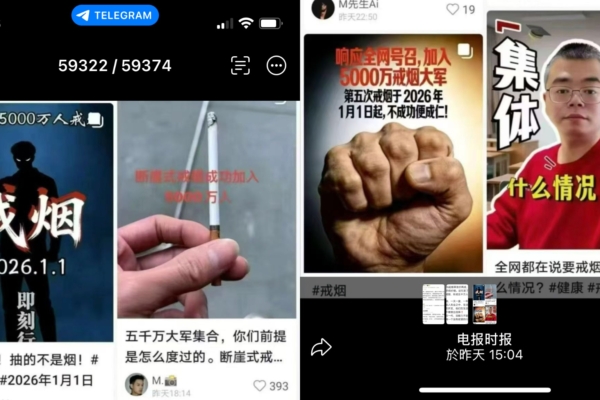
Recently circulating on mainland Chinese social media platforms is a post regarding the retirement pension levels of officials in the Chinese Communist Party’s tobacco system, which mentioned that individual officials receive nearly 20,000 RMB in pension per month after retirement, sparking public scrutiny. Discussions revolve around the disparities in retirement benefits and the support for young people to provide for officials in the social security system. Some netizens have shared screenshots calling for a nationwide smoking cessation protest starting from New Year’s Day.
In the context of China’s rapidly aging population and declining birth rates, a post regarding the retirement pension levels of officials in the Chinese Communist Party’s tobacco system has been widely spread on mainland Chinese social media platforms in recent days. The post also criticized the retirement benefits of the tobacco bureau. According to the post circulating on social media platforms, a retired official in the Chinese Communist Party’s tobacco system can receive about 19,000 RMB in pension per month. Based on calculations, if the individual passes away at around 90 years old, the duration of receiving retirement pension would be about 30 years, and at current price levels, the total retirement pension received over a lifetime would be about 6.84 million RMB.
The post further points out that maintaining this pension level would require approximately 30 young labor force members to continuously contribute to social security in order to cover the expenses of a highly compensated retired individual. Although the specifics of the institutional documents were not marked, the quoted amounts, duration, and population ratios have raised doubts about the support structure of the social security system.
Mr. Jin, a Yunnan scholar who has long been concerned about pension issues, said in an interview with reporters that the long-standing inequality in pension and other safeguard benefits between the internal and external systems of the Chinese Communist Party is the root of the current backlash of public opinion.
He stated that, for example, in the tobacco system, there has been a long-standing practice of relatively closed personnel and welfare arrangements, leading to a significant gap in retirement pension levels compared to local civil servants or corporate workers, despite all contributing to social security. “People from different systems who retire end up receiving benefits that are not at the same level,” he said.
Public statistics show that in the 1990s, mainland China’s annual birth rates once approached nearly 29 million people; however, in recent years, the number of newborns has decreased to about 9 million, less than a third of the peak period. According to the current pension system calculations, in about 22 years, when the above-mentioned highly compensated retired individuals are still receiving pension, the scale of contributing members may further shrink.
Mr. Jin told reporters that the reason why this set of population data garnered attention is because many people have started to compare it to real-life scenarios. “As the number of young people decreases and the number of contributors decreases, but the number of people retiring and receiving money in some systems continues to increase, it naturally creates a sense of imbalance.” This feeling of imbalance did not suddenly emerge but has gradually accumulated in the background of employment pressures and slowing income growth, and “once concrete numbers are seen, it is easy to ignite.”
Apart from the retirement pension issue, recent financial and policy adjustments related to the Chinese Communist Party’s tobacco system have also attracted public attention. Information from various regions indicates that starting from 2026, mainland China will raise the prices of certain tobacco products by about 20%, and simultaneously cease the sale of low-priced cigarettes below 10 RMB.
Mr. Ye, an internet user from Guangdong, told reporters that the discussion surrounding the tobacco price adjustment is related to the decreasing income of many people. “Nowadays, many people have unstable jobs, and living expenses are increasing one after another, and with the ban on selling 10 RMB packs of cigarettes, the cost of smoking has clearly gone up.” He also mentioned that many people online are calling for collective smoking cessation not only out of health considerations but “more to express a protest sentiment.”
Public promotional materials indicate that the aforementioned adjustments have rapidly led to a large number of internet users posting “quitting smoking” related content on short videos and social media platforms, with the topic’s views and discussions reaching tens of millions.
Some internet users have connected the changes in tobacco prices with personal economic pressures, health choices, and long-term consumption burdens. One user wrote: “Wake up, you’re not smoking cigarettes! Collective smoking cessation on January 1, 2026.” Another wrote, “Fifty million troops gather, cliff-edge smoking cessation.”
Calculations show that based on a 10 RMB pack of cigarettes, smoking one pack a day would incur an annual tobacco expense of about 3,600 RMB. In the current employment and income environment, this expenditure is not insignificant for some low-income or unemployed individuals.
Multiple population studies indicate that mainland China has entered a stage of low birth rates and rapid aging. In this situation, the current pay-as-you-go pension model heavily relies on the labor force size. In related discussions, some opinions believe that if the number of contributors continues to decrease while existing retirement expenditure structures remain unchanged, the Chinese Communist political system will face greater challenges.