
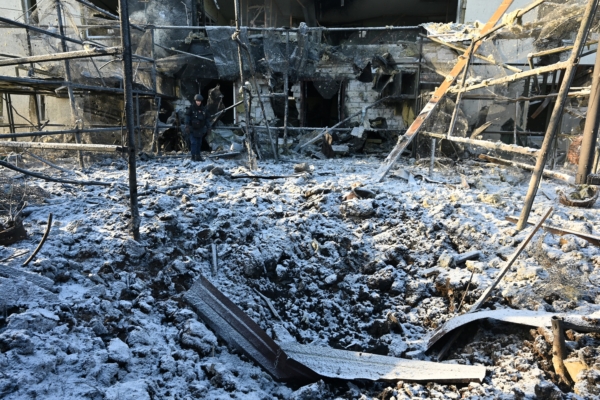
On Thursday, January 1st, both Russia and Ukraine accused each other of attacking civilian targets, intensifying the nearly four-year-long war at the start of the new year. Despite intensive peace negotiations led by the United States, the frontlines continue to see fierce clashes, and both sides are exerting diplomatic pressure on each other, showing that the path to peace is still fraught with uncertainties.
Russia accused Ukraine of attacking the village of Khorly in the Kherson region controlled by Russia. According to the Russian side, three Ukrainian drones deliberately attacked a local hotel and café on New Year’s Eve where civilians were gathered to celebrate the new year.
Vladimir Saldo, the appointed administrative head of the Kherson occupied area by Russia, stated that the attack resulted in at least 24 deaths (including a child) and 50 injuries, with many victims perishing in the fire. The Russian Foreign Ministry labeled the incident as a “terrorist attack” committing “war crimes.”
Maria Zakharova, a spokesperson for the Russian Foreign Ministry, declared in a Telegram statement that Ukraine’s Western backers should ultimately be held accountable for the incident.
However, international media outlets such as Reuters and Al Jazeera pointed out that the details of the alleged attack by Russia have not been independently verified, and the attribution of responsibility remains contentious.
Meanwhile, Ukrainian President Zelenskiy accused Russia of launching “deliberate acts of warfare” on New Year’s Eve by firing over 200 attack drones across Ukraine, targeting energy infrastructure in seven regions, causing damage to the energy system.
The Ukrainian Air Force stated that they had shot down or destroyed 176 out of 205 drones. The governor of the Kherson region, Oleksandr Prokudin, reported that the attack on the city on Thursday resulted in the death of a man and injuries to an 87-year-old woman.
While defending themselves, the Ukrainian military confirmed launching precision strikes on Russian mainland and occupied areas. The Ukrainian forces emphasized that the operations were only targeting “legitimate military and economic objectives” to weaken Russia’s war potential.
The targets hit included the Ilsky oil refinery, a high-value economic target located in the Krasnodar Krai of Russia.
The Ukrainian military also stated that other high-value targets in Russia and occupied Ukrainian territories were also struck, including a “Shahed” suicide drone warehouse near Donetsk, a “Tor-M2” air defense system near Shevchenko, and a fuel depot near Ilovaisk.
The Ukrainian General Staff also mentioned a command post near Avdiivka being targeted.
As peace negotiations progress slowly, the battlefield continues to witness brutal realities. According to the 2025 year-end assessment released by the Ukrainian Open Source Mapping Project DeepState on Thursday, Russian forces have occupied approximately 4,300 square kilometers of Ukrainian territory in 2025, roughly 0.72% of the country’s total land area.
Donetsk Oblast remains the most intense conflict area, with Russian forces currently controlling nearly 78% of the region.
Overall, Russia currently controls over 19% of Ukrainian territory.
However, despite territorial gains, the cost for Russian forces has been extremely high. The Ukrainian General Staff estimated that about 418,170 Russian soldiers (including casualties, prisoners, and missing personnel) were lost in 2025, a number roughly consistent with Western intelligence agencies’ assessments, underscoring the brutal nature of this war of attrition.
It is a sensitive period as peace negotiations accelerate. Moscow recently accused Ukraine of attempting a long-range drone attack on President Putin’s official residence in northwestern Russia, while Kyiv rebuked this as a “ploy” to disrupt peace talks.
The mutual accusations of attacking civilians during the New Year period reflect both Russian and Ukrainian attempts to further engage in a “war of narratives” to secure international support and negotiation leverage.
While Ukraine revealed progress in peace agreements, critical differences remain hard to bridge. Currently, Russia still refuses to implement a comprehensive ceasefire and demands the full withdrawal of Ukrainian forces from Donetsk, Luhansk, Kherson, and Zaporizhzhia, despite some areas not being fully occupied by Russia.
Ukraine is also seeking stronger security guarantees to prevent Russian invasion in the long term.