
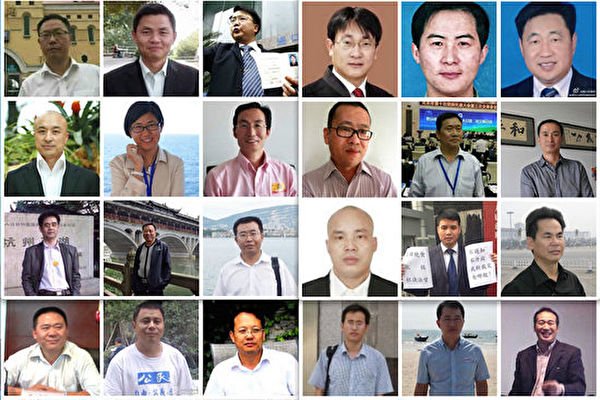
On December 31, 2025, the Chinese Human Rights Lawyers Group released the 2026 New Year’s Message entitled “When Civil Rights Are Violated, We Will Never Compromise or Be Silent,” focusing on the numerous instances of civil rights violations within China over the past year. The message emphasized that Chinese society is entering “an increasingly lifeless era” and called on the public to continue speaking out.
The message highlighted the diplomatic retaliation by the Chinese Communist Party against Japan’s Prime Minister for his remarks on Taiwan, which quickly extended to cultural and commercial aspects. For example, Japanese singer Ayumi Hamasaki’s concert scheduled to be held in Shanghai on November 29 was canceled the day before citing “force majeure”; singer Maki Otsuki was abruptly cut off from the power supply and removed from the stage during a performance in Shanghai.
It was pointed out in the message that the greatest victims were not the Japanese artists but the ticket-buying audience and the organizers, demonstrating the lack of recourse when people’s rights are violated. The Lawyers Group believes that people-to-people exchanges between China and Japan are the cornerstone of maintaining bilateral relations and should not be weakened due to political tensions.
Mr. Li, a human rights lawyer from Hunan, stated in an interview on January 1 that the events mentioned in the message are not abstract concepts. He said, “The space for free speech is narrowing. Many prisoners of conscience are simply exercising their constitutionally protected rights but are still in prison, including lawyers Yu Wensheng and his wife, and Xu Zhiyong (sentenced to 14 years in prison).” He emphasized that these people are not trying to challenge the ruling authority but merely practicing the most basic forms of expression and belief.
The message also uncommonly addressed the situation in Hong Kong. It mentioned the major casualties resulting from the fire at the Hong Fuk Yuen in Tai Po, Hong Kong on November 26 last year, where citizens demanding an independent investigation were arrested by the National Security Department. The Lawyers Group issued a public appeal on November 30 last year, demanding the immediate release of those involved and stating that their four demands were “rational, legitimate, and legal.” The message noted that Hong Kong’s freedom and rule of law had once been a window of openness for China, stating that “Mainland China and Hong Kong prosper together or suffer together.”
In a somber tone discussing the situation in Hong Kong, Mr. Li expressed his concern, saying, “Hong Kong was once seen as a symbol of freedom and rule of law, but now even seeking the truth may be considered a problem, which is worrying.”
Regarding the reality of practicing law, Mr. Li mentioned that the professional rights and workload of lawyers on the mainland have not improved this year: “The business is decreasing, the economic situation is not good, and the right to meet clients is not guaranteed.”
He stressed that mainland lawyers still have to undergo annual reviews and that representing cases involving speech, belief, and public issues may lead to penalties for the law firm. “The pressure is always there; it’s just that everyone has gotten used to it.”
Mr. Chen, a lawyer from Henan, confirmed a similar situation. He told reporters, “Lawyers representing criminal cases, especially those with human rights implications, often cannot guarantee their right to meet clients and face many obstacles. Representing sensitive cases may result in adverse consequences from the administrative or industry level.”
Mr. Zhao, a lawyer from Hubei, believed that this year’s message was more restrained in language compared to previous years and no longer attempts to create a sense of hope. He told reporters, “This year, we cannot see any expectations for the future, nor can we pretend it exists.” He explained to reporters that the Lawyers Group did not list specific cases this year because “there have been statements in the past, so there is no need to repeat them this year.”
In addition to the shrinking of lawyers’ rights, the message also pointed to institutional changes and potential risks. The amended Regulations on the Administration of Public Security will take effect on January 1, 2026. The message stated that society was concerned that sending pictures in private chats could be punishable, but the concept of “distribution” does not include point-to-point private chats. The Lawyers Group emphasized that if law enforcement agencies in the future regard private chats as distribution, infringing upon privacy and freedom of speech, society should “suppress law enforcement inertia with civil disobedience if necessary.”
In terms of people’s livelihoods, the message documented how the transfer of agricultural land has led to some farmers losing their primary sources of income, shifting the burden of elderly care onto their children, resulting in reduced consumption ability within families. The cost of the New Rural Cooperative Medical Care Scheme has increased from an initial 10 yuan to over 400 yuan, but the coverage has shrunk. The message stated, “More and more farmers are abandoning the New Rural Cooperative Medical Care Scheme,” leading to a resurgence of poverty due to illness. The Lawyers Group called on the government to increase investment in people’s livelihoods, provide direct subsidies to low-income groups, and establish a more resilient social foundation through secondary distribution.
The Chinese Human Rights Lawyers Group is not a registered organization but consists of lawyers who voluntarily come together and represent cases involving speech, belief, criminal defense, and public interest. Its origins can be traced back to a series of civil rights cases in the 2010s, with collective voices gradually becoming a means of self-rescue within the legal profession.
The message called on the authorities to ratify the International Covenant on Civil and Political Rights, establish a truly rule-of-law government, and once again demand the release of those detained for their speech and beliefs.
In the final interview, Mr. Chen from Henan told reporters, “The era of raging fire and boiling oil is over. Now we can only maintain honesty and no longer offer blind hope.”
The conclusion of the message stated in the face of an increasingly lifeless era, “We will not be silent. We witness, we are present, we express.”