
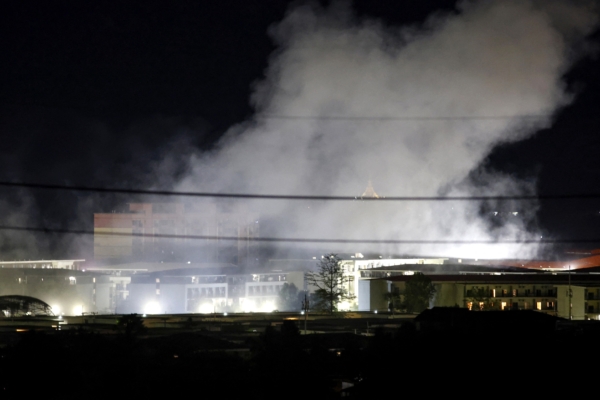
Recently, as the Thai military publicly announced the destruction of six suspected telecommunications fraud bases within Cambodia, it has drawn international attention. A group of Chinese victims who were deceived into “projects” or “companies” in Southeast Asia have recently recounted to Epoch Times their experiences of being restricted, beaten, and forced to participate in fraud activities at these sites.
Their testimonies starkly contrast with the latest military actions, prompting reexamination of these long-existing yet often overlooked gray areas.
The victims generally pointed out that these so-called “parks” do not exist in isolation but are highly overlapping with casinos, hotels, residential buildings, and other places, forming a concealed and closed gray network. Once under control, it is extremely difficult for most people to escape on their own. Those who can be rescued through fundraising by family members or external actions are seen as “very few lucky ones.”
Since December 7th, intense conflicts have erupted again between Thailand and Cambodia. The Thai military stated that they aim to “cut off the root of transnational crimes and protect people around the world from telecom fraud.” Recently, the world’s attention has been focused on the telecom fraud parks and casinos being frequently bombed in the war zone.
A victim from Hebei province, known as Xiao Zhao, recalled being deceived to the border areas of Cambodia due to believing in information about “high-paying jobs” and “getting rich quickly.” “I stayed in the park for more than twenty days, getting beaten every day, doing nothing except getting hit,” Xiao Zhao said.
Xiao Zhao mentioned that after seeking help from his family and leaking information, he was identified as crossing the “red line” and immediately subjected to concentrated punishment. “They took me to the punishment room, shocked me with a stun gun continuously, my back was covered in wounds. If they had rescued me an hour later, I might not have survived.”
He described himself as being “blank-eyed” and in a state of extreme physical and mental weakness when rescued.
A victim from Hunan province, known as Xiao Li, stated that the understanding of fraud parks by the outside world is often too simplistic, “not all companies are located in those enclosed large parks.” He pointed out that in the capital of Cambodia, Phnom Penh, some fraud companies directly hide in residential buildings, villas, or independent office spaces.
“They look like ordinary companies during the day, but at night, they start settlements and violence,” Xiao Li recalled, stating that penalties are often carried out collectively at night if performance expectations are not met, “every night at 11 o’clock, it’s like a martial arts movie.”
He also mentioned that those with long-term low performance might face continuous beatings or even “disappear.”
A victim from Sichuan province, Xiao Zhang, emphasized that despite multiple crackdowns, the fraud parks have not disappeared. “These parks are endless to defeat, the more you fight, the more there are, always expanding,” he said, noting that some parks do not even have formal names, only distinguished by codes.
“In almost every casino, there is a park upstairs,” Xiao Zhang said, indicating that fraud companies, dormitories, and punishment places are often concentrated in the same building, making it difficult for outsiders to discern the true purpose inside.
Many interviewees pointed out that these casinos are not standalone structures but highly overlap and provide cover for the fraud parks.
Xiao Zhang pointed out that many companies refuse any form of negotiations for compensation, and those who manage to contact their families or pay for release are considered “lucky.”
The claim by victims about “fraud parks located above casinos” received real confirmation through recent Thai military actions.
After about three weeks of ongoing conflict on the Thailand-Cambodia border, both sides recently declared a ceasefire. Prior to the ceasefire, the Thai military carried out air raids and control over multiple gambling establishments along the border. The Thai military announced the destruction of 6 fraud bases in Cambodia.
Additionally, the Thai military revealed that on December 22nd, multiple abandoned wild animals, including a male lion, a female lion, two Asian black bears, and a Malayan black bear, were found inside a controlled casino building. These animals were discovered to be severely hungry and weak.
Some mainland netizens raised doubts on social platforms, demanding the disclosure of relevant truths and questioning the timing of the ceasefire. Some netizens also noted that earlier this month, Cambodia announced visa-free entry for Chinese citizens. The Chinese authorities encouraged people to travel to Cambodia, and on December 28th, provided 20 million worth of aid to Cambodia.
Victims generally mentioned that as some parks were exposed and attacked, some fraud organizations began to shift to more concealed areas and even overflow to other countries. Xiao Zhang said, “They just change places, they don’t disappear.”
Many victims and their families expressed that people continue to go to Southeast Asia due to information like “high-paying recruitment” and “free food and housing,” only to later lose contact or be asked to pay exorbitant ransoms.
A victim’s family member stated that their relative was threatened with violence by the park because they were unable to raise the ransom. “They sent a video, saying they would chop off his leg, our whole family was in despair.”
Although the interviewed victims had diverse experiences, they were highly consistent on one issue – the few who can return to their home country are very rare.
“Many people will never come back in their lifetime,” Xiao Zhang said, “what you hear are from those who have managed to come out alive.”
Many victims urge for increased vigilance against related recruitment information and hope that cross-border law enforcement and information disclosure can continue to advance to avoid more people falling into the same trap.
Interestingly, Cambodia currently displays a “determined” stance in combating telecom network fraud crimes.
On December 18th, the Secretary of the Committee of Combating Cybercrime (CCOS) in Cambodia issued an official announcement, stating that during the nationwide anti-fraud operation from June 27th to December 18th this year, the CCOS task force conducted raids at 118 locations in 18 provinces and cities of the country, arresting 4,983 suspects from 23 countries and regions. So far, 4,039 foreign nationals involved in the cases have been deported.
The announcement mentioned that authorities also rescued victims of human trafficking, smashed telecom fraud networks and bases engaged in human trafficking activities, and seized thousands of electronic devices and criminal tools including computers, phones, and passports.