
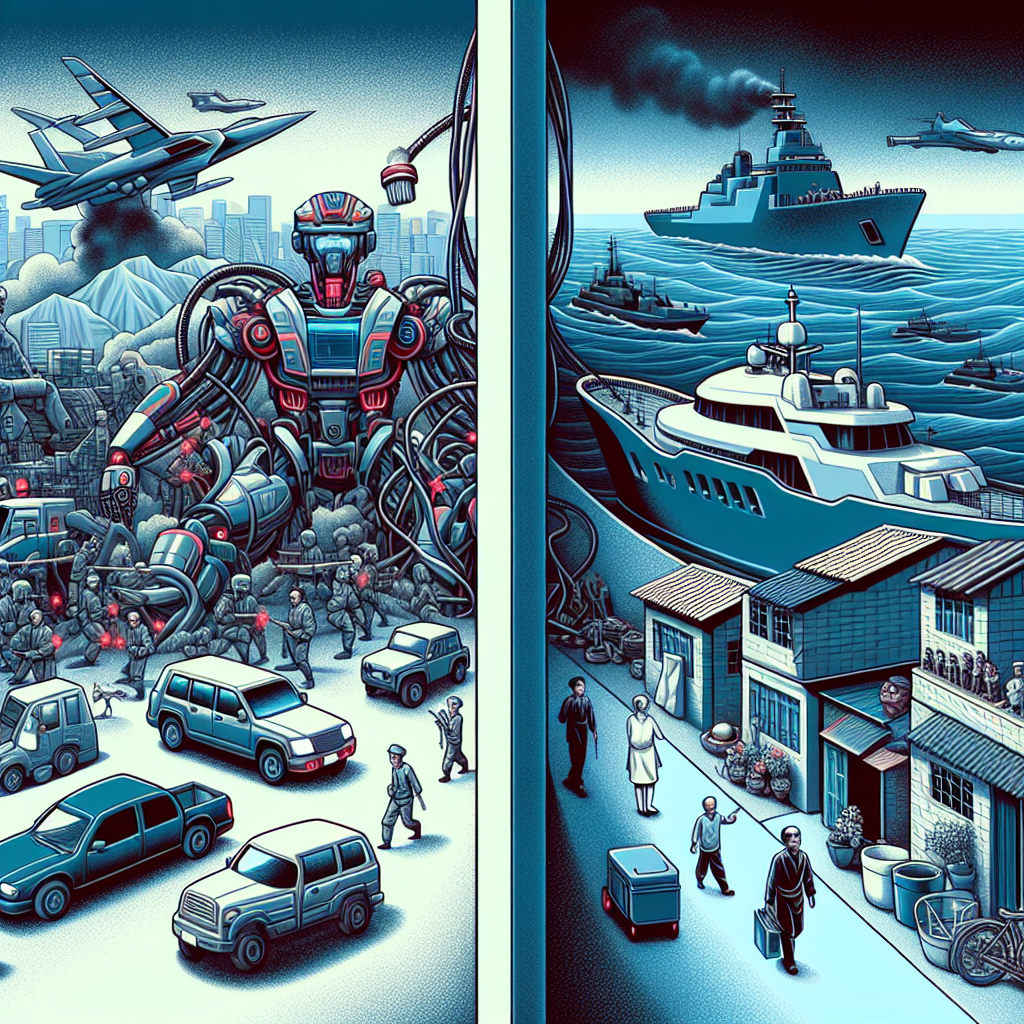
China’s economy is currently facing extremely contradictory development. While abroad, one would see the Chinese Communist Party (CCP) heavily investing in industries such as robotics, electric vehicles, and aircraft carriers. However, those within mainland China do not feel this progress. Many ordinary citizens feel that their living standards are declining, with livelihoods deteriorating.
Despite the CCP’s emphasis on emerging industries, it has not translated into business profits or job security. In fact, local tax revenues are decreasing, and many industries are facing overcapacity. Overall investment in Chinese society is declining, wage growth is stagnant, and prices are deflating. Official figures show that nearly one-fifth of Chinese youth aged 16-24 are unemployed.
Economists describe the current situation as “economic dual-track”, “economic temperature difference”, or “resource misallocation”, which bears striking similarities to the late stages of the former Soviet Union—a regime that lost public trust and ultimately collapsed due to similar economic troubles.
Since 2018, China has shifted towards a development model where political and security concerns overshadow economic development. The CCP leadership has been advocating for “high-quality development”, “new productive forces”, and “advanced industries” as economic strategies, a trend that continues post-pandemic.
Observers note that China seems to be facing two starkly different economic realities: the CCP emphasizes the “emerging industries” and digital economy, while traditional industries such as real estate are declining, making life difficult for the common people.
Under CCP directives, various provinces and cities across mainland China are promoting advanced manufacturing industries like new materials, automotive, semiconductors, biopharmaceuticals, equipment manufacturing, and new energy industrial chains, focusing on scale expansion rather than profit optimization.
According to a report by the Financial Times, a survey conducted by the World Federation of Large Enterprises on 40 Chinese cities found that many second and third-tier cities heavily rely on manufacturing investments for economic growth. In 2024, these cities’ investments accounted for an average of 58% of GDP.
On December 18th, the “Guangdong Strategic Emerging Industries Fund” was established with a registered capital of 50 billion Chinese yuan, fully owned by the Guangdong Provincial Finance Department.
According to Xinhua News Agency, since 2024, state-owned enterprises alone have invested 2 trillion yuan in strategic emerging industries from January to November, an 18.7% year-on-year increase, marking the first time the proportion of investment exceeded 40%.
The CCP’s strong support for technology and emerging manufacturing industries represents a risky gamble. Chinese enterprises are increasingly caught in a dilemma: overcapacity, weak domestic demand, and restricted export markets.
The automotive industry in China is among the hardest hit by overcapacity issues. As of last year, there were 129 brands of electric and plug-in hybrid vehicles in China, but by 2030, only 15 brands are expected to achieve financial profitability.
Overcapacity is the root cause of declining profits, debt crises, and continued deflation in Mainland China. The sharp drop in factory prices of durable consumer goods is the largest seen since the 2008-2009 financial crisis.
Supply-side policies that emphasize investment and production have led to the proliferation of thousands of inefficient and often unprofitable entities, contributing significantly to overcapacity. As early as 2019, government subsidies accounted for 1.7% of China’s GDP—three to four times higher than other major economies.
CCP officials are reluctant to shut down these enterprises on a large scale due to concerns of widespread unemployment. To keep the economy running, the government must continue to ramp up policy support, which could worsen the economic cycle to an unsustainable extent.
Consequences of overcapacity include widespread price reductions, massive losses, capital misallocation, and a surge in low-cost electric vehicle exports. At the same time, the era of convenient access to export markets is fading.
During the Biden administration, the US nearly banned all Chinese car imports, while the EU imposed tariffs on Chinese electric vehicles last year. Emerging countries are also wary of excessive imports from China and have set up trade barriers. Even Beijing’s close geopolitical ally, Russia, has significantly raised one-time fees for selling foreign cars in Russia to counter the influx of Chinese automobiles.
Regarding China’s economic situation, Taiwan’s Institute of National Defense and Security Research’s Assistant Researcher, Wang Xiuwen, emphasized that the CCP’s development model relies on a “big movement” to drive economic and technological growth without fundamental capitalist concepts like pursuing efficiency, maximizing benefits, and optimizing resource allocation. This reflects the CCP’s neglect of livelihood issues, believing that social stability can control potential unrest, leading to wasteful resource allocation despite abundant resources.
Professor Qiu Junrong from the Economics Department of Taiwan Central University shared that the CCP’s political system repeats a cycle every five years, selecting so-called strategic industries for development without objective analysis of their technical or market advantages. Once included in the five-year plan, local governments commence developmental efforts without proper evaluation, fostering a long-standing situation of overdevelopment in irrelevant areas, leading to oversupply, price reductions, or even exporting at a loss.
He further stated that resource misallocation results from a misaligned purpose. If the goal is geared towards technological dominance and turning a leading industry into a primary objective, this leads to resource misallocation.
Moreover, he emphasized that market economies fundamentally operate under the principle of selecting the best and eliminating inferior options. However, by not allowing the market to phase out inefficient manufacturers and instead propping these entities up through substantial subsidies, zombie enterprises are produced. These enterprises lack competitiveness and cannot provide quality job opportunities.
As for the rivalry with the United States, China invests significant resources but still trails behind in cutting-edge technological knowledge, predominantly held by Western countries. This competition appears more formal, aiming to replace the US’s position—a daunting challenge. Blind expansion comes at a high cost to the people.
Economist Yu Weixiong from the University of California, Los Angeles Anderson School of Management pointed out that resource misallocation is the most significant issue facing China’s economy at present. He noted that after decades of excessive investment, China is currently experiencing negative returns on investments. The more invested, the more losses are incurred, leading to increasing debt. Currently, China’s economy is in a state of economic downturn following the bursting of asset bubbles, prompting austerity measures as businesses refrain from further investments, resulting in severe youth unemployment.
Yu Weixiong indicated that the CCP holds a misconception about technology, believing it must win the tech race. Continued investment in sectors like robotics neglects economic benefits and profits, approaching it like a gamble, potentially creating another bubble.
He questioned why investments in products such as electric cars are sold at a loss, emphasizing that pursuing technological competition against the US is infeasible. The products resulting from these investments, like electric cars, are sold at a loss. He questioned the rationale behind these actions.
While China showcases its most advanced aircraft carrier, a surge in robotics, and successful space missions like Chang’e 6, these “state-of-the-art instruments” have no direct impact on citizens’ lives but rather increase the cost borne by the population as a whole.
Zhao Jian, Director of the West Jing Research Institute, recently pointed out the mystery of “economic temperature difference.” Industries like biopharmaceuticals, integrated circuits, AI, robotics, and new energy are thriving, exceeding a trade surplus of over $1 trillion. However, despite this, there is a general sense of hardship among the public, with challenges in conducting business, finding jobs, and retail investors in the stock market suffering losses.
He further explained that while GDP is piling up on the production end, large projects, and large enterprises, the gains are falling into the hands of a few technology and financial elites. Most average individuals continue to face adversities stemming from the contraction of the real estate market. The national output increase of 20 trillion cannot compensate for the shrinkage of wealth over three years due to housing price adjustments.
This article has been swiftly deleted from mainland Chinese websites.
In contrast to the false prosperity promoted by emerging industries driven by authorities, sectors related to people’s livelihoods have been declining in recent years. China’s economy faces declining overall investment, stagnant wage growth, and price deflation.
Fixed-asset investment in China has decreased by 2.6% in the first 11 months of this year, surpassing the 1.7% decline recorded from January to October and expected to mark the first annual decline since recording began in 1998.
Real estate investment fell by 15.9% year-on-year from January to November, exceeding the 14.7% decline in the January to October period. Average house prices in 70 major cities dropped by 2.8% in November, compared to a 2.6% decline in October.
Official data reveals that nearly one-fifth of Chinese youth aged 16 to 24 are unable to find jobs.
With a decrease in white-collar job opportunities, China is gradually transforming into a gig economy nation, with approximately 200 million people engaged in gig work, a figure that continues to grow.
China’s domestic securities market is generally in a deficit state, with the Shanghai Composite Index falling by over 35% from its peak in October 2007 to August 2025. In contrast, during the same period, the S&P 500 index has risen by over 300%. Recently, default events triggered by massive housing losses from Chinese trust companies have devoured billions of dollars in savings, severely affecting affluent Chinese consumers.
Consumer spending growth in China has dropped to the lowest level in over a decade, with retail sales growing at around 3.5% in 2024, significantly lower than the double-digit growth of previous years.
Despite the CCP’s efforts to stimulate consumption through schemes like electronic product replacement subsidies and support for tourism and cultural activities, these short-term measures to boost spending struggle to achieve sustainable economic rebalancing. The primary purpose of the old-to-new replacement plan is to advance imminent consumption release without significantly increasing demand or altering structural obstacles inhibiting consumption.
Wang Xiuwen remarked that the CCP imitates innovation mechanisms from Europe and the US but only scratches the surface – failing to understand the distinctive institutional characteristics of innovation in these regions. The CCP does not engage in proper research but operates on the principle of “if they have it, China must have it,” resulting in imitation. This mindset leads to misallocation of resources and continues to negatively impact people’s lives.
She stressed that the CCP ignores market demand, leading to oversupply of products that cannot be sold or even need massive international dumping, causing the Chinese economy to continue its downward trajectory, affecting the entire populace negatively.
Qiu Junrong stated that few countries, like Communist China, disregard the emphasis on public welfare and prioritize competing with the US for hegemony. This approach aims to improve livelihoods through development but with flawed logic.
He noted that living conditions in China are deplorable while electric cars are in abundance, creating an odd economic structure: a surplus in manufacturing, surplus in exports, and insufficient job opportunities and salaries, leaving more people in relative poverty.
He added that this year, China’s trade surplus has exceeded one trillion dollars, a staggering figure reflecting underwhelming economic growth. Estimates suggest that China’s economic growth rate this year is hovering around 3%, possibly dropping to below 2% in 2026, far lower than official figures. Taiwan’s economic growth rate has already exceeded 7% this year, a scenario once deemed unimaginable.
According to Qiu Junrong, due to resource misallocation, China’s economy is failing to make effective use of limited resources to improve people’s lives.
This “economic dual-track” or “resource misallocation” phenomenon mirrors the late-stage USSR, where the ruling regime lost public support which led to its downfall.
Despite Gorba…