
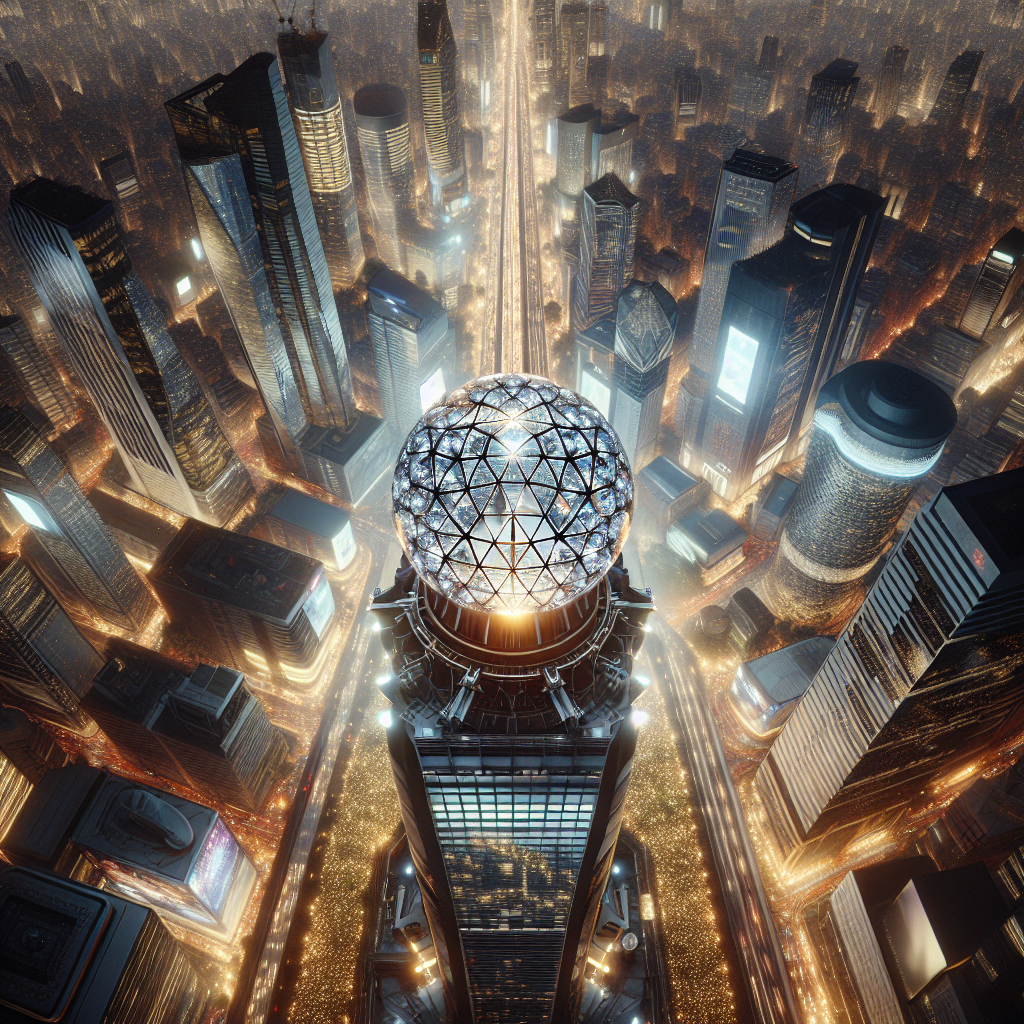
On the eve of New Year’s Eve, the One Times Square building in New York City completed its annual crucial procedure on December 30th—the ascent and light testing of the New Year’s Eve crystal ball. This year’s newly designed largest-ever New Year’s Eve crystal ball, named the “Constellation Ball,” will unveil the beginning of 2026 to a global audience at midnight on January 1st.
The Constellation Ball, the ninth generation design since its inception in 1907, is the largest in terms of size and weight. With a diameter of 12.5 feet, it is adorned with 5,280 crystals and LED lights, nearly doubling the number of crystals compared to the previous generation. The organizers stated that the light design was inspired by a night sky full of stars, with circular lights sequentially brightening during the testing as a rehearsal for the global broadcast on New Year’s Eve.
Tom Harris, the President of the Times Square Alliance responsible for the operation, mentioned in an interview that the testing aims to ensure that all technical details are flawless for the New Year’s Eve event when the world turns its eyes to New York at midnight. This year’s New Year celebrations will also integrate with the “America 250” initiative, setting the stage for the 250th anniversary of the United States’ founding.
From the perspective of city tourism, Julie Coker, the President and CEO of NYC & Company, interpreted the economic and cultural significance of this traditional event. She emphasized in an interview that during the period from Thanksgiving to New Year’s Eve, New York City attracts approximately 8 million international visitors each year, making the New Year’s celebration one of the most internationally recognized city brands in New York City. Coker pointed out that with the completion of the renovations of One Times Square building, the New Year’s Eve crystal ball-related activities will be open year-round starting from April next year, allowing visitors to experience this symbolic ritual even when not visiting Times Square at the year-end.
“This is not just a countdown event but a celebratory symbol shared globally,” Coker said, emphasizing that 2026 will be a year of high visibility for New York City and the United States.
In addition to the 250th anniversary of the US founding, the United States will also host multiple FIFA World Cup events, with the final scheduled to be held in July at the MetLife Stadium in New Jersey, further boosting international tourism and city visibility.
The event sponsor, Carnival Cruise Line, is participating in this event for the fifth consecutive year. Josh Weinstein, the CEO of Carnival Cruise Line, expressed that celebrating the new year at Times Square, a symbolic venue nationally and globally, holds significant symbolic meaning for the company. He noted that coinciding with important historical milestones in America, this year’s New Year’s celebration emphasizes collective identity and a celebratory atmosphere. The company estimates that in 2026, it will serve approximately 6.5 million passengers through its routes, hosting large-scale festive events on 29 cruise ships simultaneously.
According to the organizers, there will be multiple internationally renowned artists performing on New Year’s Eve. At midnight, the New Year’s ball will descend approximately 90 feet within 60 seconds, symbolizing the end of the old year and the beginning of the new year. Global audiences can watch the New Year’s Eve event simultaneously through various media platforms.