
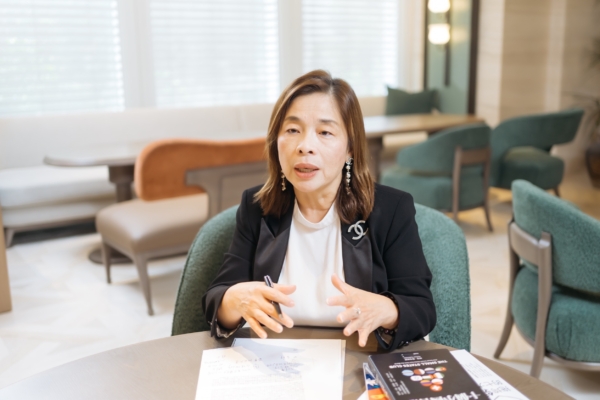
In the era of “everyone can start a business,” the real challenge is no longer getting started, but how to avoid heading in the wrong direction. Kitty Lo, founder of Manhattan Hotel Group, has deep roots in the American hotel industry with assets totaling billions of dollars. She established the MHG Charity Foundation, launching the “Compassionate Scholarship” program for high school students from various ethnicities in Southern California. The program provides hands-on guidance to enlighten young entrepreneurs.
Many young entrepreneurs fail not because of lack of effort, but because they “choose the wrong industry and do not understand the market.” Lo cited examples of recent trends in low-capital entrepreneurship such as stickers, creative trinkets, and even AI-centric ventures, which may seem easy to start but face fierce competition in reality.
“Businesses with low barriers to entry will ultimately lead to price wars, giving consumers no reason to choose you,” Lo believes. The biggest issue with such products lies in their “low replication costs;” as soon as a design is introduced, the market is immediately flooded with similar items, leading to continuous price cuts. “If your product lacks significant differentiation, why would consumers buy from you?”
In her view, the most common mistake young people make is prioritizing “whether I like it” over “whether the market needs it.”
“Entrepreneurship is not about dreams initially, but about assessing whether the industry is worth your effort for the next ten years.” Lo emphasized that even if one excels in an industry, if profit margins remain limited, accumulating capital becomes challenging.
Through her scholarship mentorship program, Lo advises students proposing ventures like sticker businesses or similar low-barrier startups, guiding them to find more suitable paths.
Lo believes that without a clear business model and understanding of customer demand, even the most advanced technology is merely packaging.
The MHG Charity Foundation, along with its mentorship program, no longer just provides financial assistance but through mentorship, conversations, and setting examples, helps children to navigate confusion, find clear directions, and explore entrepreneurial possibilities.
Reflecting on her own journey, Lo admits that what truly sets people apart is not the extent of their effort, but the direction they choose. She encourages young people not to rely on family funds for entrepreneurship, but to learn to take risks first. In her opinion, instead of aiming for rapid growth from the beginning, it is better to validate the market with limited resources, confirm the product’s value, and then consider expansion.
“Working hard on the wrong track is futile,” Lo said. Many young individuals are indeed diligent, but investing time and energy in structurally disadvantageous industries ultimately depletes confidence and resources.
Lo hopes to impart her experiences to more youth, enabling them to understand industry realities and risk assessment early on during their academic pursuits, thus avoiding unnecessary detours. The MHG Charity Foundation has awarded 100 scholarships already, with plans to expand to 300 students starting next year.
Unlike many business owners, Lo does not view philanthropy as part of corporate image or tax planning. She admits that what truly motivates her involvement in charity work is not the numbers on financial reports but “seeing people’s needs.”
“If doing good is just for tax benefits, there’s no need for personal involvement,” Lo said. Over the years, she has engaged in and supported a variety of educational, underserved community care, and local community welfare programs but rarely publicized these efforts. For her, philanthropy is not just one-time donations but a long-term commitment—accompanying children, communities, and herself to reaffirm original intentions.
As a mother, Lo holds realistic and clear views on education. While she acknowledges the importance of academics, she emphasizes whether children possess critical thinking, empathy, and responsibility.
Lo seldom lectures her children with lengthy moral lessons; she believes in demonstrating through “visible choices.” She shows her children how she treats employees, deals with failures, and gives back to society when capable.
She hopes her children understand that kindness is not just a slogan but a willingness to go the extra mile in their choices; responsibility is not pressure but an understanding that every decision made affects others.
Entrepreneur, mother, philanthropist—these roles in Lo’s life complement rather than compete with each other. She does not seek perfect balance but continues to adjust, ensuring that each choice aligns with her present self.
For many, birthdays are a time for celebration and festivity, but for Lo, it is the quietest day of the year. Without parties, she chooses to visit the temple, meditate in front of the main hall, and recite scriptures with family, expressing gratitude for the year gone by.
Having spent years in the fiercely competitive business world, Lo considers faith as a force that helps bring order to her inner self: “Before making significant decisions, I calm myself down.”
Lo puts her faith into practice in her daily life. She values integrity, moderation, and boundaries, trying to avoid emotional decision-making during conflicts. She dedicates herself to education and projects in need of support where possible. Faith has not led her away from reality but has enabled her to maintain stability and direction amidst multiple roles.
Celebrating her birthday at the temple is not a mere ritual for Lo but a form of self-calibration—a return to her origins in the noisy world, to continue moving forward steadily. ◇