
In recent times, the topic of “kill line” has sparked heated discussions in public opinion circles. At the same time, the “Shanghai Five Kill Lines” put forward by a Shanghai blogger has resonated strongly among the public. Analysts point out that the “kill line” in China is not only present in individual cities but is also widespread in rural areas of China. Official data reveals from an internal perspective a more critical and realistic constraint in the operation of the Chinese economy – insufficient domestic demand.
The term “kill line” originally comes from gaming terminology, referring to the point where a character’s health drops below a critical threshold and can be taken out with a single attack. Recently, this concept has been introduced into real-life discussions to describe the state where individuals or families rapidly lose their buffer space and are forced to interrupt their life trajectory once they cross a certain critical point.
The term “kill line” has suddenly gained popularity on mainland Chinese social media networks, originally meaning “the lack of protection for the middle class in the United States, easily falling into an irreversible situation,” such as encountering unexpected expenses which can lead to financial circumstances falling into the kill line, just a step away from being marginalized by society.
However, some netizens point out that despite the poor social welfare system in the United States, there are still safety nets such as unemployment benefits, food banks, and church relief; in comparison, China’s welfare support is even more lacking, with a sustained economic slowdown likely to lead to more severe instances of the “kill line” phenomenon.
While public attention has been largely focused on the American “kill line,” a Weibo influencer and Shanghai blogger, known as “Master Mei,” has summarized the “Five Kill Lines for Shanghai Residents” based on real-life examples, eliciting a strong response among urban residents.
“Master Mei” points out that the so-called “kill line” does not mean an immediate plunge into extremities but rather the state where individuals or families find it difficult to maintain their original standard of living once triggered, being forced to lower expectations or even withdraw from their accustomed life trajectory.
The first kill line is summarized as the “Corporation Orphans.” He notes that Shanghai has long been a gathering place for a large number of foreign-funded enterprises, and many local residents have worked in foreign companies for more than ten years, with stable positions and relatively moderate pace. However, with some foreign companies downsizing or withdrawing, a group of employees around 40 years old who are in managerial positions find it challenging to re-enter positions with equivalent salaries and intensity after being laid off. Once the income is interrupted, the standard of living experienced a rapid decline, exposing the family’s lack of risk resilience.
The second kill line points to high-cost overseas education. The blogger mentions that many Shanghai families choose to send their children to study in Europe and the United States, with expenses often reaching several million RMB just for undergraduate studies. However, in recent years, some returnees from studying abroad have experienced declining competitiveness in the job market, with income returns not matching the educational investment, leading some families to face long-term economic pressures after completing educational investments.
The third kill line comes from the financial field. The blogger points out that in the past, some Shanghai residents invested through P2P lending, trusts, and healthcare projects. However, with several risk incidents erupting, many middle-aged and elderly individuals saw substantial asset shrinkage. In situations where re-employment is not possible, such losses often directly affect retirement arrangements and the overall stability of the family.
The fourth kill line is related to the real estate market. The blogger states that some elderly families originally planned to support their retirement by selling or renting out properties, but with the decline in property prices and rental rates, the original calculations became ineffective, forcing a lowering of retirement expectations. In first-tier cities where property prices are relatively high, the absolute amount of asset shrinkage is particularly noticeable.
The fifth kill line focuses on informal education sectors. Some families choose to have their children enroll in private or international schools for an extended period. Once family income experiences fluctuations and education expenses become unsustainable, reverting to the public education system poses adaptation challenges, putting both the family and children under double pressure.
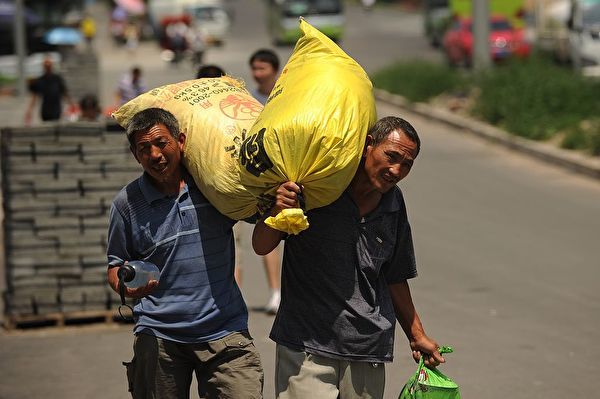
In reality, the kill line is not only present in large cities. Independent commentator Cai Shenkun posted on overseas social media platforms indicating that the “kill line” is prevalent in Chinese rural areas. According to a survey report from Tsinghua University, the suicide rate among elderly rural people between 70 and 74 has been increasing in recent years, four to five times higher than the global average, ranking first in the world.
Liu Yanwu, a sociology professor at Wuhan University, spent six years conducting surveys in more than 40 villages in 11 provinces including Hubei, Shandong, Jiangsu, Shanxi, Henan, and Guizhou, looking into the living conditions of the elderly in rural areas. The results revealed that the suicide among rural elderly people, past and present, is extremely severe beyond imagination.
In her research report, a 69-year-old man sat in his own house, lighting a pot of charcoal, burning paper money for himself, while drinking half a bottle of pesticide. He feared that if he died, his children would not even buy paper money for him, burning it himself as it was ‘still dignified.’ Halfway through burning the paper money, he had already collapsed on the ground.
There were many more cases where elderly individuals, due to mobility issues, couldn’t reach the medicine bottle or climb onto a stool to hang themselves. Instead, they tied a rope on the window sill slightly higher than themselves, holding onto their heads, curling up their legs, hanging themselves alive.
One elderly person wanted to commit suicide but feared his children wouldn’t bury him, so he dug a pit, lay in it, drank the medicine while burying himself in the soil. These cases are horrifying and despair-inducing.
What’s even more frightening is that Liu Yanwu mentioned that in some rural areas, suicide actions are seen as a “understood” or even a “rationalized” choice. It is not merely a psychological issue of individuals but rather a result of long-term structural pressures such as insufficient pension schemes and weakened family support.
Official data shows that the phenomenon of the “kill line” in China, from cities to rural areas, is not an isolated case. Recently, the official magazine of the CCP, “Qiushi,” published an article bearing the name of the CPC National Development and Reform Commission Party Group, acknowledging that “insufficient domestic demand has become one of the main challenges in the current economic operation, notably reflected in low resident consumption rates.”
In addition, according to the “China Statistical Yearbook 2025” released by the National Bureau of Statistics of China, in 2024, only eight provinces had per capita disposable income of residents reaching the national average level, with the other twenty-three provinces below the average line.
Further analysis of the sources of household income reveals that wage income remains the main pillar of China’s residents’ disposable income, implying that once employment or income faces fluctuations, the family’s capacity for buffering is extremely limited.