
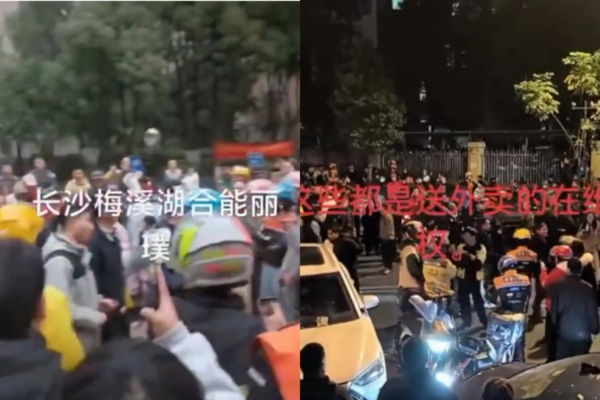
As 2026 approaches, multiple informed sources have revealed to the Epoch Times that the social atmosphere in China is becoming increasingly tense, with frequent occurrences of civil conflicts, retaliatory violence, and group incidents. Authorities have recently issued warnings to various provinces and cities, highlighting that protests potentially initiated by unemployed youths should be categorized as one of the top risks next year. Analysts believe that by only tightening surveillance without effectively resolving societal issues, future social pressures will further intensify.
According to sources within the Chinese Communist Party system, the internet has become a primary channel for organizing and contacting protesters. The authorities deem it necessary to maintain strong control and enhance efforts in identifying and blocking online risks. A source within the system mentioned hearing repeated emphasis in internal meetings that “the internet has become the primary battleground.” “Instructions were given to localities to gather public opinion and make contingency plans in advance. With local finances expected to continue shrinking next year, concerns arise that unemployed youth seeking a way out may become emotional flashpoints.”
A scholar from a research institute at the Chinese Academy of Social Sciences disclosed that he was invited to a meeting where it was mentioned that “next year, social risks do not stem from known issues but from cumulative pressures.” He outlined the discussions from the meeting, stating that participants did not reach conclusions beforehand but provided fragmented observations from various angles. Some mentioned that unemployed youth might transition from online activities to street protests, while others pointed out that grassroots levels have become the primary pressure points following fiscal contractions. Opinions were also shared that actions and communications are no longer primarily conducted on-site but flow through various platforms and communities. Finally, some participants viewed changes in demographics as the “slowest but most difficult-to-handle foundational force.” He remarked, “Individually, each aspect may not be groundbreaking, but collectively, it could potentially lead to a situation that is hard to assess, including what is commonly referred to as a ‘gray rhino’ scenario.”
The scholar added that in the latter half of this year, numerous grassroots fiscal expenditures have tightened in various regions, leading to a noticeable difference in the atmosphere within the civil servant system. He described, “There is unrest among the public, especially the youth. Some complain of high work intensity, while others struggle to find employment, resorting to venting frustrations on their phones.”
Retired civil servant Wang from Nanchang, Jiangxi, recalled recent scenes in his office, stating, “Now we only receive basic wages, and everyone is quietly working in the office. Previously, we used to chat, but now everyone is waiting and watching. My colleague mentioned that internal communications advised against speaking out randomly, as it could lead to trouble.”
A retiree in Hunan reflected on his observations over the past few years. He believed that education and healthcare initiatives should have been prioritized but noted that in practice, grassroots wages and administrative costs took precedence, while education and social projects were pushed back. He voiced concerns that failing to address issues and relying solely on suppression would lead to deteriorating public sentiments over time.
Statistics from the China Dissent Monitor, a platform under the Freedom House, showed that in the third quarter of 2025, China witnessed 1,392 protest incidents, representing an approximate 45% increase compared to the same period in 2024. The most common participants in these protests were workers, homeowners, and villagers, alongside instances involving parents, students, investors, and religious minority groups. Guangdong province had the highest number of incidents, followed by Henan, Hunan, Hebei, and Shandong.
A private business owner in Zhengzhou, Mr. Liao, expressed the mounting pressure from policies impacting enterprises this year, stating, “Subsidies have not arrived, tax refunds are delayed, and project funds are stuck. Without money to pay wages, what used to be one or two people coming to demand pay has turned into a group blocking the doors every day.”
Wang Gang (pseudonym), who previously assisted in defending the rights of migrant workers in Shenzhen, observed a different scenario. He noted that a large influx of returning young people had reentered urban villages for short periods: “Some found that their fields had been contracted out upon returning, leaving them without work. Upon their return to cities, wage payments were stalled, forcing them to sleep on street corners and survive on a few pieces of bread per day.”
After a brief silence, he added, “In debt from rent and loans, unable to farm at home, and unable to earn money elsewhere, what will these people become after a prolonged period? Everyone actually wishes for stability, but when pushed to the brink by hunger, they can only seek justice together.”
A source close to the political and legal system in Jiangsu warned reporters that while extreme events are currently scattered, there is a looming concern within the system about the potential for a sudden concentrated outbreak. Preparations for the next year involved strengthening security in shopping centers, establishing early warning systems in urban villages, monitoring transportation hubs, and ensuring seamless communication within towns and villages.
In the latter half of this year, the Chinese Communist Party introduced several regulations related to monitoring and social management, including the revised version of the Public Security Administration Punishment Law passed on June 27 and the Administrative Law Enforcement Supervision Regulations released in December. Additionally, the internet sector proposed various drafts on artificial intelligence and platform regulations, such as AI companion systems and regulations for online influencers/MCN organizations. The revised Network Security Law will come into effect from January 2026.
Public opinion contends that over the past year, many social issues in China have not been substantially resolved at the institutional level but have been postponed, suppressed, or shifted for handling. Grassroots governance units are facing financial constraints and increasing workload burdens, nearing their capacity to address social conflicts.
Some scholars suggest that if authorities continue to respond solely through control measures without providing legitimate and communicative outlets for dissent, social pressures may silently prolong and transform once again.