
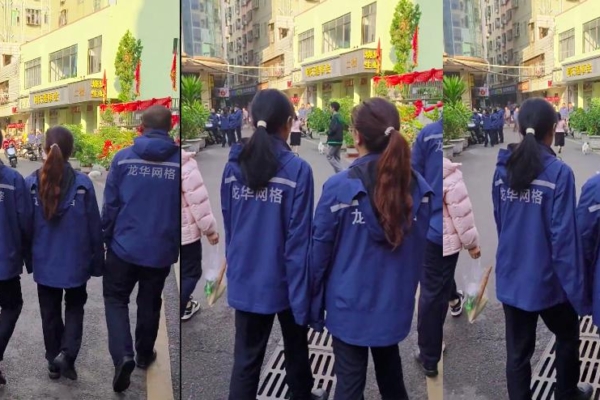
Recently, a short video circulating on the internet has sparked a discussion about the scope of community management in Longhua District, Shenzhen, Guangdong Province. A netizen filmed on the street and claimed that the area was filled with people wearing “Longhua grid” uniforms, and that “anyone renting a place must register all information about your entire family and company.”
The video shows three individuals wearing blue uniforms with “Longhua grid” printed on them walking down the street. The person filming stated that when they were registering for rental accommodations, they were asked to provide information such as family members, workplace, spouse, and native place. Netizens have labeled this as a “reporting personal details type of registration,” but the authenticity of this has not yet been officially confirmed by local authorities. Public information from Longhua District in Shenzhen indicates that the local grid system covers actual population, rental housing, business operations, and the “focus on key personnel” module.
The requirements for rental registration vary in different regions. Mr. Kong, a resident of Dezhou, Shandong, told reporters that local landlords need to register with the housing management bureau and provide basic information about the tenants, but he had not heard of tenants needing to register separately. He said, “Starting in the second half of this year, our community requires registration for rental properties, including house numbers, owner’s name, contact information, and if there are tenants, their names, ages, occupations, and number of tenants need to be registered. I haven’t heard that tenants also need to register.”
Mr. Zeng, a resident of Baiyun District in Guangzhou, stated, “Both property owners and tenants here need to register. Property owners register with the housing management bureau, while tenants register with the neighborhood committee. Once tenants move in, the grid personnel come to your door to ask you to fill out registration forms.” He mentioned that the visitation of grid personnel for registration has become a regular practice.
In the first half of this year, several local governments in China successively issued notices, and from September 15th, some cities have started implementing a housing rental registration system. According to public documents, landlords need to visit the housing management department or the street housing service window to register and report information such as property ownership, tenant identity, and lease duration. In some areas, community or grid personnel are responsible for household-by-household registration and input into the public security and housing rental system.
Ms. Wang, a netizen from Foshan, informed reporters that the implementation of this system varies by region. She said, “I heard that in some places, it is not required because it is not a nationally unified regulation. It is part of the regional stability system. However, in some areas like Shenzhen, it is stricter, where both property owners and tenants need to register.”
In cities like Jinhua, Zhejiang, and some cities in Sichuan, the local notices use phrases like “comprehensively inspecting rental housing,” “registering tenant information house by house,” and “inputting into the rental housing management system.” Ms. Lin, a rental intermediary in Yuyao, Zhejiang, stated that since October, local landlords must upload tenants’ identification cards and phone numbers and sometimes need to provide details about the tenants’ family situations, “otherwise, the online signing registration cannot be completed.” A landlord in Changchun, Jilin, mentioned on social media that local requirements include providing “tenant’s workplace and emergency contact person,” or else the rental registration won’t be allowed.
Public information indicates that the “grid management” system, as a grassroots governance system, began as a pilot project in some cities in the 2000s and was promoted around 2015. This system divides communities into grids and uniformly integrates information such as population, housing, business premises, and special populations into the system, with grid personnel responsible for patrols, registration, and reporting. With over 70% of Shenzhen’s population being migrants, Longhua District is one of the areas with a high concentration of migrant population.
On the Douyin platform, some netizens argue that tenant registration is for “stability maintenance.” Comments in the section mention, “With the high unemployment rate, the new job opportunities are grid personnel, bridge guards, and toilet attendants.” Some users mentioned that in their communities, they were only asked to register names and the number of people, without being questioned about their family situation. On overseas social media platforms, some netizens likened the registration to the “ten household heads of the Qin Dynasty.”
A lawyer’s analysis pointed out that if the registration content is directly related to public security, fire hazards, population density, it can be seen as within the scope of governance. However, if the information collected involves personal family or unit information, it may touch upon privacy boundaries. The lawyer suggests that the competent authorities should clearly define the collection basis and scope.
According to data from the Ministry of Housing and Urban-Rural Development, China’s urban rental population exceeds 200 million. In recent years, the rental market in Shenzhen has continued to expand, with different policies on housing rental and population registration being implemented in various districts. As of the time of writing, the official of Longhua District in Shenzhen has not given further public explanation about the video.