
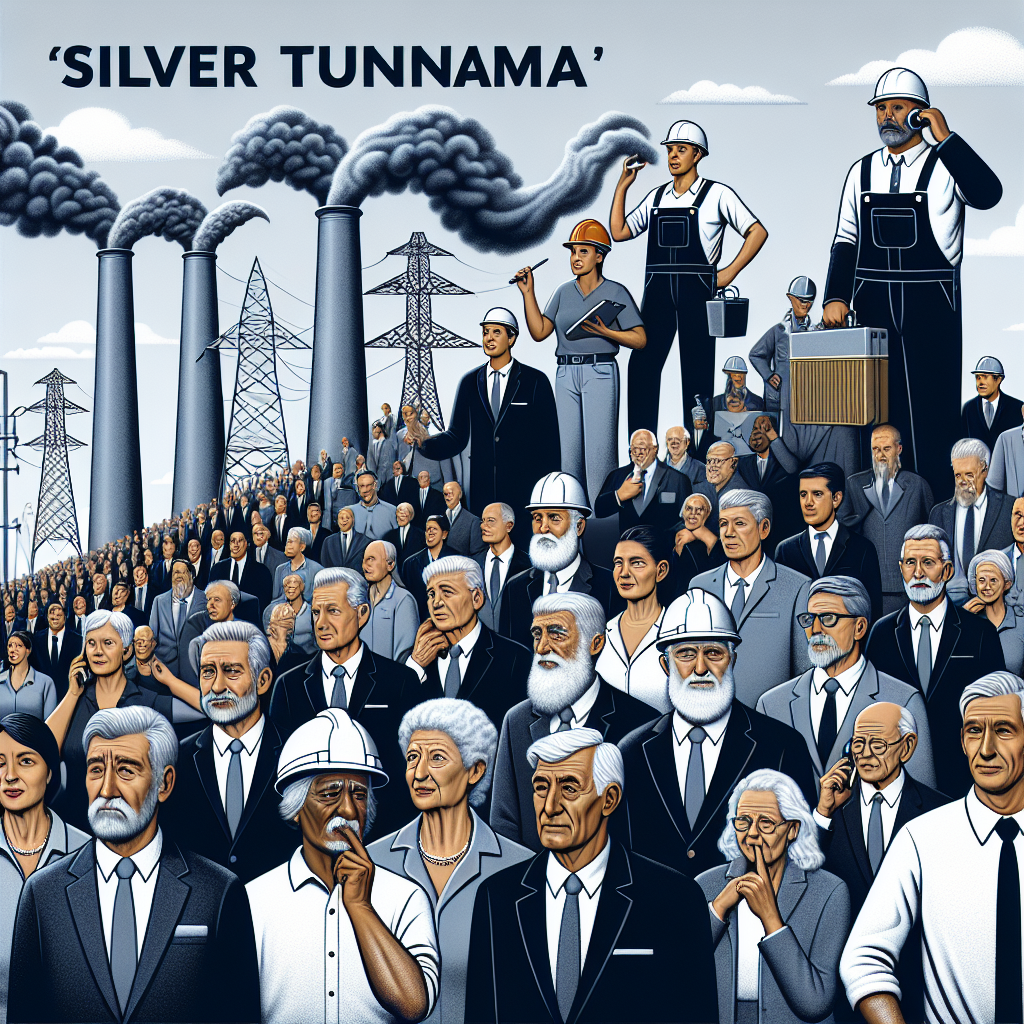
Experts warn that with a large number of employees approaching retirement age coupled with a shortage of younger successors, the utility industry in the United States is facing a “silver tsunami.”
According to a recent report released by the U.S. Census Bureau, employees aged 55 and over have been the fastest-growing age group in the U.S. workforce for over 20 years, with the utility sector particularly affected by this trend.
The report indicates that in 2022, 55 and over employees accounted for 24% of the overall U.S. workforce, higher than the 10% recorded in 1994.
In the utility sector, in 2022, in 80% of companies, employees aged 55 and over make up at least a quarter of the total workforce, compared to only 35% of companies reaching this ratio in 2006. In contrast, in the accommodation and food services industry, only about 10% of companies have over a quarter of employees aged 55 and above.
The CEO and founder of the national online job platform “Red Balloon,” Andrew Crapuchettes, told the Epoch Times that the utility industry is facing a high proportion of employees aged 55 and over, and when these individuals begin to retire, it could lead to significant problems.
“Utilities are experiencing a silver tsunami,” Crapuchettes said. “Young people are not very interested in this field because they find it not exciting enough, but if there aren’t enough people to replace retiring employees, issues will arise. We need talent well-versed in power generation and distribution skills.”
He mentioned that he has spoken with many young job seekers who have confessed that utility-related work is “not even in their consideration.”
“Young people want jobs that appear more attractive, often influenced by social media and television content,” he said. “They are unaware of the many opportunities in utilities.”
Utilities typically encompass natural gas, electricity, and water companies, and in recent years, solar and wind power enterprises have also been included.
Crapuchettes pointed out that the salaries in these industries are often higher than many white-collar positions.
“This industry actually has many good opportunities and is extremely important,” he said. “It involves all the infrastructure that enables the modern world to operate.”
According to ZipRecruiter data, the average starting salary for utility workers in the U.S. is around $41,000, which can exceed $50,000 depending on the region. Entry-level positions include field technicians, lineworkers, substation technicians, power plant operators, as well as high-skill positions like utility engineers and operations and administrative staff.
A recent report by the Deloitte Research Center for Energy & Industrials states that for just electricity demand, a 26% growth is expected by 2035, with a significant portion being driven by the continued expansion of electricity demand due to artificial intelligence (AI).
The report indicates that a challenge for utility companies in 2026 will be to ensure uninterrupted power supply in pressure areas of the grid while maintaining affordable prices for customers.
Edward Hones, managing partner at Hones Law in Seattle, Washington, with extensive experience in labor law, mentioned to the Epoch Times, that the significant increase in senior employees in the utility industry is not surprising.
“Utilities require deep industry knowledge, high safety awareness, and exceptional technical skills, so older employees in this field can maintain indispensable value for a long time, far exceeding other industries,” he said. “The challenge lies in the fact that when this experienced talent eventually retires, there is indeed a real skill cliff ahead.”
Hones acknowledged that many utility companies have yet to actively invest in succession plans, apprenticeship programs, or establish partnerships with local technical schools.
“When the talent pipeline runs dry, it leads not only to a shortage of personnel but also brings regulatory compliance risks, increased safety incidents, and costly service disruptions,” he added.
Hones recommended that utility companies promote institutionalized mentoring programs, update job designs and recruitment messages to attract young employees. Furthermore, he pointed out that companies should avoid any age-based recruitment or restructuring practices.
The Deloitte report mentioned that to supplement utility workforce, many companies may start relying on AI to enhance efficiency.
The report stated that AI assistants trained through operational manuals and incident records can provide real-time guidance to technical staff, thereby increasing the success rate of repairs.
Moreover, AI can be used to automate repetitive tasks to simplify compliance, financial, and customer service processes, and improve transparency.
By 2026, utility companies may expand the use of AI-enhanced analytics in control rooms, introduce more widespread application of generative AI assistants in operations, and establish formal supervisory frameworks while still focusing on human supervision.
Crapuchettes admitted that many utility companies are considering introducing or upgrading AI systems. A senior executive from a company supplying equipment to utility companies recently revealed concerns to him that utility managers are worried about finding qualified talent to fill vacancies after senior employees retire, hence beginning to inquire about AI technologies that can assist in simplifying outage responses.
“While AI cannot climb utility poles, it can provide the necessary technology to identify outage locations in remote areas faster,” Crapuchettes said. “Currently, simply pinpointing outage spots could take a whole day, followed by the need to address the repairs. In such scenarios, AI won’t replace anyone but can assist in saving time and costs.”
However, Crapuchettes mentioned that overall, utilities still urgently require manpower and must start attracting more qualified talent through better branding to remain competitive.
“It’s like selling a product – you have to put yourself in front of potential customers and make them feel like it’s a great place to work,” he said. “I believe utility companies need to acknowledge this and upgrade their marketing plans.”
The Census Bureau’s report shows that besides utilities, in the manufacturing and wholesale trade industries, the proportion of employees aged 55 and above has significantly increased, rising from 14% in 2000 to over 40% in 2022.
An October report released by the AARP found that in addition to the occupations mentioned by the Census Bureau, industries such as public administration, business, and healthcare services also have a considerable proportion of employees aged 50 and above.
The report indicates that among employees over 50 with no high school diploma, the industries with the highest employment rates include wholesale, retail, manufacturing, mining, and construction; whereas among middle-aged individuals with bachelor’s degrees, the top sectors in terms of employment rates are professional services, healthcare, and finance. The report also noted that in the U.S., healthcare services are a major industry for employment of older workers, in both metropolitan and non-metropolitan areas.
According to the AARP report, the median age of school bus drivers in the U.S. is 56, shuttle drivers are 54, judges and legal professionals are 53.7, and accountants are 50.1.
In comparison, there are relatively fewer employees aged 55 and above in the retail, accommodation, and food services industries. Additionally, the Census Bureau also found that startups are typically composed of younger labor forces. ◇