
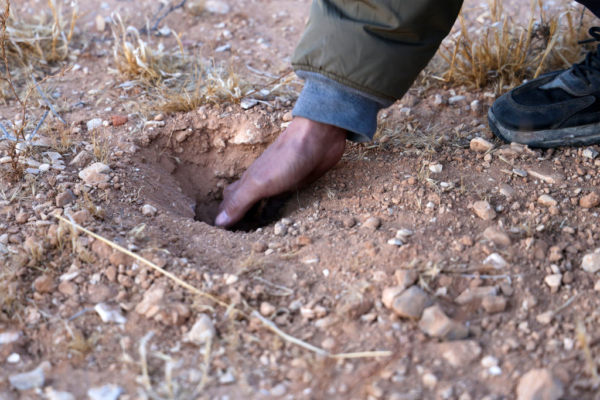
The Syrian government has ordered troops to move into a mass grave site set up by the Assad regime to cover up atrocities and has launched a criminal investigation. In the years leading up to the fall of the Assad regime, thousands of victims’ bodies were secretly hidden at a military base located in a remote desert.
According to Reuters, a former Syrian military officer familiar with the operation revealed that the mass grave is located in the Dhumair desert east of Damascus, a location that served as an arsenal during Assad’s rule. In 2018, the Assad regime initiated a secret operation to unearth the remains of thousands of victims buried in a mass grave on the outskirts of Damascus and transfer them to Dhumair, an hour’s drive away.
This covert operation, dubbed “Operation Soil Transfer,” was orchestrated by the core circle of the dictator. The new government that overthrew the Assad regime has redeployed troops to the Dhumair base and begun investigating the past atrocities of the former dictatorship.
In a development unveiled by a military officer stationed there in early December, a military official, and Dhumair’s security chief Sheikh Abu Omar Tawwaq, the abandoned military facility, inactive for seven years, was reactivated in November as a military camp and arsenal.
During the summer, Reuters reporters discovered the existence of a mass grave at the site and conducted several investigations there when the location was completely unguarded.
In mid-December, a soldier stationed at the site informed Reuters that shortly after reports in October, the new Syrian government established checkpoints at the entrance of the military facility where the base is located. Now, anyone entering the site must obtain a pass issued by the Ministry of Defense.
Reviewing satellite images since late November, Reuters found signs of increased activity of new vehicles around the main base.
An anonymous military official stated that the reactivation of the base is part of an operation to “ensure national control and prevent hostile forces from exploiting this strategic location.” Residual ISIS strongholds in Syria are connected to Damascus via desert routes.
Jalal Tabash, the chief of Dhumair police, disclosed that an investigation into the mass grave was initiated in November, including on-site photography, land surveys, and witness interviews. Among those interviewed was Ahmed Ghazal, who was a mechanic responsible for maintaining trucks transporting bodies at the Dhumair graveyard and a crucial source of information for Reuters on the mass grave.
Ghazal detailed the operation process and all the details he witnessed firsthand to the police, confirming that during the “Soil Transfer Operation,” the military facility was empty except for the soldiers escorting the convoy.
After the fall of the Assad regime, the new Syrian government established the “National Missing Persons Committee” to investigate the fate of tens of thousands of missing Syrians during Assad’s rule.
The committee informed Reuters that they are currently training personnel and setting up labs for large-scale exhumation operations meeting international standards, including the excavation of numerous collective graves from the Assad era within Syria, scheduled for 2027, including Dhumair.
The police have handed over the Dhumair case investigation report to prosecutor Zaman al-Abdullah in the Adra region. Abdullah told Reuters that he is cross-referencing information on suspects from the Assad era (both domestic and foreign) with documents obtained by security forces after the collapse of the dictatorship in December 2024.
According to military documents and testimonies from military and civilian sources reviewed by Reuters, logistics for “Operation Soil Transfer” were overseen by Colonel Mazen Ismander, a key figure. Ismander declined to comment to Reuters on their initial report on the mass grave and the new investigation.
As the Assad regime neared victory in the civil war in 2018 amid escalating accusations of atrocities and years of sanctions, the regime hoped to regain international recognition. Assad was accused of detaining and killing thousands of Syrians. Local human rights activists had previously revealed the existence of a mass grave in Qutayfah town on the outskirts of Damascus where the Assad regime buried bodies to conceal their crimes.
Amid this backdrop, the Assad regime issued orders to excavate Qutayfah and hide the bodies at the military facility in Dhumair desert.
Reuters investigation revealed that between 2019 and 2021, during four nights a week, Ismander, a former military officer in the Assad era, oversaw the secret operation, with trucks transporting bodies and soil from exposed mass graves to the abandoned military facility in the desert. As the mass grave in Qutayfah was opened, the trenches in the military facility gradually filled with bodies.
To uncover this shocking conspiracy, Reuters interviewed 13 individuals directly involved in the two-year operation and analyzed over 500 satellite images of the two mass grave sites.
Using drone technology under the guidance of forensic geologists, Reuters created high-resolution synthetic images that showcased the color variations in the excavated soil surrounding the trenches in Dhumair, providing evidence of the process of moving the bodies.