
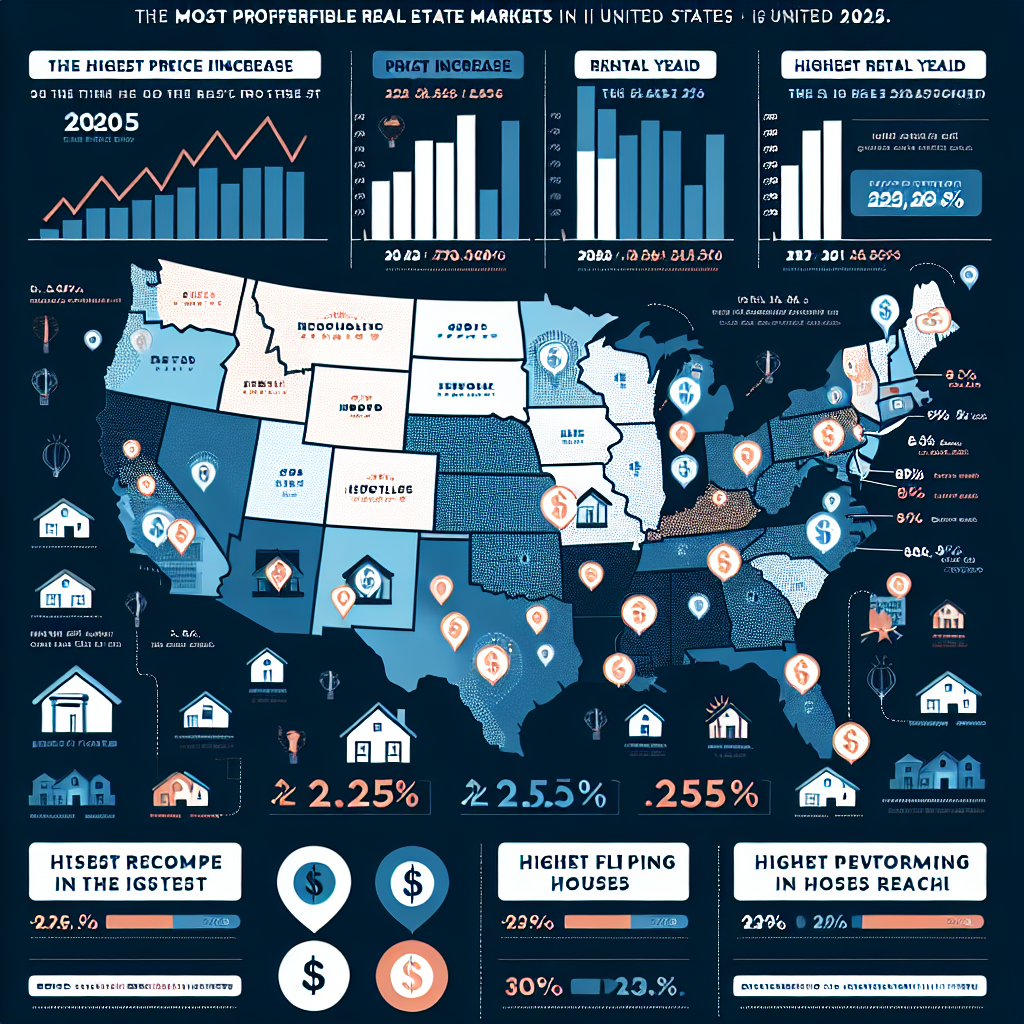
It’s time to take a look at the most profitable real estate markets in the United States in 2025! What does “most profitable” mean? Does it refer to the highest price increase, the highest rental yield, or the highest return on flipping houses? Over the past three years, the core issue in the U.S. housing market has been that the burden of buying a house is too high for the public, and budgets are too tight. Nonetheless, some people still manage to succeed in the market.
The so-called “most profitable” markets, in this analysis, will focus on the aspects of “highest price increase,” “highest rental yield,” and “highest return on flipping houses.” Let’s explore together which markets investors have been silently making big profits in amidst the relatively stable, inflation-fighting, and fluctuating buying and selling dynamics of the housing market in 2025.
First, let’s look at the analysis of the “highest price increase.” In fact, the average price increase in the entire U.S. in 2025 is not significant, but there is a significant “regional differentiation.” Markets that can profit from price increases are often not major metropolitan areas in the U.S. but rather smaller to medium-sized markets with tighter supply and lower price bases. Conversely, some markets that experienced rapid price increases in previous years are showing a phenomenon of correction in 2025.
In brief, the background of 2025 in the U.S. housing market is a “low price increase” environment, but there are still areas that can achieve excessive returns. According to the FHFA (Federal Housing Finance Agency) Q3 2025 report, the annual price increase in the U.S. is about 2.2%, with a quarterly increase of 0.2%. CoreLogic, now known as Cotality, reported an annual increase of only +1.2% as of September 2025, pointing out that inventory has reached its highest level since 2019 and regional differences are more pronounced, with the Northeast still relatively strong and Florida and the Washington D.C. area weaker.
According to Redfin statistics for November 2025, the annual increase was +2.6%, with some metropolitan areas experiencing a monthly decline (such as Austin, among others). Realtor.com’s “Hottest Markets” report shows that for several consecutive months, the hot zones are mainly concentrated in the Northeast and Midwest, with the “hot zones in the Midwest market” seeing an average annual increase of around +4.5% in November 2025.
Analyzing the top 20 metropolitan areas in terms of annual growth rates based on the FHFA Q3 2025 report shows that most areas are located in the Northeast and Midwest, and most are not traditional major cities, but rather “safe harbor markets” that are relatively affordable, have tighter supplies, and stable demand – consistent with Realtor.com’s description of the Midwest markets as “refuge markets.”
The top cities with the highest price increases, highest rental yields, and most profitable flipping opportunities in 2025 are silently making big profits! You wouldn’t expect #USRealEstateHotspot Episode 221.
Due to space constraints, only the top ten metropolitan areas with the highest price increases are listed:
1. Hagerstown–Martinsburg, MD–WV: Hagerstown–Martinsburg (Maryland/West Virginia) +9.88%.
2. Jefferson City, MO: Jefferson City (Missouri) +9.81%.
3. Syracuse, NY: Syracuse (New York) +9.06%.
4. Duluth, MN–WI: Duluth (Minnesota/Wisconsin) +8.86%.
5. Rockford, IL: Rockford (Illinois) +8.71%.
6. Norwich–New London–Willimantic, CT: Norwich–New London–Willimantic (Connecticut) +8.66%.
7. Champaign–Urbana, IL: Champaign–Urbana (Illinois) +8.54%.
8. Waterbury–Shelton, CT: Waterbury–Shelton (Connecticut) +8.32%.
9. Muskegon–Norton Shores, MI: Muskegon–Norton Shores (Michigan) +8.14%.
10. Allentown–Bethlehem–Easton, PA–NJ: Allentown–Bethlehem–Easton (Pennsylvania/New Jersey) +7.89%.
Analysis reveals why the top three areas have seen the highest price increases in 2025. The key reasons lie in the affordability migration under high-interest rate environments, tight supply, and catalyzing effects of local employment or investments in areas such as Hagerstown–Martinsburg, Jefferson City, and Syracuse.
In Hagerstown–Martinsburg, the price growth stems from overflow demand that can afford Washington, D.C., and Baltimore. These belt markets, where metropolitan areas are still affordable, benefit significantly during high-interest rate periods.
Moreover, the job and population influx brought by the I-70 and I-81 logistics corridors highlights Hagerstown–Martinsburg’s advantage. According to Amazon’s description of its site in Hagerstown (HGR6), its strategic location at the intersection of I-70 and I-81 is emphasized. Maryland transportation authorities have pointed out in documents related to the I-81 freight corridor that there are several large distribution facilities around the corridor.
In the second spot, Jefferson City has a clear urban planning focus on state government employment, making it resilient during economic fluctuations and supporting housing demand. As the state capital, housing prices are inherently more affordable, making it easier to achieve relatively strong annual growth rates in an environment where buyers are sensitive to monthly payments.
Zillow’s market page also indicates that homes in Jefferson City spend a short time in “pending” status (around 9 days), indicating strong buyer competition and inventory pressure.
Syracuse, in the third spot, was originally a Rust Belt city, resulting in relatively lower housing prices; however, investments by Micron in the central part of New York have driven increased demand for housing ahead of major investments. Several reports now describe more intense buyer competition and bidding wars in the area.
Prior announcements by Micron detailed plans for up to four fabs (fabrication plants) in Clay, near Syracuse, with an investment scale potentially exceeding $100 billion over a period of twenty years or more. Micron also expects to create about 50,000 jobs (including in the supply chain, contractors, and peripheral service industries), with around 9,000 direct Micron positions. Therefore, the popularity of Syracuse is understandable.
Next, let’s explore the second focus of this analysis: “rental yield.” Here, we look at ATTOM (3-bedroom SFR) statistics, using the ratio of “annual rental income for a 3-bedroom property divided by the median purchase price of a 3-bedroom property” to rank returns on investment.
Gross rental yield = “annualized rental income of a 3-bedroom property ÷ median purchase price of a 3-bedroom property”; excluding taxes, insurance, maintenance, vacancies, management, HOA fees, and financing costs.
The top 5 markets with the highest yield according to ATTOM and their corresponding metropolitan areas are:
1. New York metropolitan area (Suffolk County, NY): 18.0%.
2. Atlantic City metropolitan area (Atlantic County, NJ): 16.8%.
3. Birmingham metropolitan area (Jefferson County, AL): 13.6%.
4. Mobile metropolitan area (Mobile County, AL): 12.9%.
5. Odessa metropolitan area (Ector County, TX): 12.5%.
However, it is important to note that these are “gross” yields and do not represent net cash flow; expenses such as taxes, insurance, maintenance, vacancies, management fees, (apartment) HOA fees, and interest on loans will significantly reduce these returns.
Generally, high yield markets often have a structure where housing prices are relatively low. They also usually have stable rental demand (in the Midwest, parts of the South, and Rust Belt regions). However, effective risk management at the neighborhood level is essential for factors such as safety, property condition, tenant quality, local tax burdens, and single-industry risks.
For example, Suffolk County contains a significant number of vacation or second homes and upscale rental properties, creating a market with high rental prices for 3-bedroom or single-family properties. Rental distribution is easily influenced by high-priced properties, and rental growth in Suffolk County surpassing income growth indicates strong rental pressure and robust demand.
Atlantic County’s lower base price, compared to many counties in the “core commuting zones of New Jersey,” provides a better foundation for rental yields. Additionally, the presence of industries such as services, tourism and gambling, healthcare, and education around Atlantic City supports long-term rentals at lower price points (even if the rental rates do not soar, as long as housing costs are lower, the yields will rise).
In Jefferson County, Birmingham, houses are relatively affordable, but rental prices provide support, naturally leading to higher rent-to-price ratios. Alabama was noted in 2025 for its prominence in investment home purchases, with median purchase prices for investor-owned homes lower than the general median sale price, making it easier to achieve higher actual returns.
Lastly, let’s explore the most profitable markets for flipping houses in the U.S. housing market of 2025. According to ATTOM’s Q3 2025 report, the metropolitan areas with the highest typical gross profit margins are as follows:
1. Lynchburg, VA: 130.5%.
2. Scranton, PA: 104.0%.
3. Pittsburgh, PA: 103.6%.
4. Buffalo, NY: 94.1%.
5. Shreveport, LA: 86.5%.
In reality, flipping houses in 2025 has become more challenging. Typical flipping data for Q3 2025 in the U.S. shows a gross investment return rate of 23.1%, with a gross profit of around $60,000 (buying at $260k and selling at $320k in a typical scenario), which is at its lowest level since 2008.
In other words, only markets with a high gross investment return rate have a better chance of generating “net profit” after deducting costs. Experienced market players estimate renovation costs at about 20% to 33% of the After Repair Value (ARV).
For those concerned about “liquidity” (reducing risks of not being able to sell or finding similar properties), the metropolitan areas with the highest share of flipping house transactions, according to ATTOM Q3 2025, include Columbus, GA; Tuscaloosa, AL; Spartanburg, SC; Canton, OH; and Atlanta, GA.
These areas, where flipping activity is high, do not necessarily guarantee the highest profits; however, they are more likely to favor professionals who focus on replicability and the speed of turnover – quantity often prevails.
There is another algorithm called the “Flip Factor,” which measures how much a renovated house can be elevated to a higher price level. Realtor.com, based on the 2025 sample of renovated listings in October, introduced the Flip Factor: the difference between the ratio of the purchase price before renovation to the median listing price in the metropolitan area and the ratio after renovation (upward movement). The median Flip Factor in the U.S. increased by approximately 36.4 percentage points.
For instance, in a hypothetical metropolitan area with a “median listing price for standalone homes” at $400,000, if you purchase a property in need of renovation for $200,000 (buying ratio of 50%) and then list it after renovations for $350,000 (listing ratio of 87.5%), the Flip Factor (degree of price elevation after renovation) would be 87.5% – 50% = 37.5pp (percentage points).
Therefore, a 37.5 percentage point increase notates that you have moved the house from being priced at “half the market median” to being positioned near the “market median.”
Realtor.com identified the metropolitan areas with the highest Flip Factors in 2025:
1. Pittsburgh, PA: 58.2 percentage points (typical purchase at 48.1% of the median price, and listing post-renovation at 106.3%).
2. Cleveland, OH: 46.0 percentage points.
3. Buffalo–Cheektowaga, NY: 45.5 percentage points.
4. Cape Coral–Fort Myers, FL: 45.3 percentage points.
5. Birmingham, AL: 44.9 percentage points.
However, it is important to note that the “listing price elevation” measure does not equate to net profit; in 2025, the median discount on sales of renovated homes compared to the highest listing price was about 8.3%.
To summarize, in 2025, to make handsome profits in the U.S. real estate market, the key lies not in chasing national trends but in selecting the right money-making strategies and markets: target areas with tight supply and stable demand for price gains, prioritize metropolitan regions with strong employment and population support, thick tenant bases, and controllable supply increments for rental markets, and select second or third-tier cities with lower price bases and premium repair margins for flipping ventures.