
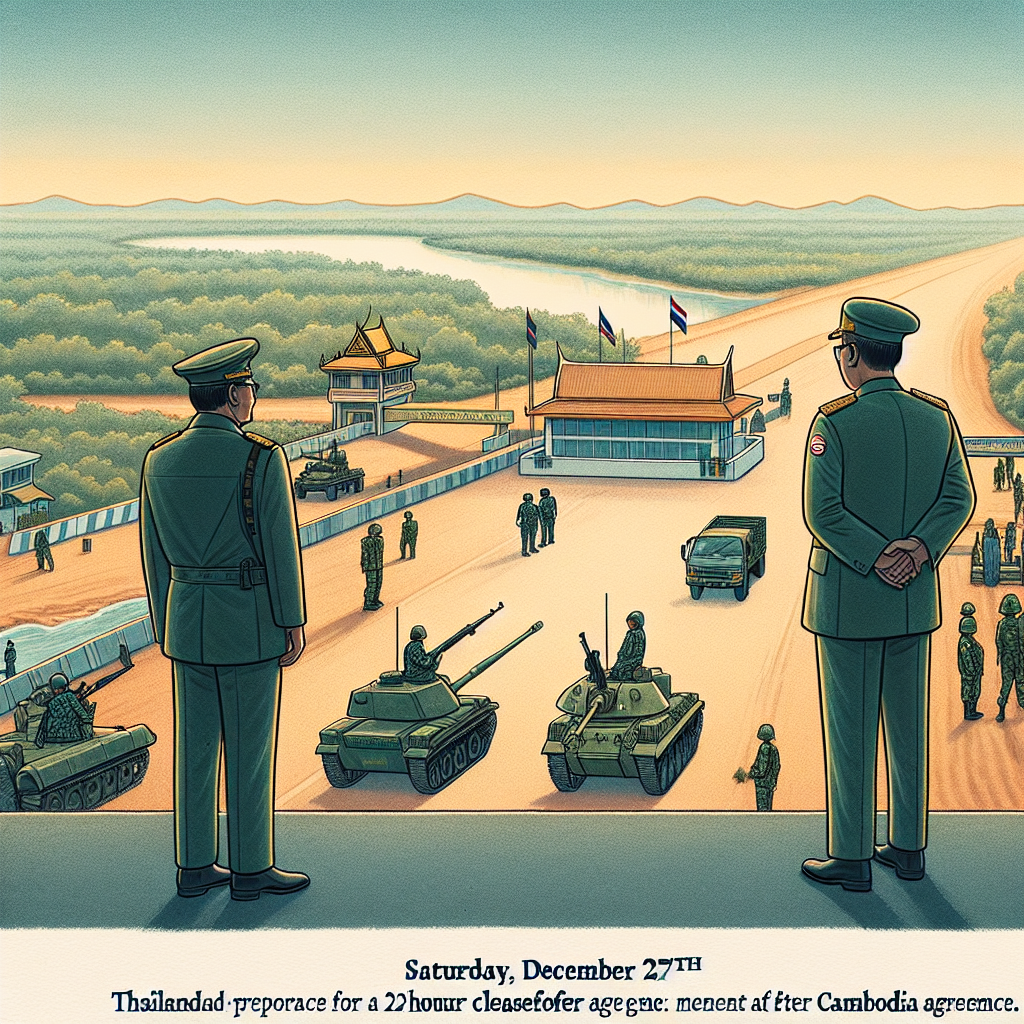
Thailand and Cambodia have reached a new consensus on a ceasefire agreement in the border area after weeks of ongoing military conflict. The defense ministers of both countries announced on Saturday (December 27) after a meeting at a Thai border checkpoint that a 72-hour ceasefire would take effect starting at noon local time, putting a temporary halt to the bloodshed that has escalated multiple times since July.
According to the joint statement released by both sides, Thai Defense Minister Natthaphon Narkphanit and Cambodian Deputy Prime Minister and Defense Minister Tea Seiha have agreed to completely cease any form of hostile actions during the ceasefire period, regardless of military or civilian targets, and not launch attacks on civilians, infrastructure, or essential facilities.
Both sides have committed to maintaining current troop deployments, refraining from increasing troops or shifting forces along the border, and avoiding any military actions that could lead to miscalculations, including patrol advances or weapon deployment adjustments, in order to prevent the situation from spiraling out of control.
On the humanitarian and security front, Thailand and Cambodia have agreed to promote demining and mapping operations in the border area, prioritizing the clearance of residential areas to reduce the risk of landmines and providing security for border residents to safely return home.
The statement highlights that if the ceasefire can be sustained for 72 hours, further de-escalation measures will be advanced; both sides have also agreed to enhance law enforcement cooperation to combat transnational crimes, including cyber fraud and human trafficking, to promote long-term stability in the border area.
The statement emphasizes that the ceasefire and related arrangements do not involve substantive handling of border disputes, with all measures aimed at de-escalating tensions, maintaining stability, and creating conditions for follow-up negotiations.
Thailand and Cambodia have long-standing disputes over border sovereignty. In July this year, the region saw intense fighting for five days, resulting in at least 48 fatalities.
Although in October, with mediation from US President Donald Trump and Malaysian Prime Minister Anwar Ibrahim, both sides signed a peace framework agreement, conflicts have escalated again this month.
According to official statistics from both countries, the recent rounds of fighting have led to approximately 50 deaths, with over 700,000 border residents forcibly displaced, schools closed, agriculture and cross-border trade activities significantly affected, and the humanitarian impact continuing to expand.
Despite the ceasefire agreement taking effect, the situation on the battlefield remains uncertain. The Cambodian Defense Ministry earlier on the 27th still accused the Thai military of launching attacks, indicating a weak foundation of mutual trust. Natthaphon stated after the meeting that this 72-hour ceasefire is “not built on complete trust,” but rather a period to observe whether both sides truly cease armed provocations.
As per the agreement, the ceasefire and de-escalation measures will be monitored and verified on-site by the ASEAN Observer Team, assisting in ensuring that all commitments are fulfilled and, conditions permitting, aiding the gradual return of Thai and Cambodian border residents who have been evacuated since early December, gradually restoring basic civil order.
Cambodia has expressed cautious optimism towards the ceasefire. Tea Seiha stated at a press conference that the ceasefire has opened “a path” for border area residents to return home, resume work, and school teaching. The Thai Defense Ministry, on the other hand, emphasized that the most crucial aspect at present is to avoid any form of attack or provocation to ensure that the ceasefire mechanism remains intact.