
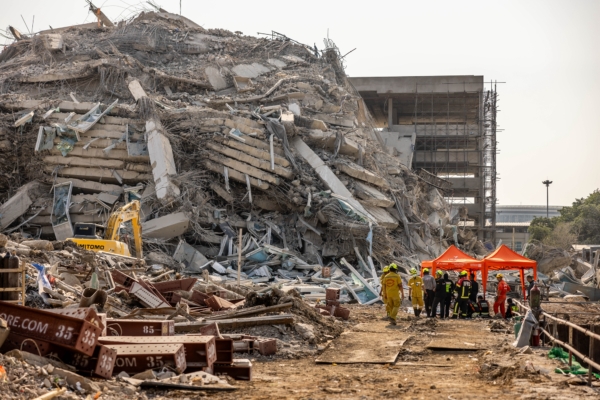
The 30-story new building of the State Audit Office (SAO) in Thailand collapsed in a strong earthquake in Myanmar in March, resulting in 95 deaths. The SAO confirmed on Friday (December 26) that the collapse was due to construction and design defects in the building.
The project was jointly constructed by China Railway Construction Corporation, a state-owned enterprise of the CCP, and Italian-Thai Development, a construction giant in Thailand.
On March 28, a 7.7 magnitude earthquake struck Myanmar, with tremors felt in Thailand. The nearly completed 30-story State Audit Office building in the Thai capital Bangkok collapsed shortly after. This was the only building in Thailand to collapse during this earthquake, raising concerns about the quality of construction by Thai authorities.
According to the Bangkok Post, the Thai State Audit Office stated on Friday that an investigation committee established two days after the earthquake found that the collapse began from the lower part of the structure, specifically from floors 1 to 4, due to shear forces acting on shear walls caused by the earthquake.
The SAO also mentioned that based on testing of some concrete samples, the walls did not meet the required standards. Additionally, the detailed design plans of the building and the anchorage length of the reinforcement bars did not comply with relevant regulations.
In August of this year, 23 defendants, including a senior executive of China Railway Tenth Bureau (Thailand) and Premchai Karnasuta, the CEO of Italian-Thai Development, were charged by Thai prosecutors. They were accused of violating building regulations and causing deaths due to negligence.
Investigators found that the elevator shaft was not located in the center of the building but towards the back edge. This displacement led to the torsional center of the structure deviating from the geometric center. After the earthquake and the shaking of the building, the elevator shaft and the foundation columns collapsed almost simultaneously, resulting in the rapid vertical collapse of the entire building.
The Department of Special Investigation (DSI) has initiated an investigation under the Foreign Business Act and has transferred some cases deemed worthy of prosecution to the public prosecutor.
DSI investigators also reviewed the statements submitted by the SAO regarding bid-rigging allegations. Additionally, DSI has forwarded some cases to the National Anti-Corruption Commission (NACC) for further investigation.
DSI stated that up to 70 public officials may have been involved in bid-rigging.
“The State Audit Office is willing to cooperate with the investigation and has full confidence in the judicial process,” the SAO said in a statement. The SAO also mentioned that if any government officials are found to have violated regulations, they are prepared to act in accordance with the law at any time to ensure transparency and fairness in the investigation and to build trust with the public.