
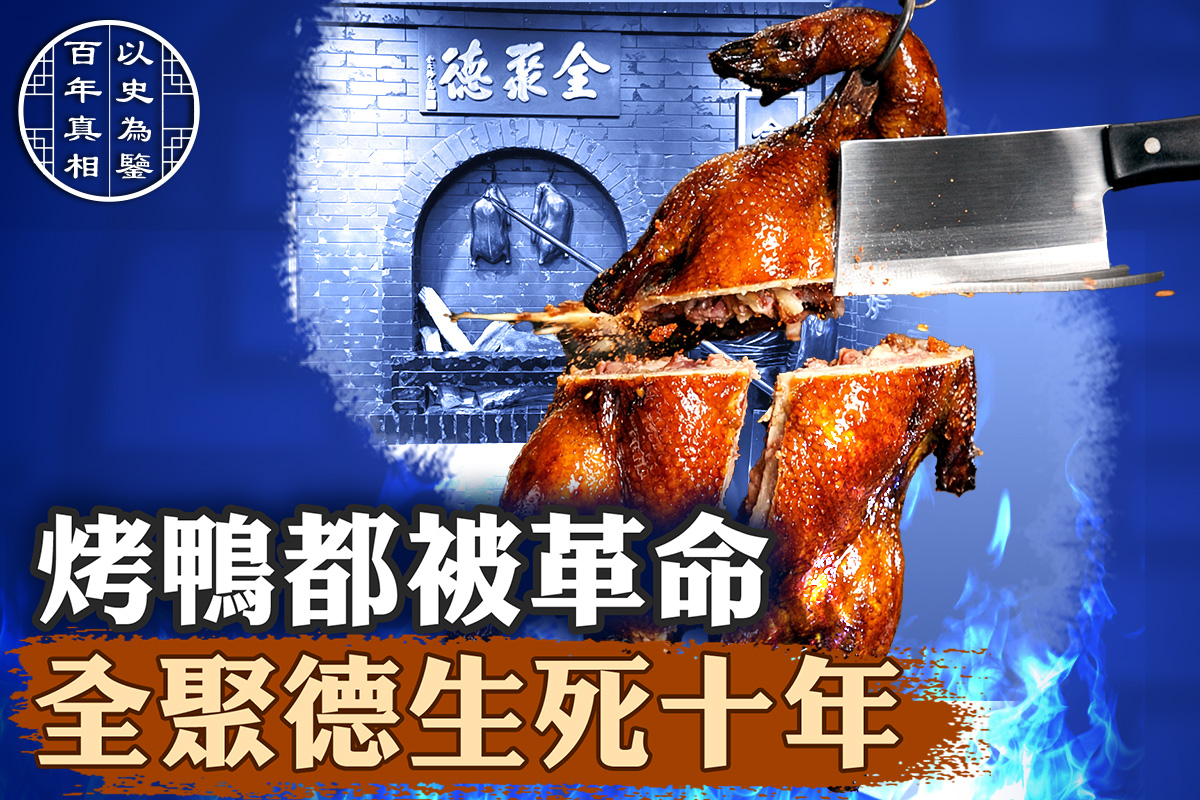
When it comes to Beijing roast duck, almost everyone knows about Quanjude – a name that has weathered a hundred years of storms. Its signboard has witnessed prosperity and absurdity. During the fervor of the Cultural Revolution, this shop was taken over by a group of Red Guards, the old signboard was smashed with a wooden hammer, and in its place, bright red slogans and Mao Zedong’s portrait were put up.
Today, we will use the memories of someone who was there at the time – a former Red Guard, to take you through time and see how Quanjude stepped into that farce.
In 1864, the third year of the Qing Dynasty’s Tongzhi era. The streets of Meat Market Street outside Beijing’s Front Gate were bustling with people, vendors shouting their wares.
A tall and skinny young man – Yang Quanren, carrying a pole, navigated through the crowd. He was from Jizhou, Hebei Province, and at the age of 15, he left his hometown due to a flood and came to Beijing to make a living. Initially, he sold live chickens and ducks, living a simple life, but with hard work, he gradually saved up some money.
Every day, he passed by a dried fruit shop named “De Juyuan”. Although the sign was bright, the business was very slow, with a layer of dust accumulating at the wooden door. Yang Quanren observed this and quietly calculated in his heart. When he turned 45, he finally used his savings to buy this shop. Since he had been in the poultry business all along, he decided to sell roast ducks and roast pork.
With his own shop, what should he name it? Before opening, he invited a Feng Shui master. The master walked around the shop twice, stroking his beard and said, “This is truly a treasure land of Feng Shui! Look at the two small alleys on both sides of the shop, like two sedan poles. If a building is built in the future, it will be like a grand sedan chair, with unlimited prospects!”
The Feng Shui master also said, “However, this shop used to have very bad luck, and the misfortune was hard to dispel. Unless the old signboard of ‘De Juyuan’ is turned upside down and renamed as ‘Quanjude’, only then can it break the streak of bad luck and pave the way for a smooth future.”
This name was indeed perfect for Yang Quanren – not only did it match his name, but it also implied “gathering virtue and doing good”.
He invited a scholar who was knowledgeable in calligraphy to write the three big characters of “Quanjude”. The characters were written in a vigorous and powerful manner, adding color to the small shop with a golden plaque.
At the beginning, the business was not good. The front gate was a gathering place for gourmet food, and it was not easy for a new shop to stand out. Yang Quanren, unwilling to accept this, searched for a skilled roast duck master and finally poached one from a royal restaurant.
This master enlarged and deepened the roasting oven, allowing ducks to roast while hanging, using a different method from the popular steaming oven at that time. The ducks hung in the oven, with the flames from fruit woods reflecting on them, gradually turning the skin into a dark red, and the dripping fat making a sizzling sound on the charcoal fire, releasing a fragrant aroma out the door.
Soon, Quanjude’s roast duck became a sensation in the capital – crispy skin, tender meat, fatty but not greasy, lean but not dry. Whether it was high-ranking officials or common people, as long as they saved enough money, they were willing to come here to taste it.
After Yang Quanren passed away, his son Yang Qingmao took over. He did not have his father’s skills, but he had the courage. He employed the shrewd and capable Li Ziming as the head waiter, pioneering the hiring of outsiders to manage a restaurant. Li Ziming’s abilities were outstanding, and under his leadership, Quanjude was rejuvenated.
Quanjude’s reputation gradually grew, the shop was renovated, becoming one of the top restaurants at Front Gate. From the Qing Dynasty to the Republic of China, from the Beiyang army to the Kuomintang army, Quanjude had always thrived.
Until 1949, when the Communist Party came to power, the era of the Yang family came to an end.
In 1952, like most of the country’s old brands, Quanjude was included in the “mixed public-private ownership” system. It became a state-owned enterprise, still an important place for entertaining foreign guests in Beijing. Zhou Enlai often hosted banquets here for foreign guests, and the restaurant still retained the old Beijing charm – with high-hanging plaques, warm murals, and the scent of roast duck in the air.
However, everything came to a halt in the summer of 1966. With a decree from Mao Zedong, the country launched the “Smash the Four Olds” movement – smashing old ideas, old cultures, old customs, old habits. Old brands became the prime targets of this “seal up, take over, and renovate” campaign.
According to a Red Guard who participated in the Quanjude smashing event that year, on August 18, 1966, Mao Zedong met with a large group of Red Guards in Tiananmen Square, and he was among them.
After being received by the great leader, these Red Guards seemed to be injected with chicken blood, as if being endowed with the supreme mission of “revolution.” They searched for targets to “Smash the Four Olds.” Unfortunately, Quanjude, a century-old shop, became the top priority.
The next night, thousands of Red Guards from Beijing No. 2, No. 15, No. 25, and No. 63 gathered at the entrance of Quanjude. Under the streetlights, they raised red flags, shouting slogans that shook the heavens.
The Red Guards found the manager of Quanjude and declared that Quanjude, as a symbol of renovating the old, could no longer use its signboard. They had already made a new signboard and it must be replaced.
The Red Guard recalled that the manager of the roast duck shop, seeing the crowd surging, felt the situation was not good and said, “Quanjude is not a private enterprise, it has long been a mixed public-private ownership, now it is a socialist roast duck shop.”
The Red Guards questioned, “If it is a socialist roast duck shop, why still use ‘Quanjude,’ this legacy of the old society?”
The manager, helpless, agreed to change the signboard. He wanted the workers to take down the old signboard and then store it, before putting up the new Red Guard’s nameplate.
However, the Red Guards did not agree. They said, “Take it down? Do you intend to put it back up?”
The manager dared not say another word. At that moment, the Red Guards and some of the shop’s employees rushed forward, smashing the over 70-year-old old signboard, and then stamping on it. Subsequently, they displayed a large wooden sign painted with the words “Beijing Roast Duck Shop” above the main entrance.
It is said that this destroyed hundred-year-old signboard was later exhibited at the 1968 “Smash the Four Olds Results Exhibition,” becoming a “feat” of the Red Guards.
Changing the signboard was just the beginning. The Red Guards began organizing the staff to learn about the documents of the Cultural Revolution, making them understand that the three characters of Quanjude represented “exploitation and oppression, reflecting class struggle.”
Under the incitement of the Red Guards, the staff assisted in destroying all the characters, calligraphy, banners, and regulations in the restaurant, hallways, display windows, and dormitories, then bought back 100 portraits of Mao Zedong from the Xinhua Bookstore, and posted them overnight in the restaurant, hallways, display windows, and dormitories.
Quanjude, once specialized in hosting foreign dignitaries. Zhou Enlai often entertained foreign dignitaries there, and there was a large mural of Beijing roast duck hanging inside. The Red Guards unhesitatingly tore it down and replaced it with a large Mao Zedong quotation plaque.
By the next morning, the century-old Quanjude had been completely transformed. Not only was the signboard changed, but a new sign was hung at the entrance saying, “Welcome workers, farmers, and soldiers to dine.” The service staff also wore red armbands. Ten Red Guards were left as “security guards,” “waiters,” and “Mao Zedong thought propagandists” at the roast duck shop, stationed there regularly.
In this way, the former roast duck shop had now become guarded by Red Guards, with red armbands, a solemn atmosphere. Passing locals were surprised when they walked by the door, thinking they were mistaken, but upon seeing the Red Guards, they dared not ask questions and quickly hurried away.
Every customer entering the shop had to be interrogated about their class identity, any slight negligence could lead to being labelled a “class enemy.” In such an environment, who would dare to come and eat? Business plummeted, and the bustling scene of the past was gone.
However, those Red Guards who were left to stay at Quanjude to guard the place indulged in feasting. According to the Red Guard’s recollection, while stationed at Quanjude, the restaurant staff could not afford to provoke the Red Guards and often served them food. Most of the Red Guards came from working-class families, had never been to such high-end places, and now, they enjoyed a lavish meal.
At that time, the manager Yang Fulin was also criticized and sent to work at a pig farm. Later, because there were frequent visits by central leaders accompanying foreign guests for meals, he was “pardoned” and returned to the restaurant.
Many years later, this Red Guard who took part in “remodeling” Quanjude was not willing to apologize. He said, “I smashed Quanjude, but I dare not apologize publicly. If I do, I will stink up the place, and no one will hold the instigators accountable but will blame us small fry. In any case, under the guidance of ‘class struggle must be talked about every day,’ we did wrong. Those who killed or beat people were not good to begin with!”
He said that they were so crazy back then because they had been indoctrinated with the theory of class struggle at school, “talking about class struggle year-round, month after month, day after day. We particularly hoped for the opportunity to go to the frontlines to eliminate imperialist, revisionist, and reactionary forces and liberate two-thirds of the suffering people in the world.”
Young and full of zeal, like him, believed in the propaganda of the Communist Party, thinking “the rest of the world except for socialist countries lived in deep water and hot oil, living worse than cattle and horses.”
Mao Zedong’s reception was a recognition and instigation for them, “Who are the class enemies? It’s not determined by the law, whoever we say is, is.”
This Red Guard recalled that his father was a worker. His father told him, “Don’t go too far, in fact, the capitalists are not as bad as the newspapers say, almost there, don’t hit others.”
Fortunately, he listened to his father and did not actually hit anyone, but still participated in the smashing operation. He sincerely said, “Looking back now, those who received a Republican education were better off than those who grew up drinking wolf’s milk.”
This former Red Guard also said that his generation had a tough time, “Later, we went to the countryside, returned to Beijing in the 70s, and were laid off in the 90s, that’s how our whole life went by.”
During the Cultural Revolution, it was not just Quanjude that suffered. At that time, all of Beijing and even the country’s old brands, old shops, old streets, old hospitals, old buildings had their names changed. Beijing Union Hospital was renamed by the Red Guards as the “Anti-Imperialist Hospital,” old brands destroyed in public.
The famous shop specializing in Chinese calligraphy and paintings, “Rong Baozhai,” was renamed by the Red Guards as the “People’s Fine Arts Publishing House Third Branch.”
Quanjude was greatly affected during the Cultural Revolution, only officially restoring its old brand name in 1980 and retrieving the hundred-year-old signboard that had been smashed from the Palace Museum.
Translation and adaptation by [Your Name], News Reporter