
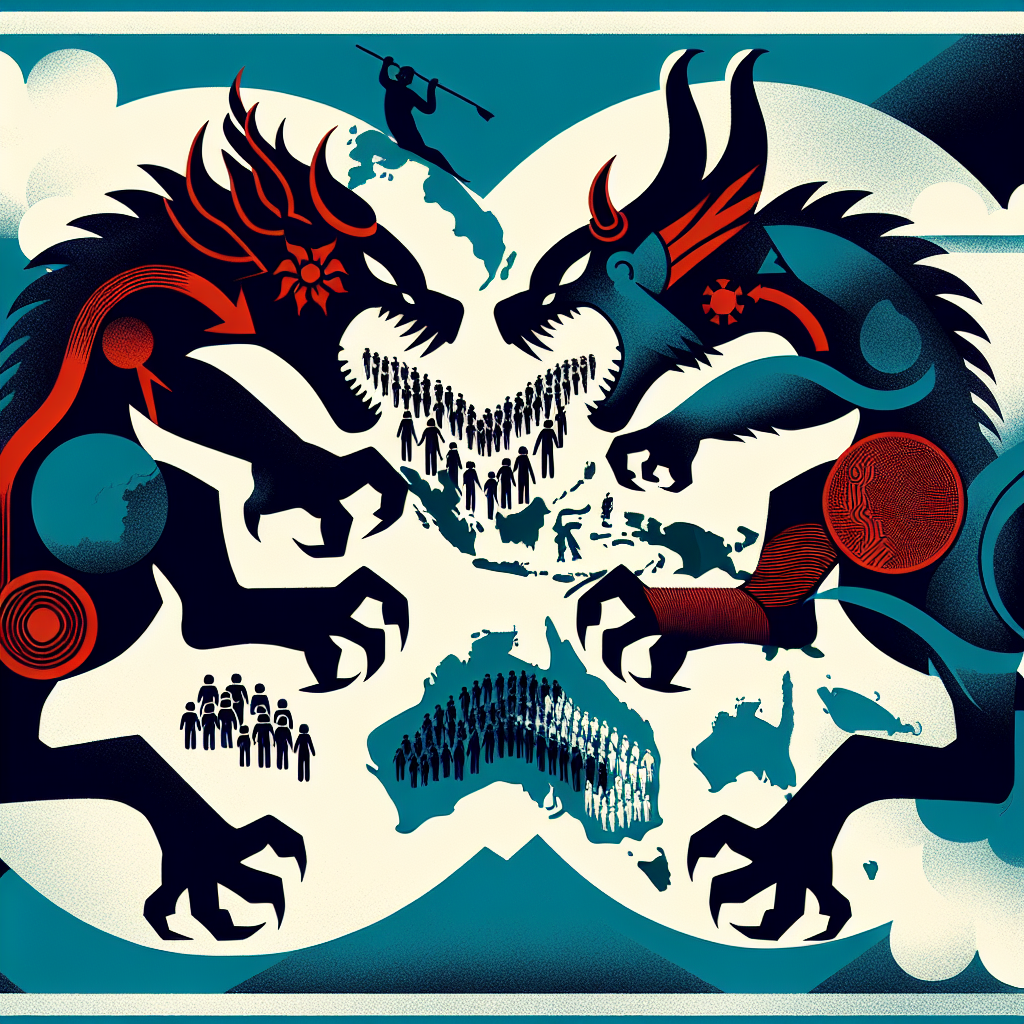
The United States and China are embroiled in a battle for rare earths and strategic minerals in the South Pacific region, with the Cook Islands, home to 15,000 people, becoming a focal point of the US-China rivalry.
According to a report by The Wall Street Journal, in October of this year, a US research vessel arrived at the Cook Islands in the South Pacific and captured high-definition images of the underwater terrain. Weeks later, a Chinese research vessel also headed to the area to conduct a similar survey. This marks a surprising new front in the global competition for mineral resources between the US and China.
Due to its proximity to tectonic fault lines, the islands in the South Pacific are believed to hold significant untapped mineral reserves. These reserves are rich in cobalt, copper, manganese, and some rare earth elements that have never been exploited before.
Both the US and China are eager to develop new sources of rare earth minerals, which are crucial for the manufacturing of laser-guided weapons, advanced fighter jets, and high-tech industries. China currently controls 70% of global rare earth extraction and 90% of rare earth processing, often using its rare earth supply as a diplomatic tool to pressure developed economies like the US and Europe in negotiations.
Reducing dependence on Chinese rare earths has become a top priority for the Trump administration.
Earlier this year, the Cook Islands reached a controversial agreement with China, allowing Chinese exploration of the seabed surrounding its waters in exchange for Chinese investments in its infrastructure and fishing industry. While the agreement has been made public, some details were initially kept confidential, leading to protests from local residents and some regional leaders. Subsequently, Beijing swiftly arranged for leaders from the Cook Islands to visit China, showcasing their underwater mining technology and offering training programs and scholarships for Cook Islands students to study in China.
On the other hand, in August of this year, the Trump administration reached an agreement with the Cook Islands to explore and support potential seabed mining activities in the region.
Former US Navy officer and current head of Trump Mining, David Copley, personally traveled to Rarotonga, the most populous island in the Cook Islands. During subsequent meetings, the US representative made offers to build an airport, provide research vessels, and even donate a bus to the Cook Islands.
As part of the agreement reached with the Cook Islands in August, the US sent representatives from the National Oceanic and Atmospheric Administration to meet with environmental organizations. Subsequently, the 220-foot-long EV Nautilus exploration vessel embarked on a 21-day mission equipped with remotely operated vehicles and acoustic mapping systems to study the seabed conditions.
US Treasury Secretary Scott Bessent stated that China’s repeated threats to halt rare earth exports were a “real mistake.” The US is expected to secure alternative supplies within one to two years, at which point China would lose its rare earth leverage.
The efforts made by the US to engage with the Cook Islands reflect the Trump administration’s growing emphasis on acquiring critical minerals. These minerals are essential for US economic and military security.
Recent developments indicate that near-sea mineral resources have become a key priority for the Trump administration. In April of this year, Trump signed an executive order to expedite deep-sea mining development. The administration also released a list of US waters exploration areas, including offshore regions in California, Alaska, and Hawaii.
“Maintaining leadership in deep-sea technology and underwater mineral resources is critical to America’s core national security and economic interests,” Trump stated in the executive order.
The US is seeking to achieve self-sufficiency in critical minerals.
In July, the Pentagon announced an agreement with US rare earth mineral company MP Materials, acquiring a 15% stake in the company, making it the largest shareholder.
The US government also announced an investment in the Canadian company Lithium Americas, which is developing one of the world’s largest lithium mines in northern Nevada.
On October 20th, Trump met with Australian Prime Minister Albanese at the White House and signed an agreement concerning critical minerals and rare earths. Kevin Hassett, chairman of the White House Council of Economic Advisers, stated that Australia would play a role in helping reduce global economic risks and counter China’s rare earth coercion, noting that Australia is “one of the best mining economies in the world.”
“The smartest and most capable refining businesses are in Australia,” he said, “and they have a vast reserve of rare earths.”
At the end of October, during the ASEAN summit in Malaysia, Trump signed a series of trade and critical mineral agreements with several countries.