
On December 26, the Xi’an to Yan’an high-speed railway in China officially began operations, marking the total operational mileage of high-speed railways in China exceeding 50,000 kilometers. State media touted China’s high-speed railway operational mileage as “ranking first in the world.” However, what was not mentioned by the official media is that only a few high-speed railway lines in China are profitable, accounting for approximately 5% of the total mileage nationwide. The Chinese high-speed railway system has been burdened with enormous debts, and negative news about shoddy construction and unfinished projects has been rampant.
The Xi’an to Yan’an high-speed railway opened with the train C9309 departing from Yan’an station towards Xi’an. The high-speed railway connecting the capital city of Zhejiang province, Hangzhou, with the western city of Quzhou (Hangzhou-Quzhou high-speed railway) also officially opened on the same day.
The Chinese Communist Party’s official media has extensively publicized the so-called “achievements” of China’s high-speed railways. The People’s Daily of the CCP stated, “Our country’s high-speed railway operational mileage exceeds 50,000 kilometers, ranking first in the world”; while CCTV’s website published an article claiming that China “has built the world’s largest and most modern high-speed railway network,” with operational mileage ranking first in the world, surpassing the total operational mileage of high-speed railways in other countries.
However, what the official media did not mention is that the ongoing high-speed railway projects in China continue to bear massive debts. By the end of 2024, the China Railway Group’s total debt had reached 6.2 trillion yuan, with a debt ratio of 63.52%. Only a few lines such as Beijing-Shanghai, Beijing-Tianjin, Shanghai-Hangzhou, Shanghai-Nanjing, Nanjing-Hangzhou, and Guangzhou-Shenzhen-Hong Kong high-speed railways located in economically developed and densely populated areas are profitable, with their combined mileage accounting for about 5% of the total national high-speed railway network.
The Wall Street Journal previously reported that the Chinese authorities have been following a model of sustaining economic growth through infrastructure spending, even though China already has most of the necessary infrastructure. However, this model has now become a “huge money pit.” The report questioned whether China really needs so many high-speed railways.
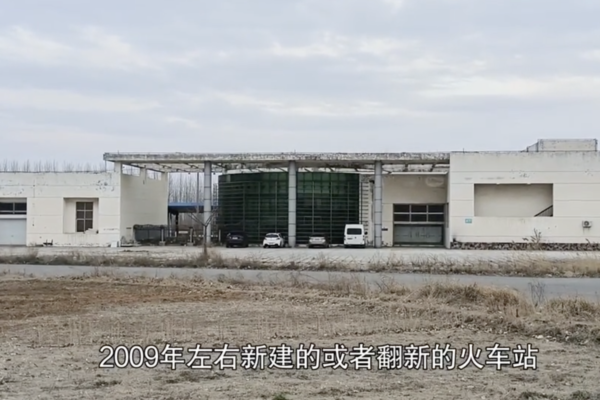
In China, there are abandoned high-speed railway stations that have been built but remain unused, referred to by netizens as “ghost high-speed railway stations,” with such stations scattered throughout the country. For example, the Zhoucun East Station in Zibo, Shandong, has been built for 15 years but remains unused and abandoned to this day, ranking first on China’s list of ghost high-speed railway stations.
The high-speed railway projects in China also face safety risks due to the use of substandard materials and practices. In 2024, two journalists from Xinhua News Agency’s Economic Reference News reported from the construction site of the Hefei-Xinyi railway (from Hefei to Xinyi) in Anhui province and found that multiple construction units had replaced the “ethylene propylene diene rubber elastic cushion layer” with substandard “recycled rubber imitation products” in violation of railway industry standards. These counterfeit products have much lower performance than the design requirements, posing safety risks. These two journalists were even attacked during the investigation, causing public concern.
The Economic Reference News had reported in July 2023 that a subcontractor for the Shandong Lai Rong high-speed railway’s third section had accused the main contractor, China Construction Eighth Engineering Bureau Co., Ltd., of using substandard materials and practices. Most of the screw piles in the Lai Rong high-speed railway did not meet the design requirements, presenting significant safety hazards.
The railway system under the Chinese Communist Party has traditionally been a hotbed of corruption, with the former Railway Ministry. Since the fall of Liu Zhijun, who had been in charge of the Railway Ministry from 2003 until his downfall in February 2011 due to massive corruption, and his subsequent sentencing to a suspended death sentence in July 2013, the ministry was restructured into the National Railway Administration in March 2013, managed by the Ministry of Transport, along with the establishment of the China Railway Corporation to assume the enterprise responsibilities, with the Railway Ministry no longer in existence.
The last Minister of Railways and the first General Manager of China Railway Corporation, Sheng Guangzu, retired as vice chairman of the National People’s Congress in 2018 and was arrested in March 2022.
Fei Dongbin, a member of the Chinese Communist Party’s Ministry of Transport Party Committee, Secretary of the National Railway Administration Party Committee, and Director of the Administration, was investigated for corruption in June this year.