
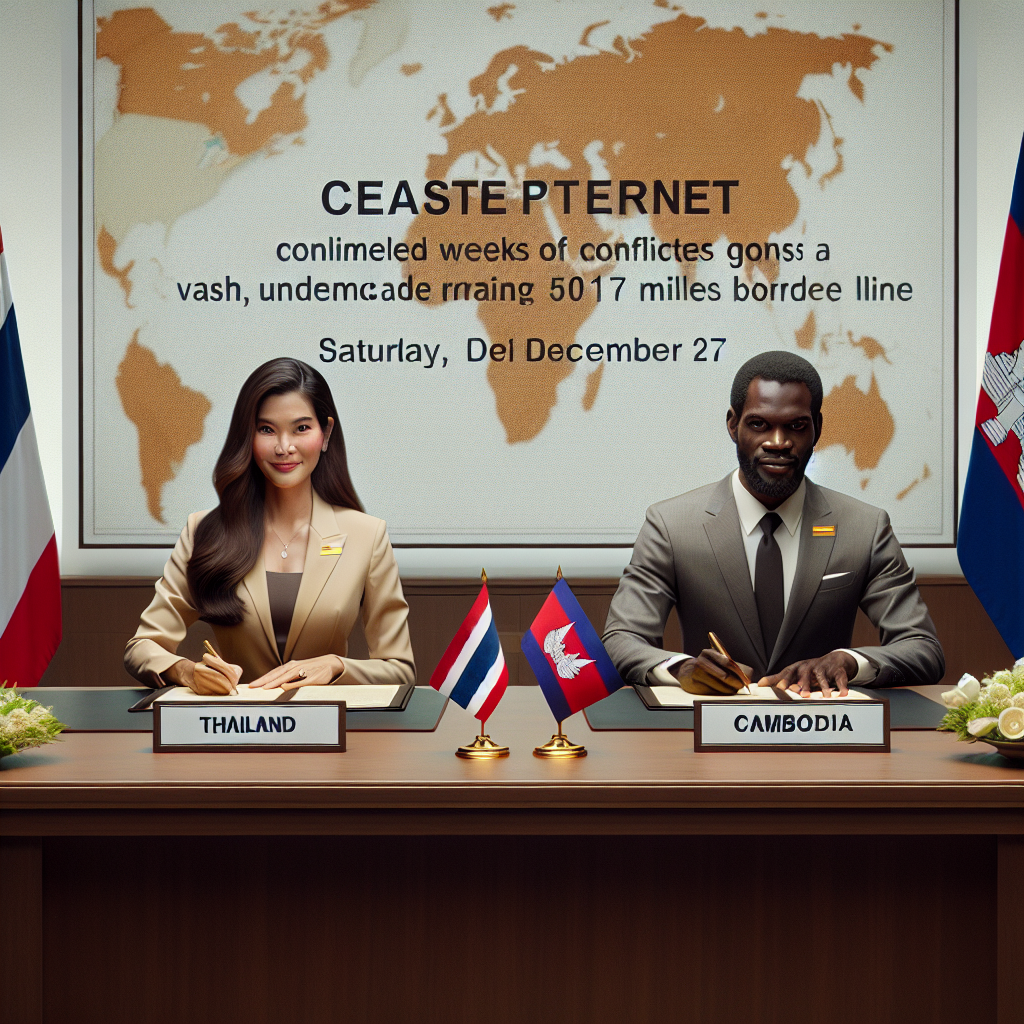
On Saturday, December 27, Thailand and Cambodia officially signed a ceasefire agreement, putting an end to the intense conflicts that have erupted along the undemarcated 817-kilometer (approximately 508 miles) border line for the past few weeks.
This conflict has been considered as the most serious border war between the two countries in years, involving fighter jets, rockets, and heavy artillery, resulting in at least 101 fatalities and displacing over 500,000 residents from both sides.
The agreement, which took effect at 5:00 GMT, noon local time, was jointly signed by the Thai Defense Minister Natthaphon Narkphanit and the Cambodian Defense Minister Tea Seiha at a border checkpoint, signaling a temporary stabilization of the regional situation.
According to the crucial agreement, both sides pledged an immediate cessation of hostile actions and agreed to maintain the current troop deployment status quo, refraining from any further military movements or reinforcements to avoid escalating tensions.
Furthermore, both parties explicitly agreed that military action should not violate each other’s airspace. The Cambodian Defense Ministry specifically pointed out that only Thailand had conducted airstrikes during this conflict, with the latest strike occurring on Saturday morning before the ceasefire took effect.
As a concrete measure to ease tensions, if the ceasefire holds for a complete 72 hours, Thailand will release 18 Cambodian soldiers detained since the conflict reignited in July, which has been a core demand from the Cambodian side during negotiations.
Official data has revealed the grim toll of this war in terms of humanitarian consequences and casualties. According to statistics, since the conflict reignited on December 7, 26 Thai soldiers and one civilian have died in combat, with an additional 44 civilians reported dead due to what the Thai side called “collateral effects.” While Cambodia has not disclosed exact military casualties, they have reported 30 civilian deaths and 90 injuries.
To accommodate displaced civilians, the ministers of both countries have agreed to arrange for the return of displaced civilians to border areas and have reiterated that neither side will resort to the use of force against civilians in the future.
In order to ensure the implementation of the ceasefire agreement, both parties have agreed for a monitoring group of observers from the Association of Southeast Asian Nations (ASEAN) to oversee the agreement, in conjunction with a direct coordination mechanism between the two countries.
Apart from establishing communication channels between armed forces chiefs, the two sides will also engage in dialogue through the existing “Joint Border Committee” to prevent situations from escalating due to misunderstandings. Additionally, the agreement includes several functional clauses, such as commitments to adhere to the International Anti-Landmine Treaty, addressing Thailand’s recent concerns over soldiers being injured by newly buried landmines, and collaboration in combating the increasingly rampant transnational crime of online fraud.
In July of this year, a ceasefire agreement was mediated by US President Trump and Malaysian Prime Minister Anwar Ibrahim between Thailand and Cambodia. However, the agreement collapsed in early December, despite efforts by Anwar and Trump to intervene, ultimately requiring three days of intensive negotiations at the border between the two countries following a special meeting of Southeast Asian foreign ministers in Kuala Lumpur to reach this new consensus.
Although a new agreement has been signed, both sides have made it clear that this does not affect the ongoing border demarcation activities between the two countries, and territorial sovereignty disputes still need to be negotiated bilaterally.