
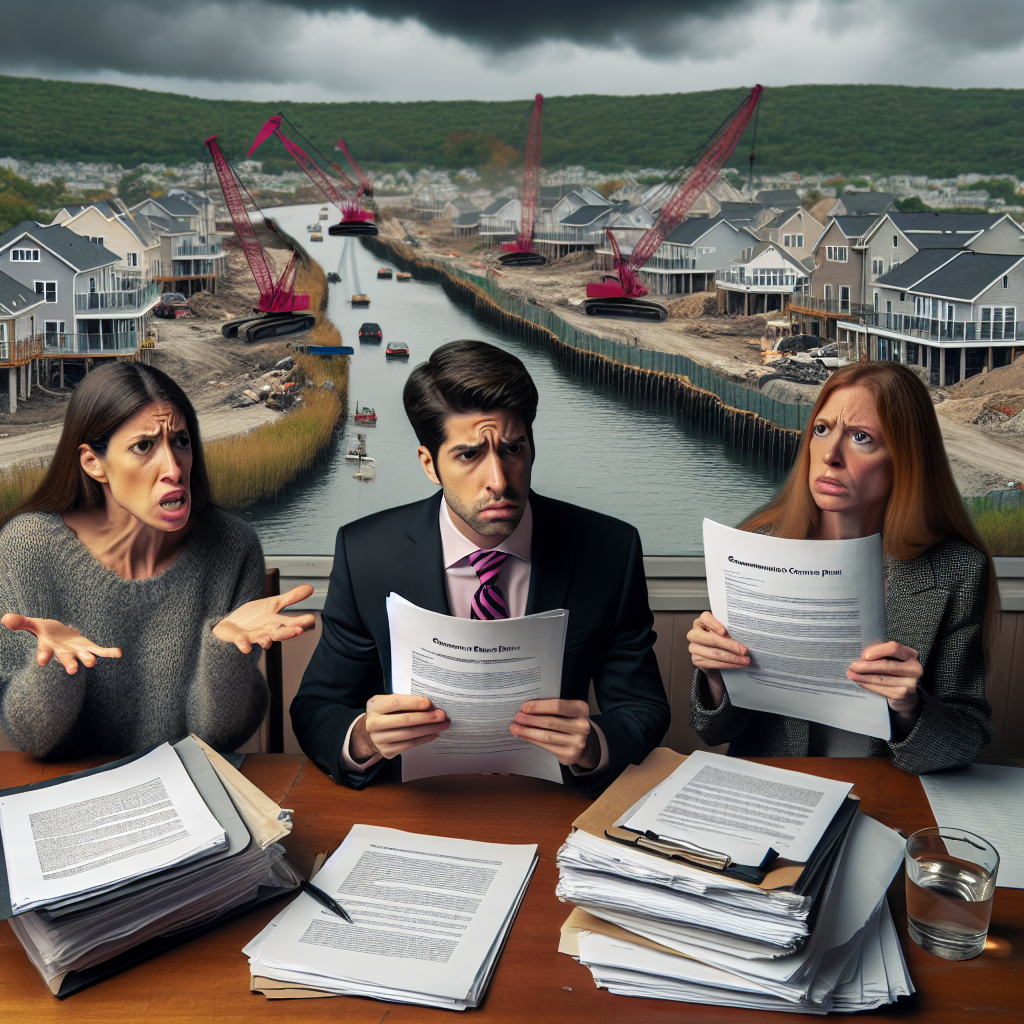
In a recent development concerning the opposition from the Sheep’s Head Bay community to the construction project by the homeless people on U Avenue, residents have accused the project of not applying for the required stormwater discharge construction permit. They have recently filed an appeal with the New York City Board of Standards and Appeals (BSA). The BSA has officially accepted the case and assigned Deputy Director Toni Matias as the designated contact person.
Residents have pointed out that the developer’s application for the main construction project at 2134 Coyle Street on U Avenue and the connected 2114 plot involves risks of violating the city’s stormwater pollution control regulations. According to regulations, when the disturbed land area exceeds 20,000 square feet or the addition of impervious surfaces (such as concrete coverings) exceeds 5,000 square feet, the applicant must apply to the city’s environmental protection agency for specific stormwater construction permits.
This system stems from New York City’s MS4 stormwater discharge standard permit obtained from the state on July 15, 2022. In order to obtain state authorization to manage stormwater pollution control, the city must establish stricter pollution prevention standards to prevent rainwater carrying construction pollutants from entering water bodies, with enforcement measures exceeding state standards and covering the entire city.
Unlike conventional flood drainage facilities, stormwater discharge construction permits aim to prevent pollution. Residents have emphasized that the common misconception that simply building more retention ponds, releasing water after heavy rain, or increasing drainage capacity meets the requirements is misleading. The focus is on preventing construction site pollutants from entering municipal pipelines or nearshore waters, involving environmental regulations and administrative responsibilities. In the event of violations, developers and approval agencies could face fines of up to $37,500 per day, with a potential legal liability lookback period of up to 15 years.
Residents argue that for developers, the core issue lies not in the engineering complexity but in procedural legality. With the Uniform Stormwater Rules (USWR) in effect, it means an additional “must be stamped” checkpoint before construction – without this stamp, access to blueprint review, obtaining loans, and legally commencing construction are all prohibited.
The current dispute revolves around the 2114 plot adjacent to the main construction project for homeless individuals at 2134, which legally requires applying for and obtaining stormwater engineering permits. However, there is currently no clear record of issuance, yet the developer has still applied for demolition operations as part of the land division process.
Residents argue that should the BSA ultimately deem the demolition permit process for 2114 as illegal, once the document is revoked, the entire subdivision project, demolition operations, and the main construction project at 2134 would legally become “jointly invalidated,” potentially leading to work stoppage or even project withdrawal. This could also trigger a chain of legal lawsuits, with developers, the Department of Health and Mental Hygiene (DOHMH), and the Department of Buildings (DOB) possibly being included as defendants in collective litigation due to environmental pollution risks.
The BSA serves as an “administrative arbitration body” in reviewing the legality of building decisions in New York City, with the authority to overturn or modify projects approved by the Department of Buildings, upholding zoning resolutions enforcement and balancing the interests of property owners and neighborhoods. It is an important legal avenue for residents to combat improper developments.
Residents acknowledge that without legal mechanisms for checks and balances, “communities will find it difficult to contend with the alliance of corporations and the government.” The case being taken over by BSA Deputy Director Matias is seen as the government’s first direct response to residents’ concerns about institutional loopholes, signaling an increased possibility that developers “will no longer operate arbitrarily.” Residents describe it as “the community’s first successful use of legal weapons, forcing the government and developers to the negotiation table.”
Next steps may involve BSA scheduling a public hearing once all documents are in order. At that time, residents will have the opportunity to publicly discuss and question points of concern regarding stormwater engineering procedures with relevant agencies such as the Department of Buildings and the Environmental Protection Agency.