
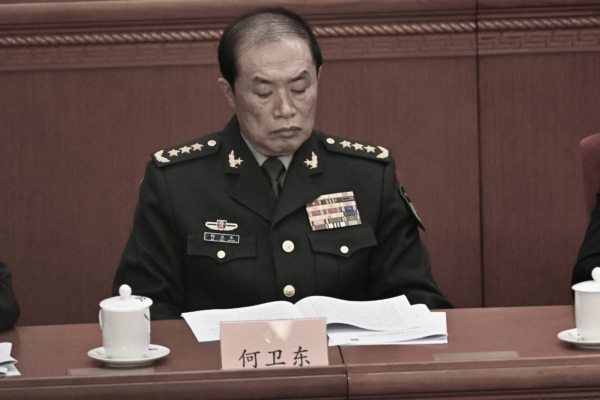
The Chinese Communist Party (CCP) held a meeting of the Political Bureau yesterday, claiming that next year they will “combat corruption with even higher standards,” signaling a possible escalation in internal conflicts. Today, the CCP military newspaper published an article mentioning individuals such as He Weidong and Miao Hua once again. Following the notification of cases involving He and Miao, the CCP military newspaper has openly criticized and named them three times, leading to speculation that this reflects intense infighting within the Party.
The Political Bureau of the CCP declared yesterday that they will “strictly govern the Party with higher standards and more practical measures.” Some Taiwan media outlets have suggested that Beijing has already set the tone for a new wave of anti-corruption actions, with the number of officials being investigated likely to increase rather than decrease.
In response to yesterday’s meeting, the CCP military newspaper published another article today highlighting the “serious violations of discipline and law” by individuals such as He Weidong and Miao Hua, emphasizing that “there must be no place for corrupt elements in the military” and calling for the removal of harmful influences.
On October 17th, authorities announced the investigation of nine senior generals including He Weidong, Miao Hua, and Lin Xiangyang. The official report from the CCP’s Fourth Plenum on October 23rd confirmed the expulsion of He Weidong and Miao Hua from the Party, while the military newspaper on October 24th discussed anti-corruption measures within the military, stressing the importance of rooting out corrupt elements to eliminate significant political risks.
On November 13th, the CCP military newspaper published another commentary on cases involving He Weidong and Miao Hua, warning that failure to thoroughly eliminate harmful elements before a crisis could lead to unimaginable consequences.
Several analysts have stated that the CCP military newspaper’s statements reveal Xi Jinping’s current predicament within the Party.
Su Ziyun, Director of the Strategic and Resource Institute at the Taiwan Institute of National Defense and Security Studies, told a media outlet that this is an attempt to shift blame onto Xi Jinping. The dismissed senior officials are all categorized as part of the “Xi faction,” with He Weidong, Miao Hua, and Eastern Theater Commander Lin Xiangyang being part of the “Fujian clique,” suggesting that their downfall may be related to factional struggles. The editorial in the military newspaper uses anti-corruption as a cover for political struggles but ends up exposing them instead.
Shen Mingshi, a researcher at the Taiwan Institute of National Defense and Security Studies, also stated that the military media’s reporting is an attempt to shift blame onto Xi Jinping, implying that the anti-corruption campaign is solely orchestrated by him in order to absolve him of any wrongdoing or nepotism accusations.
Commentator Li Linyi emphasized that while the CCP military discussing anti-corruption is normal, the repeated mention of “significant political risks” and the need to “thoroughly eliminate harmful elements before a crisis” raises concerns of potential internal conflicts or even armed uprisings, suggesting premeditated actions to preempt such events.
On December 22, 2025, the Central Military Commission of the CCP held a ceremony at the Bayi Building in Beijing to promote senior generals, with Yang Zhibin, commander of the Eastern Theater Command, and Han Shengyan, commander of the Central Theater Command, being promoted to senior generals. This brought the total number of senior generals promoted under Xi’s thirteen-year tenure to 81. However, out of the active senior generals present at the promotion ceremony that day, only four were in attendance: Vice Chairman of the Central Military Commission Zhang Youxia, Zhang Shengmin, Commission Member Liu Zhenli, and Minister of National Defense Dong Jun. Including the two newly promoted senior generals, only six active senior generals appeared publicly.
On December 26, commentator Wang Youqun wrote an article for a media outlet stating that Zhang Youxia was not promoted to senior general under Xi but under Hu Jintao’s chairmanship of the Military Commission. Therefore, at the end of 2025, only five of the senior generals promoted by Xi were publicly present at the promotion ceremony. Nearly all senior generals promoted by Xi were conspicuously absent.
Wang Youqun drew five conclusions: first, corruption in the CCP military has reached unprecedented levels; second, Xi bears primary responsibility for military corruption; third, Xi’s full affirmation of Jiang Zemin ensures the inevitable decay of the CCP military; fourth, the Party’s military has reached the end of its historical course; fifth, a major transformation in China is impending.
(Previous report: Wang Youqun: Only 5 of Xi’s promoted senior generals present?)