
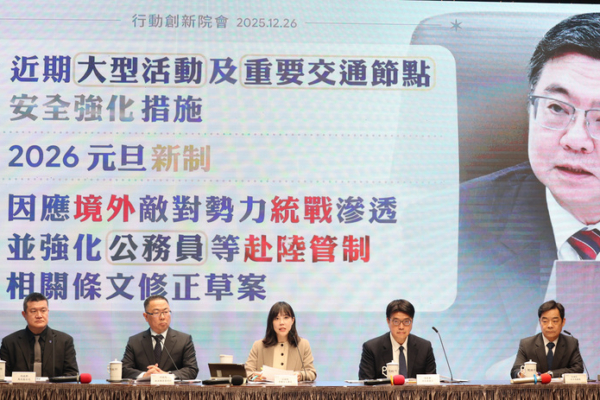
The Executive Yuan of the Republic of China approved today (December 26) the draft amendment to the “Act Governing Relations between the People of Taiwan Area and the People of Mainland Area,” which includes the provision that “Legislators must obtain permission to visit the mainland,” and public servants going to the mainland will also require comprehensive permission.
In response to infiltration by hostile forces from abroad and to strengthen control over public officials traveling to the mainland, the Executive Yuan of the Republic of China today passed the draft amendment to the “Act Governing Relations between the People of Taiwan Area and the People of Mainland Area” proposed separately by the Mainland Affairs Council and the Ministry of the Interior, as well as the draft amendments to certain articles of the “Social Order Maintenance Act,” totaling two bills, which will be submitted for legislative review.
Premier of the Republic of China, Su Tseng-chang, stated that President Lai presented 17 response strategies to the five major national security threats facing Taiwan on March 13. The Executive Yuan subsequently conducted a comprehensive review, identifying 20 laws requiring enactment or revision, with over 120 related plans and administrative measures currently being implemented.
Su Tseng-chang expressed gratitude for the recent passage of the Submarine Seven Law amendment in the Legislative Yuan. Additionally, on the 18th, the Executive Yuan approved the amendment process for four other laws including the “National Security Law,” and has submitted them for legislative review. The two new amendment processes pushed forward today are all in line with the response strategies instructed by President Lai to demonstrate Taiwan’s determination to defend against infiltration and uphold sovereignty.
Emphasizing the loyalty obligations of public officials and elected officials to the country, Su Tseng-chang highlighted the continued strengthening of Communist Party of China’s (CCP) infiltration into Taiwan. The current amendment serves to enhance control over public servants traveling to the mainland, requiring elected officials to disclose contact with CCP officials from the party, government, and military. It also strengthens the behavior norms for former officials who have held specific positions traveling to the mainland to ensure national security.
Referring to Article 20, paragraph 2 of the International Covenant on Civil and Political Rights, which prohibits any advocacy of national, racial hatred that constitutes incitement to discrimination, hostility, or violence, Su Tseng-chang emphasized that such actions should be legally prohibited.
Furthermore, in light of the significant impact of hate speech, terrorism, and undue demands from hostile foreign forces on national security, while ensuring freedom of speech, this amendment adds regulatory measures and penalties for publicizing, broadcasting, or disseminating relevant statements that affect public order in public places or through online platforms, in order to uphold public interests and social tranquility.
Su Tseng-chang concluded by urging the Mainland Affairs Council and the Ministry of the Interior to actively communicate with all parties in the Legislative Yuan to expedite the amendment process and strengthen the national security legal framework. After completing the amendment process, relevant authorities are asked to enhance enforcement, effectively prevent infiltration and uphold national sovereignty and security.
The Mainland Affairs Council stated that the Executive Yuan passed the draft amendment to the “Act Governing Relations between the People of Taiwan Area and the People of Mainland Area” it proposed, aiming to enhance national security maintenance and strengthen civil oversight to prevent CCP’s united front infiltration.
The Mainland Affairs Council stressed that the total number of military, public servants, and teachers nationwide is approximately over 620,000, with around 28,000 categorized as controlled personnel, accounting for about 4%. For example, from January to October of this year, there were 233 applications to visit the mainland, 32 of which were not approved, making the approval rate 86.3%. The Council clarified that the permit system for travel to the mainland is not a ban but rather a necessary risk control measure to protect national and public safety. Under the principle of minimal control, the regulations mainly focus on public servants and will not affect ordinary people traveling to mainland China.
The Council stated that if this amendment is smoothly passed, it can enhance the current regulations for travel to the mainland, streamline the control process, make the agency’s permit procedures more rigorous, and ensure better protection of the rights of controlled individuals traveling to the mainland. The amendment incurs minimal cost changes, the vast majority of public servants’ application procedures will remain consistent with the current situation, the scope of controlled individuals will be more comprehensive reducing national security risks; the review process can alert individuals to personal safety risks when traveling to the mainland, increase civil oversight, ensure transparency and protection of democratic mechanisms, and prevent CCP’s united front infiltration, enhancing democratic defense.
Finally, the Council pointed out that the amendment draft was passed by the Executive Yuan today and will be submitted for legislative review promptly. The Council will actively explain to the parliament the need and urgency for amending laws, hoping for parliamentary support to protect national security jointly with the executive branch and strengthen the management mechanism for traveling to the mainland.
The Ministry of the Interior stated that in response to advocating, promoting, disseminating, or broadcasting inappropriate remarks affecting public order in public places or on the Internet, the ministry has proposed a draft amendment to certain articles of the Social Order Maintenance Act where the current regulations are insufficient. After holding multiple intensive review meetings and gathering cross-agency consensus, the proposal was discussed and adopted during today’s Executive Yuan meeting and will be submitted for legislative review.
The Ministry mentioned that the current amendment to the Social Order Maintenance Act balances legislative intent, human rights protection, and national law enforcement requirements, specifying the conditions for relevant penalties and executing specific measures to strengthen the existing legal framework. The ministry will continue to cooperate with subsequent legislative review processes to promptly complete the amendment, aiming to maintain public order and social harmony effectively.