
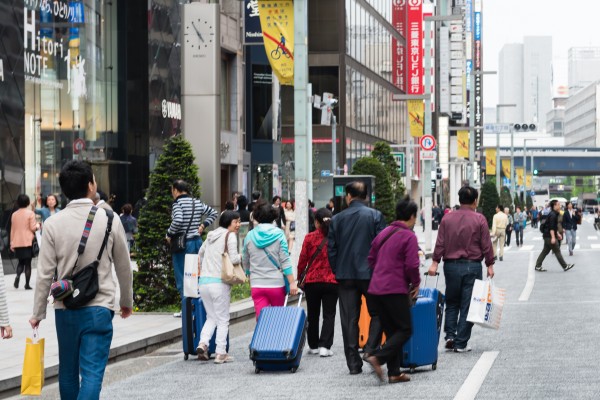
Recently, according to Japanese media reports, the Chinese Communist Party (CCP) is demanding local travel agencies to “control” the number of people traveling to Japan, reducing the number of Chinese visitors to Japan by 40%. It is truly tragic, as pointed out by Japanese veteran media personality, Akihio Yaita, that the real cause for sorrow is not the potential economic impact on Japan, but the fact that Chinese citizens are still living under the shadow of a government that exercises such strict control.
Akihio Yaita, a seasoned media figure in Japan and Executive Director of the Indo-Pacific Strategic Think Tank, expressed his disbelief in a Facebook post regarding a news article by the Kyodo News Agency. The CCP authorities are demanding that travel agencies across the country “control” visa applications for Japan, forcibly reducing the number of Chinese visitors to Japan to 60% of the original figure.
Yaita mentioned that the justification for this action stems from the ongoing propaganda about “poor public safety in Japan” and being “unfriendly to Chinese.” However, in any normal society, the decision to travel abroad should be a personal choice, not a directive from the state.
He emphasized that Chinese individuals visit Japan for various legitimate reasons such as tourism, visiting relatives, seeking medical treatment, conducting business, and pursuing education. Yet, these reasons are now being arbitrarily restricted by a sudden numerical limit imposed because the “leaders are unhappy” and deem it necessary to reduce numbers to 60%, without any scientific basis. Not 50%, not 70%, but precisely 60%, indicating dissatisfaction without causing significant economic harm, in the leaders’ perspective.
Furthermore, according to official statistics from the CCP, during past movements aimed at eliminating “remnants of the Nationalist Party” and various “bad elements,” over a million people were executed. It is not hard to imagine the extent of injustice and wrongful convictions involved in these actions.
Yaita pointed out the absurdity of the Anti-Rightist Movement in 1957, where Mao Zedong declared that “Rightists should constitute 5% of intellectuals” and demanded that this quota be achieved. This led to a frenzy of political persecution, where individuals were labeled as Rightists based on minor flaws in their past writings or statements, in a rush to fulfill quotas. Meetings were disrupted, individuals were labeled Rightists for mundane incidents like taking a restroom break, all to satisfy the arbitrary quotas. Those identified as Rightists at that time faced public denunciation, exile, and tragic consequences.
In essence, Yaita emphasized that the current 60%, similar to the past 0.1% and 5%, follows the same pattern of political sentiment influencing policy decisions driven by predetermined numerical targets. In the past, lives were sacrificed; today, it is economic prosperity, freedom, and common sense that are being cut short. The true tragedy lies not in the reduction of Chinese tourists to Japan to 60%, causing economic losses for Japan, but in the continued oppression faced by Chinese individuals living under the shadow of a government that rules with such heavy-handed tactics.