
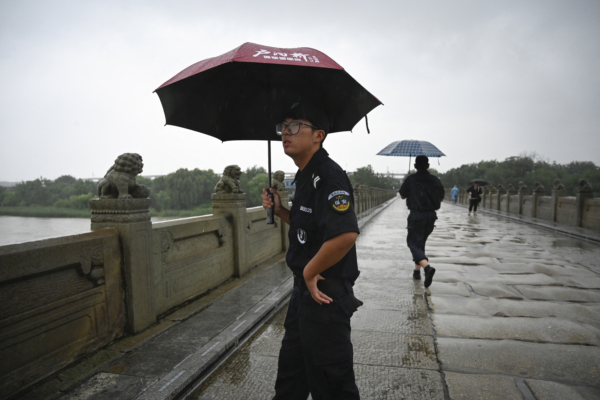
As the New Year of 2026 approaches, China has entered a new round of “stability maintenance” status from north to south. Governments in many places across China have issued notices to streets and grassroots departments, requiring them to investigate the movements of key individuals and deploy “secure” measures for the New Year’s Eve. Some residents have reported being instructed to stay at home and not to go out.
In the Chaoyang District of Beijing, a street office personnel told reporters that they have recently organized personnel to deploy security for the New Year’s Eve, requiring inspections of community risk units, including checking the property’s fire safety, the condition of public area facilities, and emphasizing that “if there is a situation, it must be reported immediately, with no delay.”
A long-term monitored rights activist in Beijing revealed to reporters that there are police cars stationed in the residential area where he lives all year round. He mentioned that surveillance measures by street offices escalate noticeably before holidays, and during the New Year’s Eve and New Year period, people gathering are more likely to be monitored. He stated, “They are afraid of us gathering, just like how the Communist Party started cracking down on revolutions from small group meetings.”
A visitor in Chengdu, Sichuan, Ms. Jiang, told reporters that she recently received a call from national security, instructing her not to visit and not to go out during the upcoming New Year. The two sessions of Sichuan Province will be held next month, and she was asked to “stay at home properly.”
She mentioned that the national security in China has been noticeably tense before New Year: “They told me to cooperate with their work and even offered me some subsidies. Last year, they gave me two thousand yuan.”
In addition to Sichuan, residents in Beijing, Shanghai, Chongqing, and other places have also reported receiving visits from national security or community grid workers asking about their whereabouts and confirming if they have left their residences.
In Shanghai, Ms. Wang from Jing’an District told reporters that the street authorities indicated the need to strengthen security measures for New Year’s Day. She added, “The economy is not good now, and they are worried that residents will take to the streets.” She further stated that authorities will focus on observing the behavior of crowds during the holidays.
A netizen in Chongqing, Mr. Chen, pointed out that after three years of epidemic control measures, China’s economy is declining, many shops are closing, and public dissatisfaction could erupt at any time. He emphasized, “Especially during holidays, various social emotions are prone to arise. The protest by food delivery drivers in Changsha, who were protesting against communities prohibiting them from entering, actually reflects dissatisfaction with the government.”
A visitor in Chongqing, Ms. Li, said that the community recently requested to confirm if family members have gone out: “A few days ago, our community issued a notice in the group chat, stating that those planning to travel between cities during the holidays need to report in advance.”
Similar situations are also occurring in Guangdong. Mr. Liu, a resident of Jiangmen, stated, “It seems that this is a nationwide security operation.” He mentioned that the community received a text message requiring residents to “celebrate the holidays safely and avoid gatherings.”
A scholar in Nanchang, Jiangxi, Mr. Qin, analyzed and pointed out that the Communist Party’s control over stability maintenance has deeply penetrated grassroots levels, with street offices, neighborhood committees, community workers, and police stations forming a “frontline management” system.
“There are village police responsible in the villages, and these stability maintenance notices are conveyed from top to bottom. Before the holidays, they require on-site management to verify the situation,” Mr. Qin added. He further noted that stability maintenance funds are still a key expenditure for local finances in multiple provinces.
According to public information and several provincial financial reports from 2020 to 2024, many local governments have listed group events during festivals as annual risk items. Some counties and cities in Hunan, Henan, and Guangxi explicitly stated “zero visits during major holidays” as an indicator in the reports, considering pre-holiday inspections, list filing, and keeping personnel in place as the basis for assessing completion of tasks.
In previous New Year’s Day, National People’s Congress, and Qingming Festival periods, many provinces in mainland China have had cases where visitors were restricted from traveling or persuaded to return, forming institutionalized and seasonal characteristics. Research data in China indicates that the Communist Party’s grassroots governance is showing an all-encompassing trend, emphasizing a preventive “pre-intervention mode,” including early investigation, phone reminders, and mobility restrictions. Checkpoints have been set up at train and long-distance bus stations to inspect travelers’ belongings at any time.
The Communist Party’s “Petition Regulations” and grassroots management documents establish the principle of “territorial responsibility,” and several county-level government annual work reports have explicitly stated “preventing sudden group events before the holidays.” Mr. Qin believes that this excessive prevention tactic of treating people as enemies may deepen the conflict between officials and the public, leading to possible outbreaks of protest actions.
Sociologist Mr. Li analyzed and told reporters that the Chinese economy is currently in a contraction phase, with numerous businesses shutting down, decreasing employment market capacity, and accumulating rapid pressures on young and middle-aged groups. “People are in a tense state of mind before the holidays, making emotions easily spread out. The society is like a powder keg now, with the only matter of time before it ignites.”
A resident in Hubei posted in a WeChat group stating that with the poor economy, everyone is holding back their anger, and the holidays become an emotional outlet, therefore drawing more attention. Another study by sociologists pointed out that Chinese festivals have a “collective moment” attribute, making them prone to becoming nodes for public expressions, hence authorities adding them to the risk list, including predicting the movement of crowds and public scenes. As the New Year approaches, communities and stability maintenance forces across the country are deploying in advance, restricting the movements of visitors and key individuals.