
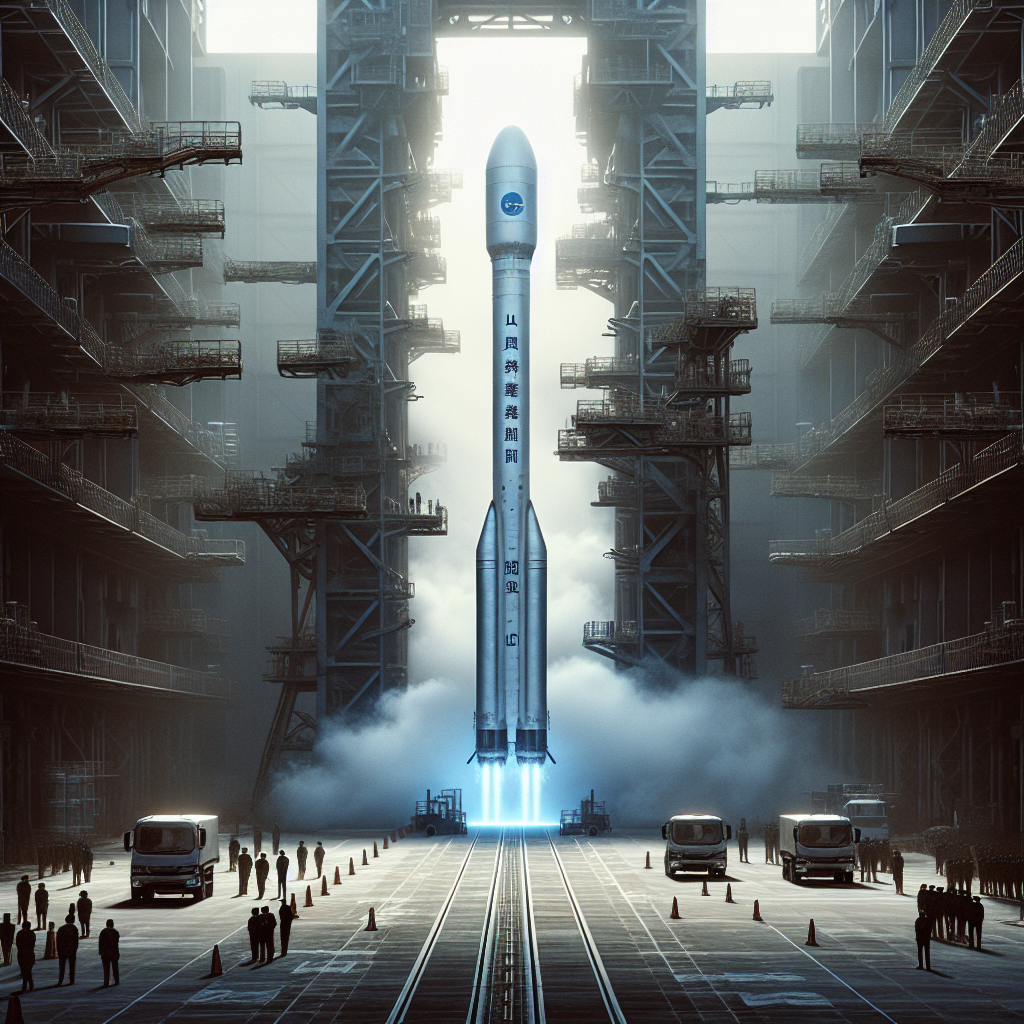
On December 24, 2025, the Chinese self-developed reusable carrier rocket, Long March 12A, also known as Chang Zheng 12A, underwent its first test launch this Tuesday morning, December 23. However, the mission to recover the first stage of the rocket failed. This marks the second failed attempt this month by China at reclaiming orbit-class booster rockets, prompting attention to the underlying reasons. The United States became the world’s first country to successfully reclaim orbit-class booster rockets ten years ago, highlighting a significant technological gap between China and the U.S.
According to Chinese state media reports, Long March 12A conducted its inaugural test launch at 10 a.m. on December 23 at the Dongfeng Commercial Aerospace Innovation Test Area in Jiuquan, Gansu Province. Officials stated that the second stage of the rocket reached its intended orbit, but the first stage failed to be recovered successfully. The flight test mission was described as “mostly successful” despite the setback.
The first stage of a rocket is the bottommost booster. Chinese media reported that an anomaly occurred after the first stage fired its engines for landing, leading to a failure in achieving a soft landing with debris crashing on the outskirts of the Minqin Recovery Site in Gansu.
Long March 12A, being the reusable version of the Long March 12 rocket, utilizes liquid oxygen and methane propellants. It is the first 3.8-meter-diameter single-core liquid carrier rocket developed by the China Aerospace Science and Technology Corporation Eighth Academy.
This failure in recovering orbit-class booster rockets on December 23 follows a similar incident earlier this month. On December 3, LandSpace’s Zhuque-3 Y1 carrier rocket launch encountered an abnormal burning during the first stage recovery process, preventing a soft landing at the recovery site.
The official Chinese response to the failed rocket recovery mission on December 23 only mentioned preliminary analysis suggesting potential anomalies in engine thrust adjustment or attitude control failure as possible causes.
Researcher Shen Mingshi from Taiwan’s Institute for National Defense and Security Studies commented to Epoch Times that apart from the official reasons given for the rocket recovery failure, factors such as ignition stability, flight control algorithms, structural materials, and even human operational errors could all be contributing factors.
Shen Mingshi further pointed out that China’s claim of the flight test mission being “mostly successful” is a typical propaganda tactic aimed at saving face. Without pinpointing the true cause of the failed recovery of the first-stage rocket, costs for future launches could increase.
Moreover, a debate among military personnel and aerospace professionals has been ongoing on various social media platforms since the earlier failure in the recovery of the Zhuque-3 Y1 carrier rocket. Discussions have raised concerns about factors including power struggles within departments, financial constraints in certain units, and corruption. The ongoing purging of military officials has intensified interest in these discussions.
Since the internal troubles within the Chinese military from 2023, several dismissed senior officers previously held positions in the satellite launch sector. Key figures such as former Minister of National Defense Li Shangfu, Deputy Chief of the Joint Staff Department of the Central Military Commission Zhang Zhenzhong, former Deputy Director of the Equipment Development Department of the Central Military Commission Zhang Yulin, and Deputy Commander of the Strategic Support Force and Commander of the Aerospace System Department Shang Hong. Several former heads of the China National Space Administration including Xu Dazhe and Zhang Kejian have been dismissed, with Ma Xingrui being absent from major events, leading to speculations of trouble within the organization.
The growth trajectories of the space industries in China and the United States have stark differences. In the U.S., private enterprises dominate rocket launches, with SpaceX’s reusable Falcon 9 rocket leading the way. As of mid-December this year, SpaceX has completed 165 launches. In contrast, in China’s 2025 total rocket launches, 67 were from one-time use Long March series rockets produced and launched by the China Aerospace Science and Technology Corporation (CASC) and other state-owned manufacturers. Although China has also seen private companies launching rockets in the past decade, the total still falls short of 50 launches.
Shen Mingshi noted that while there is a perception of private entities within China’s aerospace industry, these so-called private companies likely have connections to state-owned aerospace enterprises, falling under the category of military-civil fusion enterprises through which the authorities may acquire relevant technology from abroad.
Assistant researcher Wang Xiaowen from Taiwan’s Institute for National Defense and Security Studies expressed to Epoch Times that this recent failure in reclaiming the first stage of the rocket reveals the unreliability of China’s “copycat” or “reverse engineering” technology, which lacks solid scientific foundations. China’s aim to seize satellite positions and communication spectra lacks robust scientific backing. As a result, despite launching multiple satellites and rockets, they may face continuous setbacks.
Reusable rocket technology improves launch frequencies, reduces costs, and aids large-scale space engineering projects. Currently, the United States remains the only country to successfully reclaim orbit-class booster rockets. SpaceX achieved this milestone ten years ago on December 22, 2015, with the Falcon 9. Additionally, Blue Origin, Jeff Bezos’ aerospace company, announced last month the successful development of the New Glenn rocket, becoming the second rocket to successfully reclaim orbit-class booster rockets.
SpaceX has almost monopolized the heavy rocket launch sector and become the leading provider of low Earth orbit internet services. SpaceX operates a network of around 9,000 Starlink satellites.
China has been eager to keep pace, with both state-owned and private aerospace enterprises striving to advance in the launch and recovery of reusable rockets. The timing of the trial launch of China’s Long March 12A on December 23, coinciding with the 10-year anniversary of the successful recovery of orbit-class booster rockets by the United States, adds an intriguing element.
The South China Morning Post noted that so far, both Chinese state-owned and private enterprises have not succeeded in this endeavor, placing China technologically behind the U.S. by approximately ten years.
Shen Mingshi emphasized that compared to the successful moon landing by the United States, China has yet to achieve this feat, indicating a gap of more than ten years. Moreover, when comparing Chinese enterprises to SpaceX, while China may adopt designs like single launch for multiple satellites, its launch efficiency still falls short of SpaceX. Therefore, the ten-year technological gap is only a general assessment whereas across various technologies, China may lag significantly more than a decade behind.
China’s ambitious satellite deployment plans far exceed the current capabilities of private launch industries. Taking the “Thousand Sail Constellation” as an example, with over 100 satellites at present, the goal is to have approximately 1,300 satellites by 2027 and reach 15,000 after 2030. Last August 6, Shanghai Space Star Technology, a state-owned enterprise, launched the first 18 commercial networking satellites for the “Thousand Sail Constellation” (G60 Star Chain Project), successfully placing them in their intended orbit, seen as the formal launch of China’s version of the Star Chain project.
The U.S. Starlink has introduced over 2,300 satellites between mid-2024 and July 2025 alone, through more than 100 launches by SpaceX. According to recent reports from The Wire China, for China to catch up to the scale of the Starlink satellite constellation, it must reach a similar number.