
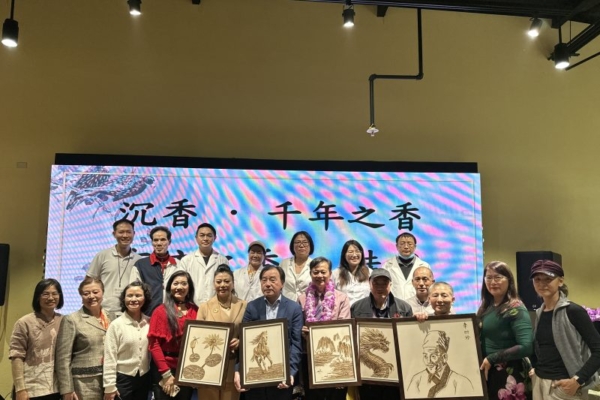
On the afternoon of December 21st, the University of Silicon Valley in California held a cultural exchange event titled “Aloeswood: Scent of a Thousand Years.” The event featured presentations from city officials, traditional Chinese medicine and neuroscience experts, showcasing the applications of aloeswood in the field of health and wellness. More than 30 individuals concerned with mental and physical well-being participated in the event.
During the event, Vice Mayor Wang Yaoming of Union City delivered a speech emphasizing that fragrance culture is not confined to the East but holds significant importance in world history and religious cultures. Drawing on the example of the “gold, frankincense, and myrrh” presented by the three wise men in the Western Christmas story, Vice Mayor Wang highlighted how fragrances have symbolized preciousness and spirituality since ancient times. In an interview with the media, Vice Mayor Wang expressed that in today’s fast-paced and stressful society, fragrance culture can help individuals relax, regulate emotions, and promote multicultural understanding and exchange.
Chairman Wang Keyuan of the Guangdong Aloeswood Group introduced the origin, cultivation techniques, and potential applications of aloeswood in the field of health and wellness. The organizers stated that this sharing aimed to let the public understand the transition of aloeswood from traditional culture to modern life.
Dr. Chen Guangyue, a traditional Chinese medicine and neuroscience expert, delivered a speech on “Brain Aromatherapy,” delving into the functioning modes of the primitive brain, emotional brain, and rational brain. He elaborated on the impact of consciousness and subconsciousness on emotions and health, proposing a three-step approach of “nourishing the brain, understanding the brain, and awakening the brain” to enhance self-awareness and achieve mental balance. The fusion of traditional Chinese medicine theories with modern neuroscience was well-received by the audience.
Teacher Huang Lizhou demonstrated aloeswood tea ceremony on-site, while Teacher Xiang Cai Rong performed a guzheng (Chinese zither) show, immersing attendees in ancient oriental charm. Huang Lizhou mentioned in an interview that aloeswood tea, unlike regular teas, is brewed directly with aloeswood, aiming to guide drinkers into a state of tranquility to deeply sense the subtle changes in aroma and the mind-body connection. The combination of guzheng music and tea ceremony allowed guests to slow down in the ambiance of music and fragrance, appreciating the aesthetics of eastern living.
At the event, Ms. Athena Liu Goodman, Executive Chair of the South Asian Pacific American (SAPA) Friendship Alliance and also Executive Chair of the World Harmony Foundation under the United Nations Environment Programme (UNEP), presented the “Global Outstanding Philanthropist Contribution Award” to Chairman Wang Keyuan, Principal Yang Lei, and Chairperson Jia Huijun, recognizing their contributions to the development of traditional Chinese medicine, education, and community charitable services. She also introduced relevant health initiatives of the United Nations, emphasizing the roles of traditional medicine and mental health in global public health, as well as the importance of intercultural cooperation.
Furthermore, the organizers held a memorandum of understanding signing ceremony among five parties, aiming to deepen cooperation in research, education, cultural exchange, and industry promotion to advance the systematic development of aloeswood culture in the United States.
A woman formerly employed in the transportation sector, Ms. Xie, expressed to the media her long-standing struggles with sleep and seasonal discomfort. She found the event to be both “refreshing and relatable.” She believed that activities integrating culture and health could provide gentle self-regulation methods for individuals.