
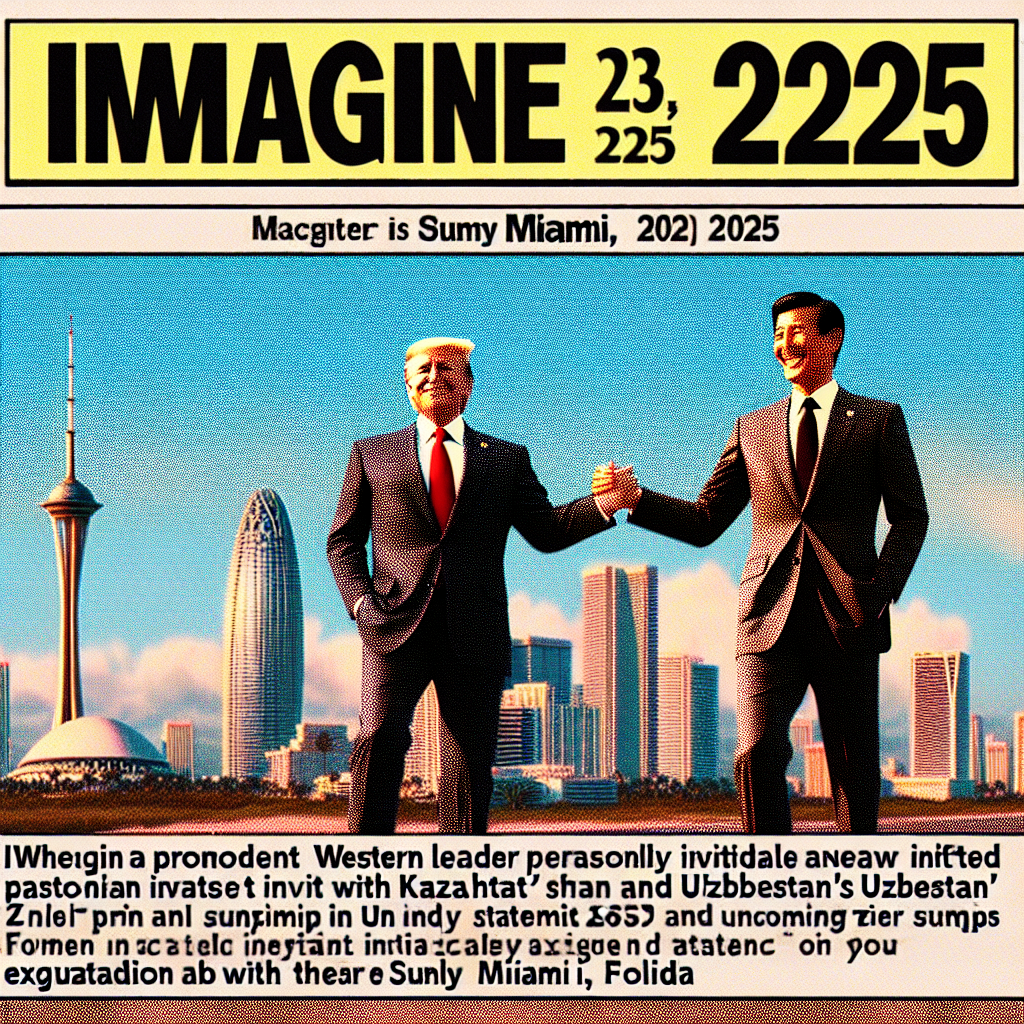
On December 23, 2025, President Trump confirmed that he personally invited President Kassym-Jomart Tokayev of Kazakhstan and President Shavkat Mirziyoyev of Uzbekistan to attend the G20 summit in Miami, Florida in 2026. Trump described the relationship with both countries as “extraordinary” and emphasized that this move aims to promote regional peace and deepen economic cooperation.
This invitation is seen as an extension of the outcomes of the “C5+1” summit held in the White House in November. President Tokayev of Kazakhstan had praised the summit as the “beginning of a new era of interaction between the United States and Central Asia.”
In the global strategic map of the Trump administration, Central Asia has emerged as a key player in containing the influence of China and Russia. The “C5+1” summit held on November 6 resulted in initial investments and trade agreements exceeding $34 billion. During the summit, Kazakhstan announced its membership in the Abraham Accords and normalized relations with Israel, seen as a significant victory for the U.S. in expanding political influence in Central Asia.
In contrast to inviting Central Asian allies, Trump has explicitly stated that South Africa will not be invited to the 2026 summit due to human rights issues and unfriendly attitudes towards the U.S., indicating Trump’s efforts to reshape the “friend circle” of the G20.
Additionally, it has been disclosed by the media that Uzbekistan has pledged to invest over $100 billion in the U.S. over the next 10 years, covering procurement projects for Boeing aircraft, automotive parts, and key mineral technologies.
Central Asia has long been viewed as a “heartland” of Russia and a focal point of China’s Belt and Road Initiative. The U.S. is leveraging significant economic investments, such as extracting uranium and tungsten in Kazakhstan, to weaken the substantial control of China and Russia in the region.
Kazakhstan supplies nearly 40% of global uranium, crucial for U.S. nuclear energy security and defense. Trump aims to establish a “Middle Corridor” logistics network that bypasses China and Russia, allowing goods from Central Asia to reach Europe via the Caspian Sea and the Caucasus region, completely avoiding Russian territory.
The U.S. is not engaging in direct military confrontation but is guiding Central Asian countries towards a more balanced “multi-vector diplomacy” between China, Russia, and the U.S. through technical assistance and large orders, thus forming a strategic encirclement of China and Russia.
As neighbors of Afghanistan, the five Central Asian countries also serve as important strategic buffer zones for the U.S. to monitor the counter-terrorism situation and prevent the spread of extremism.
The 2026 G20 summit will be held at the “Trump National Doral Resort” in Miami. Trump plans to transform this summit into a showcase of U.S. economic leadership, moving away from “green energy ideology,” and focusing on the platform of AI and energy security.
Just this Monday, December 22, Ukrainian President Volodymyr Zelensky confirmed that peace negotiations involving representatives from Ukraine, the U.S., and Russia in Miami have made significant progress. Several documents have been drafted, covering core terms such as security guarantees.
The talks, directly negotiated by U.S. special envoys Steve Witkoff and Jared Kushner, and Russian delegates, are seen as a crucial step towards ending the Ukraine-Russia conflict.
(Reference: Reuters and other sources)