
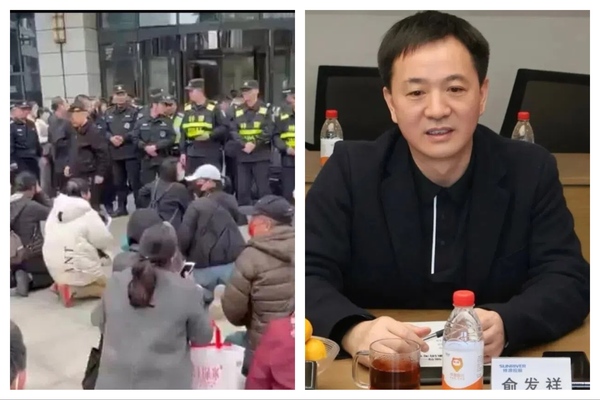
Recently, the controlling shareholder and well-known Zhejiang businessman Yu Faxiang of Zhejiang Financial Trading Platform Zhejin Center’s wealth management products was taken into custody by the police. By the end of November, several financial wealth management products of Zhejin Center failed to make payments as scheduled, involving over 20 billion RMB in funds and nearly ten thousand investors. Beginning in early December, a large number of investors began clamoring for their rights.
On the evening of December 22nd, three listed companies under the Xiangyuan Holdings Group released simultaneous announcements – Xiangyuan Tourism (600576.SH), Jiaojian Co., Ltd. (603815.SH), and Haichang Ocean Park (02255.HK). The companies announced that their actual controlling shareholder Yu Faxiang was under criminal coercive measures by the Shaoxing Public Security Bureau due to suspected crimes, with the case currently under investigation.
Jiaojian Co., Ltd. also disclosed that on December 19th, Yu Honghua resigned as a director and a member of the Audit Committee for personal reasons and would no longer hold any positions in the company. Public records indicate that Yu Faxiang and Yu Honghua are first cousins.
The incident originated from the multiple financial products’ default within Zhejin Center, leaving nearly ten thousand investors unable to retrieve over 20 billion RMB of investments.
Several investors reported to Caixin that starting from November 27th, numerous fixed-term products at Zhejin Center, previously operating steadily, started experiencing issues such as failure to payout upon maturity and inability to withdraw funds, which involved dozens of products such as “Jinduo Shaoxing,” “Lishui Mingfan,” “Shaoxing Chenjian,” and “Wanyu Changxing” backed by Xiangyuan Group. The combined scale of these products is estimated to exceed 20 billion RMB, affecting nearly ten thousand investors.
One investor told Caixin that the underlying assets of the defaulted products were accounts receivables packaged by related companies of Xiangyuan, turning bad assets into recoverable debts.
On December 5th, Shen Baoshan, the CEO of Xiangyuan Holdings, confirmed the above perspective when answering investors’ questions at Zhejin Center. He said, “Real estate used to sell two to three hundred billion a year, but now it can’t. We invested in two projects in Fuyang and one each in Yueyang and Hangzhou Bay between 2020-2024. One project in Fuyang fell through.” “Prior to this, we scrambled to pay by any means, and now we are out of money.” The company is now looking to the Shaoxing government for funding to become a major shareholder, hoping to stabilize the company’s assets and prevent further depreciation.
On the evening of December 7th, Xiangyuan Tourism, Jiaojian Co., Ltd., and Haichang Ocean Park issued announcements stating that the overdue payout financial products were not related to the listed companies but were cooperation projects of Xiangyuan Holdings in the real estate sector. Xiangyuan Holdings and its actual controller Yu Faxiang bear joint guarantee obligations for the aforementioned payments.
On December 16th, Xiangyuan Tourism and Jiaojian Co., Ltd. announced that over 600 million shares and 274 million shares, respectively, were frozen, awaiting freeze, or judicially marked due to debt disputes of Xiangyuan Holdings. A working group from Shaoxing City had been deployed to Xiangyuan Holdings. Both companies stated that their actual controllers and controlling shareholders remain independent from the companies but that a high percentage of shares being frozen may impact the stability of their control.
Over the past month, investors have gathered outside the registration building of Zhejin Center in Hangzhou multiple times for their rights. A video circulating online shows investors singing the national anthem together, kneeling in front of the building, and engaging in physical confrontations with on-site security personnel.
Zhejin Center, formally known as the “Zhejiang Financial Asset Trading Center,” was established as the first financial asset trading platform approved by a provincial government. From 2019 to 2023, there was a shift in ownership from state-owned to private capital. Hangzhou Minzhi Investment Management Co., Ltd. holds 58.57% of Zhejin Center’s shares, with the remaining shares held by state-owned capital.
Caixin found that the largest shareholder, Minzhi Investment, has strong ties to Xiangyuan Holdings. Anhui Yixiang Tourism, a subsidiary of Xiangyuan Holdings, holds a 55% stake in Hangzhou Microgame Travel Co., Ltd., while Minzhi Investment holds the remaining 45% stake in Microgame Travel.
Established in 1992, Xiangyuan Holdings primarily focuses on tourism investment, construction, and operation, with over 50 tourism projects covering various World Heritage Sites and top-tier scenic spots. The group also has involvement in infrastructure and real estate sectors. The crisis facing Xiangyuan Group is related to the downturn in China’s real estate market.
Public records show that Yu Faxiang was born in 1971 in Zhejiang Shengzhou and is the actual controller of the Xiangyuan Group. He controls Xiangyuan Tourism, Jiaojian Co., Ltd., and Haichang Ocean Park, all of which are listed companies. He also serves as the Executive Vice Chairman of the Zhejiang Chamber of Commerce in Shanghai. In October 2025, Yu Faxiang ranked 465th on the Hurun Rich List with a wealth of 14.5 billion RMB.
Following the collapse of Xiangyuan series’ financial products, the stock prices of the three listed companies under the Xiangyuan Holdings Group experienced a simultaneous decline. As of the closing on December 22nd, the stock prices of Xiangyuan Tourism, Jiaojian Co., Ltd., and Haichang Ocean Park had fallen by 17.73%, 34.46%, and 31.43% respectively this month.