
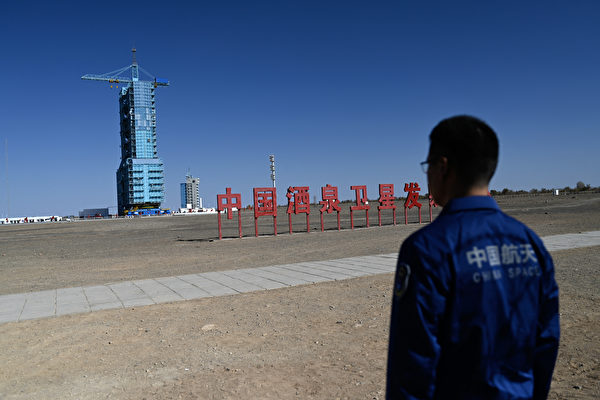
On December 23, 2025, the Chinese Communist Party’s first reusable carrier rocket, the “Long March 12A,” was launched for the first time. However, the recovery of the first stage of the rocket failed, with debris falling to the ground. This marks the mainland’s second unsuccessful attempt at recovering an orbit-level booster this month.
According to reports from Chinese media, the Long March 12A carrier rocket was launched at 10 a.m. on December 23 at the Dongfeng Commercial Aerospace Innovation Test Zone. The second stage of the rocket successfully entered its planned orbit, but the first stage failed to be recovered. The media described the flight test mission as “basically successful.”
It was reported that abnormalities occurred in the sub-level during the landing phase, preventing a soft landing and leading to the debris crashing on the edge of the Gansu Minqin recovery site. Preliminary analysis suggests that this may be related to abnormalities in engine thrust adjustment or malfunction in attitude control.
The “Long March 12A” is a reusable version of the Long March 12, using liquid oxygen and methane propellants. It is the first 3.8-meter-diameter single-core liquid carrier rocket developed by the China Aerospace Science and Technology Corporation Eighth Academy. The total length of the rocket is 70.4 meters, with a diameter of 3.8 meters for the first and second stages, and a fairing diameter of 4.2 meters, weighing about 437 tons at liftoff.
This is the second unsuccessful attempt by the Chinese Communist Party in recovering an orbit-level booster this month. On December 3, Landspace’s Zhuque-3 remote-sensing carrier rocket was launched successfully, with the second stage reaching its planned orbit. However, during the simultaneous recovery verification of the first stage, abnormal combustion occurred, preventing a successful soft landing at the recovery site, marking the failure of the recovery test.
Furthermore, the private company Tianbing Technology’s “Gushenxing-1” failed to deliver a satellite into its planned orbit in November.
In January of this year, the Long March 12A previously conducted a vertical takeoff and landing test, the results of which were not publicly disclosed.
Earlier this month, reports from Dajiyuan stated that informed sources revealed that several missions this year did not meet expectations, leading to increased discussions within the Chinese military and aerospace systems. Some attribute the failures to the lack of consulting geomancers as per traditional practice.
He mentioned that before Xi Jinping came to power, for every rocket launch, relevant units would invite geomancers to inspect the site and adjust equipment placement. There would also be a brief ritual involving lighting incense at the scene.
Within various social media chat groups, some individuals with military backgrounds and aerospace professionals have been discussing the recent failures, citing factors such as power dynamics within departments and financial constraints in some units.