
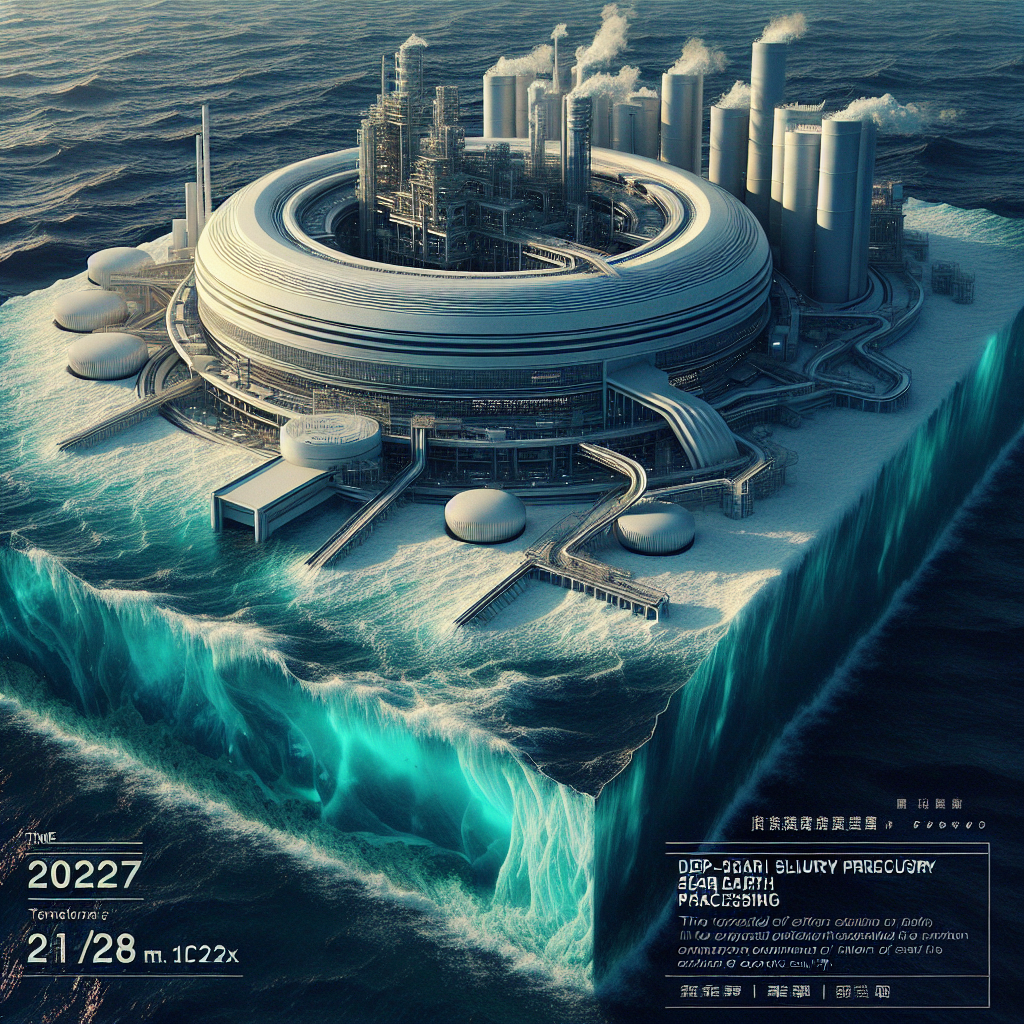
Japan is planning to build a deep-sea rare earth slurry processing plant on the easternmost island by 2027 to extract rare earth elements from resources at the sea floor 6,000 meters deep, aiming to enhance national economic security.
According to local time in Japan on Tuesday (December 23), the Nikkei Asian Review reported that the Japanese government will construct a rare earth extraction plant on Minamitorishima, one of the Ogasawara Islands, through the Strategic Innovation Promotion Program (SIP).
The seabed near Minamitorishima is rich in slurry containing rare earth elements such as dysprosium, an important material for electric vehicle motor magnets. The slurry in that area is almost free of radioactive substances or other harmful elements, making it easy to process.
The Japanese government’s SIP program has identified the extraction of marine rare earth resources as a key challenge. In January and February 2026, Japan’s Ministry of Marine Earth Science and Technology will conduct trial extraction in the exclusive economic zone of Minamitorishima using a deep-sea research vessel to collect a mixture of rare earth slurry and seawater through a pipe descending to the seafloor.
In February 2027, Japan will conduct a comprehensive demonstration experiment on the project to test the capacity to extract 350 tons of rare earth slurry daily. As the ship onboard cannot handle such a large amount of slurry, they will be transported to a facility on Minamitorishima and processed to reduce the volume by about 80% using equipment similar to a washing machine centrifuge to remove seawater from the slurry.
Afterwards, another vessel will transport the dehydrated slurry to Japan for the separation and extraction of rare earth elements.
Project manager Shoichi Ishii stated that they will test the entire process of extracting rare earth elements from the slurry and then evaluate its economic feasibility.
In the recently passed supplementary budget for the 2025 fiscal year, Japan allocated 16.4 billion yen (approximately 1.05 billion US dollars) for the development of rare earth mineral resources, including the costs related to the demonstration trial in 2027, such as processing facilities, transport ships, helicopters, and airplanes for personnel rotation.
Minister of Science and Technology Policy Kimi Onoda emphasized at a press conference on December 4, “Ensuring a stable domestic supply of rare earths is of utmost importance for economic security.”
Rare earth metals are essential for electric vehicles and many other high-tech industries. China currently produces about 70% of the world’s rare earth metals.
SIP believes that constructing an industrial base on Minamitorishima at the easternmost part of Japan (about 1,950 kilometers southeast of central Tokyo) holds significant importance, but this project also faces unique challenges. In addition to building slurry processing equipment, the project encounters constraints in basic infrastructure such as electricity and water supply, as well as the need to provide accommodation facilities for workers.
The region around Minamitorishima has also identified other resources, including seabed hydrothermal deposits, cobalt-rich crusts, and manganese nodules. However, due to concerns about profitability and environmental impacts, no projects have been commercialized yet.