
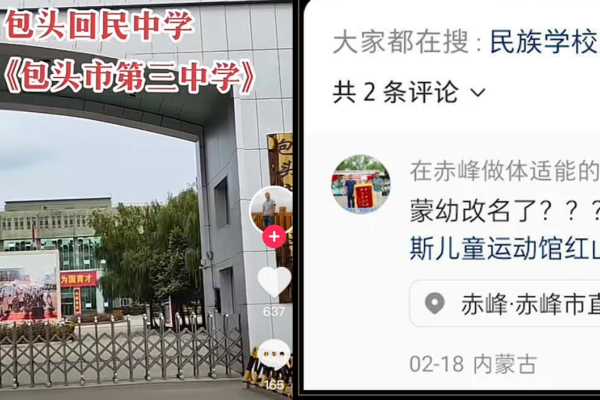
In the last month of 2025, there have been ongoing cases of renaming primary and secondary schools as well as kindergartens originally named after “Mongolian” or “Hui Muslim” in Inner Mongolia and Xinjiang. According to lists and on-site information provided by local residents, some school gates have had their ethnic markers replaced, with the new school names no longer containing ethnic terms. At the same time, some Mongolian language teachers are being required to undergo Mandarin training or are being reassigned.
As December progresses, many Mongolian schools in Inner Mongolia have changed their names, eliminating ethnic terms from their names. Some Mongolian schools and Hui Muslim schools in Xinjiang’s Bayingolin Mongol Autonomous Prefecture have been renamed using serial numbers or geographical names. For instance, a school that was previously known as “Bayingolin Mongol Autonomous Prefecture Mongolian Ethnic Primary School” has been renamed to “Bayingolin Mongol Autonomous Prefecture First Primary School,” with both the full name and abbreviation on the school gate changed synchronously. The renaming of Mongolian middle schools in the region to Third Middle School has sparked discussions within the Mongolian community.
Han Ying (pseudonym), a Mongolian individual familiar with the related documents, told reporters that she had reviewed the school renaming documents issued by the education authorities in Bayingolin. Considering the previous renaming of Mongolian middle schools, many Mongolian people are feeling confused and uneasy about the consecutive changes in school names.
“What are they trying to do? The space for using Mongolian script is shrinking, with many public places switching from Mongolian to Chinese characters,” Han Ying believes that such actions are impacting the original ethnic education system.
Several ethnic minority individuals from Inner Mongolia have informed reporters based on compiled lists that Mongolian schools in Hohhot have been renamed as the Third Affiliated School of Inner Mongolia Normal University; Tongliao Mongolian Middle School has been renamed Tongliao Second Middle School; Baotou Hui Muslim Middle School has been renamed Baotou Third Middle School; and Mongolian middle schools, primary schools, and vocational schools in Chifeng, Hangjin Hou Banner, and Lindong have also been renamed using serial numbers or geographic names.
Saren Nawa (pseudonym), a Mongolian language teacher in Inner Mongolia, told reporters that she has also noticed the renaming of schools in many areas recently, though the actual extent of the changes remains difficult to fully grasp. “I have asked around, and it seems like maybe all schools have been renamed, or something like that, but I’m not very sure about the specifics.”
She further revealed that some original Mongolian schools in Hohhot no longer retain their ethnic names. She said, “Schools like the Mongolian schools in Hohhot, Xinan Road Primary School, which were Mongolian schools in the past, after removing the Mongolian name, have all been renamed to First, Third, Fourth Primary Schools, and so on, basically all changed.”
Saren Nawa, who is nearing retirement, stated that after the school renaming, the teaching arrangements for Mongolian language teachers have also been adjusted. She said, “Now many Mongolian language teachers at schools either switch to teaching other subjects, if they can; otherwise, they go to logistics, that’s how it’s arranged. If you are a bit older, you can retire.”
She added that the Mongolian language class hours at the middle school level have noticeably decreased. “In general high schools, there is only one Mongolian language class per week; in some places at junior high schools, there are two classes per week. With fewer class hours, fewer teachers are needed, and many people transition to teaching other subjects or move to the second line, the situation is more or less the same.”
Regarding the possibility of outside teachers being brought in, Saren Nawa said she does not have specific information. She said, “I’m not too sure about this. However, there are already many Han Chinese teachers in Inner Mongolia, so they should be internally absorbed. Major cities may allocate some, but whether they have brought in teachers from the mainland, I can’t say for sure.”
In response to the school renaming in Bayingolin, Mr. Ma, an official in charge of language education in the local education system, told reporters that due to the limited number of directly affiliated primary schools in the prefecture, there may be new second or third primary schools established in the future, and the name changes are based on school size and management needs. He denied that this move involves restricting Mongolian language and culture and stated that ethnic language and literature courses are still retained.
However, a Mongolian individual from Inner Mongolia expressed to reporters that news of most Mongolian school name changes has spread locally, with many Mongolian parents feeling concerned about the changes in the educational environment. He stated that the simultaneous adjustment of school names and language use methods has made some worry that the space for Mongolian mother tongue education is shrinking. He said, “By canceling our mother tongue education, we have repeatedly voiced our concerns to the autonomous region government, but have not received any response.”
In addition to Mongolian schools, there have also been cases of name changes for secondary schools named after the Hui Muslim community. According to information provided by locals, the original Baotou City Hui Muslim Middle School in Inner Mongolia has recently been renamed to Baotou Third Middle School, with the school gate’s original name sign also adjusted synchronously. Following the circulation of this information on local internet platforms, some Hui Muslim and Mongolian parents have shown concern.
In recent years, there have been ongoing adjustments in the teaching arrangements of ethnic languages and school management in some areas of Inner Mongolia and Xinjiang. The renaming of many schools has sparked different reactions within the Mongolian and other ethnic minority communities, with disparities between official and public opinions. Discussions surrounding changes in school names, textbooks, and teaching languages continue to draw attention in Inner Mongolia.