
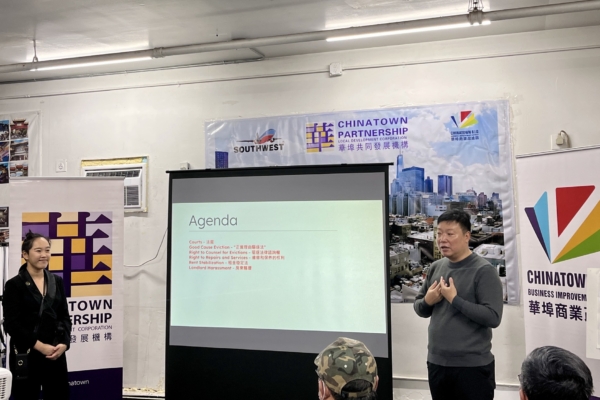
Following the implementation of New York State’s “Good Cause Eviction” law in 2024, the Chinatown community’s concern for housing rights continues to grow. On December 19th, at a legal seminar geared towards residents, organized by the Chinatown CLT (Chinatown Community Land Trust), housing lawyer Xia Zixu systematically explained the key points of the new law, its application thresholds, and the practical implications to assist tenants and landlords in clearly understanding their respective rights and responsibilities within the framework of the new law.
To facilitate understanding among Chinatown residents, the seminar was conducted with the coordination of Chinatown CLT coordinator Jacky Wong serving as the emcee and Chinese translator.
Xia Zixu pointed out that many residential buildings in Chinatown are aging, with a high proportion of rent-stabilized units. There have long been disputes over maintenance and management due to inadequate repairs, leading to friction between tenants and landlords regarding lease renewals, repairs, and rental adjustments. She emphasized that the core of the seminar is to help residents understand what the law “can and cannot do”, to handle conflicts legally when they arise, rather than resorting to emotional confrontations.
One of the most anticipated changes under the new law is the establishment of a cap on rent increases for certain market-rate rental properties. According to the regulations, annual adjustments must be calculated based on inflation, ranging between 5% to 10%, with the highest at 8.79% in 2024. This significantly restricts the previous practices of substantial rent hikes or non-renewals leading to “de facto displacement”. Additionally, landlords must provide a “good cause” to evict or refuse to renew leases, including nonpayment of rent, serious breaches of the lease, property damage, illegal activities, or the landlord’s own or immediate family member’s desire to reside in the unit, or plans to demolish and rebuild.
She reminded that the law does not apply universally, mainly targeting landlords with more than 10 residential units in New York State. Owner-occupied landlords, sublets, public housing, as well as housing already protected by other regulations such as rent stabilization, Section 8, Mitchell-Lama, cooperative apartments, and condominiums are not within the scope of application, and tenants need to confirm if their housing is protected.
On the practical side, the seminar outlined eviction cases in housing courts, the HP (Housing Part) maintenance procedures tenants can initiate, and small claims court as three common avenues. Xia Zixu emphasized that regardless of immigration status, tenants do not have to move out before a court ruling and have the right to consult a lawyer. Regarding maintenance disputes, she advised tenants not to withhold rent on their own and to notify their landlord in writing, report to 311 when necessary, and keep records, as required by law, to safeguard their rights.
Moreover, the seminar introduced the rights under the rent stabilization system, as well as programs like SCRIE and DRIE, to assist seniors and individuals with disabilities in reducing their rental burdens. The organizers stated that clarifying rights and responsibilities through legal education helps reduce misunderstandings, resolve conflicts, and create a more stable and affordable living environment in Chinatown.