
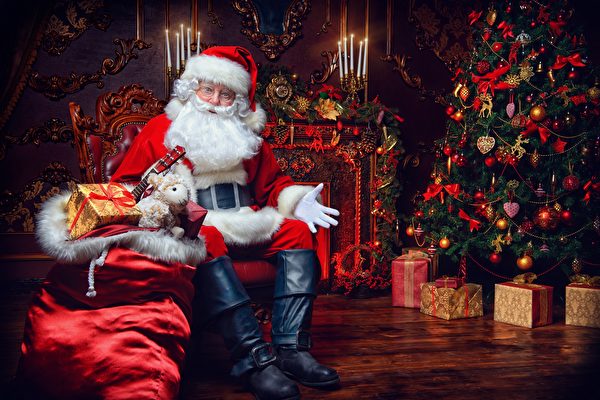
According to tradition, Santa Claus lives in the North Pole and on Christmas Eve, he travels from house to house on a sleigh pulled by reindeer to deliver gifts before returning home. But Earth has two North Poles, so how does he know which North Pole he is headed to?
Scott Brame, an assistant professor of Earth Sciences at Clemson University in the United States, wrote in an article on The Conversation website that Earth has two North Poles – the geographic North Pole visible on maps, and the magnetic North Pole that compasses rely on.
Brame explained that the geographic North Pole is the point at one end of Earth’s axis of rotation, which is different from the magnetic North Pole. Earth has a magnetic field, acting like a giant magnet influencing the direction indicated by a compass. The magnetic North Pole, which is the pole of this magnetic field, moves over time and is not a fixed point.
The reason for the movement of the magnetic North Pole is attributed to Earth’s active core, specifically the outer core. The core, located about 3,200 miles (5,150 kilometers) beneath the surface, consists of a solid inner core and a liquid outer core, where the molten iron and nickel are predominant.
The heat within the core causes the molten iron and nickel in the outer core to circulate, similar to the movement of soup in a hot pot on a stove. This movement of the iron-rich liquid generates the magnetic field covering the Earth, leading to the shifting of the magnetic North Pole.
For most of the past 600 years, the magnetic North Pole has been wandering in the northern regions of Canada. Its movement was relatively slow until around 1990, with an average yearly speed of about 6 to 9 miles (9.7 to 14.5 kilometers). However, after this period, its movement accelerated significantly, reaching speeds of up to 34 miles (54.7 kilometers) per year.
About a century ago, the magnetic North Pole began moving towards the geographic North Pole direction. Scientists cannot precisely explain the cause but attribute it to changes in the flow within the outer core.
In the scenario where Santa’s home is at the geographic North Pole, located at the center of the frozen Arctic Ocean, how should he adjust his direction with the differing positions of the two North Poles?
Regardless of whether Santa uses a compass or a smartphone for navigation, both devices rely on the magnetic North Pole as a reference point to determine the direction of travel. The modern Global Positioning System (GPS) can precisely pinpoint your location, but without the orientation of the magnetic North Pole, the devices cannot accurately guide you on which way to go.
If Santa uses an old-fashioned compass, he would need to calibrate based on the disparity between the geographic and magnetic North Poles. For this, knowing the magnetic declination – the angle between the geographic and magnetic North Poles at the specific location – is crucial for compass correction. The National Oceanic and Atmospheric Administration in the United States provides a calculator on its website to assist with this process.
Alternatively, if Santa opts for a smartphone, the built-in magnetometer can aid in navigation. It measures the Earth’s magnetic field at his location, then uses the World Magnetic Model to correct and provide precise navigation guidance.
In conclusion, Brame highlighted that Santa, regardless of the method used, likely relies on the magnetic North Pole to find his way to your home before returning. However, maybe the reindeer already know the way and don’t need navigation assistance.
Previously reported by Dajiyuan, the legend holds Santa’s hometown to be in Lapland, a region encompassing the northern areas of Norway, Sweden, and Finland known as the Arctic Circle. These Nordic countries have been in contention to be recognized as Santa’s official hometown.
Finland took the lead in establishing the “Santa Claus Village” in Rovaniemi, the capital of Lapland, a themed amusement park that attracts numerous visitors every December.
Within the “Santa Claus Village” is the “Santa Claus Office,” where visitors can glimpse Santa’s presence, chat with him, take photos, ask questions, and make wishes. Additionally, there is a year-round post office for visitors to purchase commemorative postcards and stamps, allowing them to send greetings to distant friends and family or back to their own homes.