
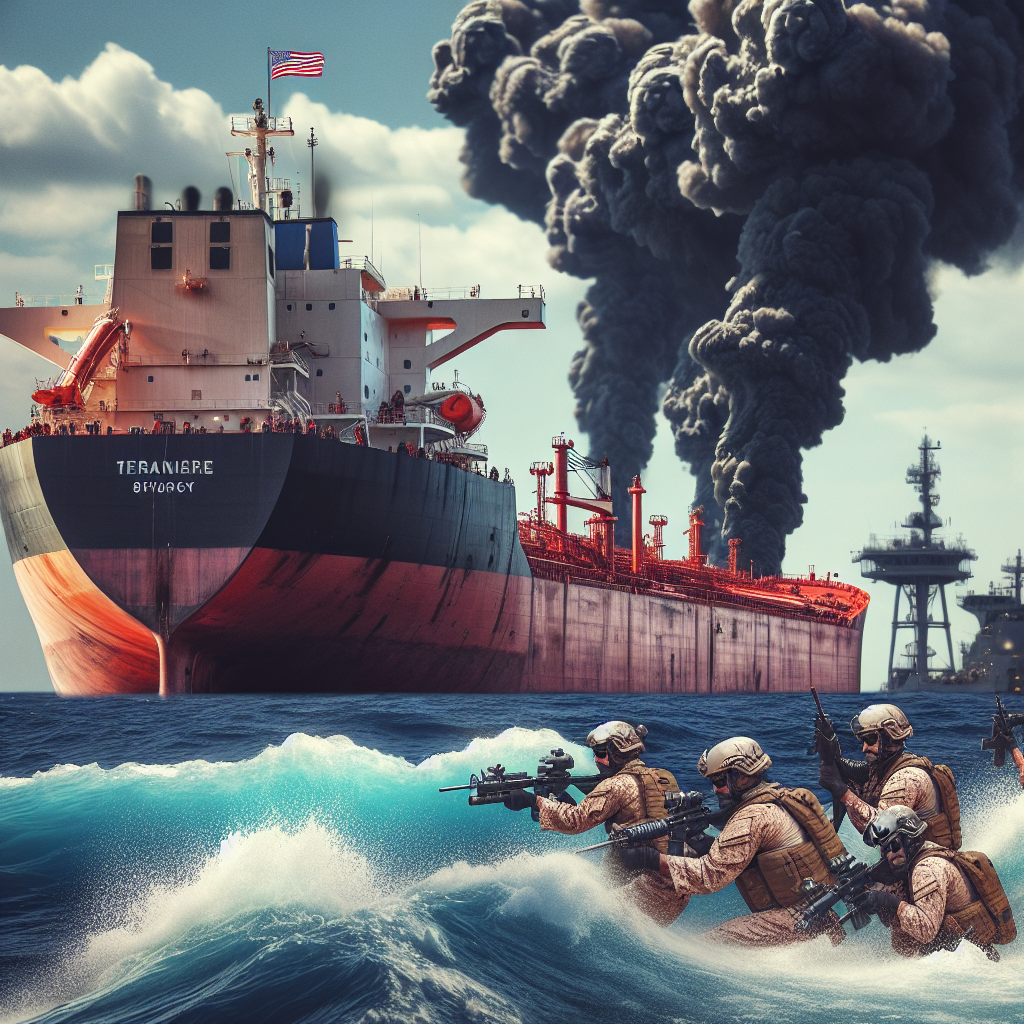
In recent international waters, there have been two consecutive unusual interception incidents. One took place in the Caribbean Sea, where the U.S. military directly intervened and seized a super tanker carrying Venezuelan crude oil. The other occurred in the Indian Ocean, where U.S. special forces boarded a cargo ship departing from China en route to Iran, and confiscated the goods on board.
At first glance, these two events may seem unrelated: one involving oil, the other involving cargo; one in the Americas, the other in Asia.
However, when looking at these two incidents together, it’s not hard to see that there is a more crucial player behind the scenes – the U.S.-China confrontation is unfolding a new drama.
Starting with these two maritime operations, we can see how the Trump administration is simultaneously taking action in different ocean regions to block the energy and logistical channels that support these regimes.
Let’s begin with the first incident.
On December 10th, the U.S. seized a super tanker carrying Venezuelan crude oil named “Skipttper” in the Caribbean Sea.
At that time, the 332-meter-long tanker was sailing in a zigzag pattern near the coast of Guyana, indicating an attempt to conceal its true trajectory. After obtaining relevant intelligence, U.S. special forces swiftly boarded the vessel from helicopters and took control.
Now, let’s delve into the background of this tanker. The “Skipttper” had previously appeared on the U.S. radar. Back in 2022, it had been included in the U.S. sanction list for transporting sanctioned crude oil from Iran and Venezuela.
White House Press Secretary Karoline Leavitt later confirmed that this operation was a legal enforcement approved by the Department of Justice, reflecting the implementation of government sanction policies. The tanker will be escorted to a U.S. port, and its cargo of 1.85 to 2 million barrels of crude oil will be formally confiscated after completing legal procedures.
The Wall Street Journal disclosed that the market value of this oil batch is approximately $80 million. President Trump himself commented, stating that this oil shipment will be “left behind,” and the U.S. government will continue to enforce sanctions without leniency.
This is the first direct seizure of Venezuelan oil cargo since the U.S. implemented comprehensive sanctions against Venezuela in 2019.
In the past, the U.S. had typically frozen accounts, sanctioned companies, and blocked intermediaries. However, this time, the oil tanker along with its cargo were seized.
What does this step signify? Why is it said that this move truly strikes at the heart of the Maduro regime?
The U.S.’s seizure operation signifies an escalation in the Trump administration’s strategy of pressuring the dictator Maduro by cutting off oil revenue.
For Venezuela, oil is not just an industry but its lifeblood. Crude oil comprises over 90% of Venezuela’s export revenue, so where does its foreign currency come from? How does its economy operate? How does it make imports? It heavily relies on this.
This time, the U.S. did not freeze accounts, sanction intermediaries, or issue warnings as before. Instead, they directly seized the “goods.” This significantly intensified the impact.
The Wall Street Journal mentioned that such seizure actions would have a greater impact on Maduro than past military operations targeting drug trafficking. This move triggers a “survival-level” issue: without cash flow, how can the regime sustain itself?
Imagine if such seizures become routine, what would happen? Firstly, Venezuela would only be able to sell oil at significantly discounted prices to a limited number of buyers. Why? Because there would be fewer willing buyers due to increasing risks. This means cutting into already meager revenue.
Secondly, it would have to tap into depleting foreign exchange reserves to curb domestic inflation and sustain imports. But eventually, it would lead to societal supply shortages.
The Wall Street Journal also mentioned a detail: the value of the oil cargo on that ship is equivalent to about 5% of Venezuela’s monthly import expenditure on commodities. Do not underestimate this 5%; for an already fragile country, this could imply shortages of medicines, food, and essential goods.
Therefore, Fernando Ferreira, geopolitical affairs director of Rapidan Energy Group, stated that the U.S.’s actions against the oil industry could destabilize the Venezuelan regime. The Trump administration’s moves are aimed at building a larger poker chip to force Maduro out.
Francisco Rodríguez, a Venezuelan economist at the University of Denver, mentioned that if the U.S. seizes an oil tanker every month, resulting in a significant decrease in oil revenue, it would push Venezuela into an economic recession.
Moreover, subsequent actions swiftly followed. On December 11th, the U.S. Treasury announced sanctions on three of Maduro’s family members, six shipping companies, and six vessels involved in transporting Venezuelan crude oil. This clearly indicates that it’s not just about seizing one ship but rather aiming to pinpoint and cut off the entire shipping chain.
U.S. officials hinted that this is just the beginning. More vessels may be directly seized, and the U.S. will conduct large-scale military deployments in the Caribbean region to deal fatal blows to drug trafficking vessels, possibly even considering airstrikes on Venezuela.
Interestingly, following the announcement of the seizure, even without the regular seizure of more oil tankers by the U.S., the threat itself was enough to make the shipping industry collectively hit the brakes.
On December 11th, outside Venezuela’s main oil port, over ten oil tankers were queuing up, but not a single vessel dared to enter the port for loading. Under normal circumstances, this port would have been bustling, but now it seemed as though it had been paused.
Shipping industry personnel mentioned that ship owners, operators, maritime agencies were on high alert, reevaluating routes urgently. Even port staff in Venezuela experienced situations of taking sick leave or absenteeism.
Just imagine, a regime relying on oil for sustenance suddenly finds its entire supply chain tense – what does this mean for Maduro?
Therefore, on December 8th, Trump mentioned in an interview that Maduro’s days are numbered and clearly stated that sanctions would be continued. This was not just rhetoric but paired with actions that were already underway.
At this point, it becomes evident that the U.S.’s true aim is not just to “seize oil shipments” but to turn Maduro’s regime’s oil cash flow, on which it heavily relies, into a high-pressure valve that can be cut off at any moment.
This raises the question: who does Venezuela mainly sell its oil to?
Here, we need to mention Venezuela’s “shadow fleet.”
With Venezuelan crude oil under sanction, mainstream traders, regular shipping companies, and international insurance systems had almost entirely withdrawn. Stepping in were a vast “shadow fleet” comprising around 1,000 aging oil tankers. These vessels not only carried Venezuelan oil but also ran errands for Russia, Iran, other sanctioned countries. Many of these ships themselves faced U.S. sanctions.
These older vessels were registered under complex information, lacked formal insurance, and frequently manipulated automatic identification systems (AIS) to disguise their true trajectory, making it appear as if they were sailing far away, sometimes even hoisting false flags or using registration information of other vessels.
Experts pointed out that these vessels often transferred cargo to other ships at sea, further concealing the source of the goods.
This strategy wasn’t originated by Venezuela. Juan Matias Szabo, a retired Venezuelan oil executive living in Spain and working as an energy consultant, mentioned that after the U.S. tightened punitive measures in 2019, aiming to cut off Maduro’s financial sources, Venezuela learned from its sanctioned allies like Iran and Russia on using black market oil tankers.
And to whom was this oil ultimately sold? The answer inevitably leads to China.
Szabo estimated that this shadow fleet helped Venezuela transport over 600,000 barrels of oil daily to a few willing markets, with much of this oil mixed with other countries’ oil before being sold. The largest and most stable final market is none other than China.
Data confirmed this fact.
According to shipping data company Kepler, Venezuela exported approximately 749,000 barrels of crude oil per day this year, with at least half of it heading to China.
Reuters reported that before the oil tanker seizure this week, in November, Venezuela exported about 952,000 barrels of oil and fuel per day, with approximately 80% destined for China either directly or indirectly.