
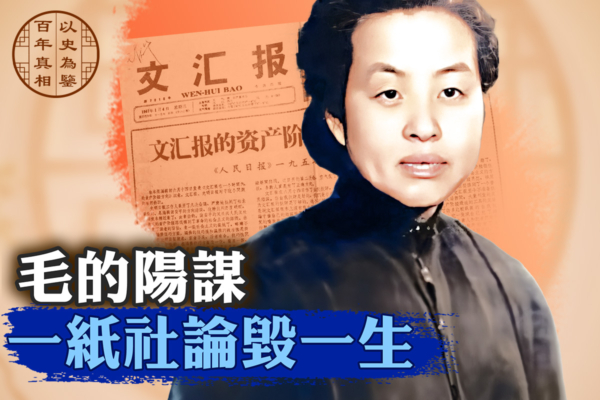
Today we are going to talk about the story of female journalist Pu Xiu Xiu.
During the Republic of China era, she was a renowned journalist, one of the four most prominent female journalists in the Republic of China’s news industry. She worked for the “Xin Min Bao” and “Wen Hui Bao,” writing many influential reports.
She was the second sister among the Pu’s family of three sisters. Zhou Enlai once affectionately referred to her as “Sister Pu Er.” Her eldest sister, Pu Jiexiu, studied in Germany and became an entrepreneur. Her younger sister, Pu Anxiu, married Peng Dehuai, who later became a Marshal of the Chinese Communist Party.
After the establishment of the Communist government in 1949, Pu Xiu Xiu became a target of the Communist Party’s “united front,” participating in the Party’s founding ceremony.
However, in 1957, Pu Xiu Xiu was manipulated by Mao Zedong during the “anti-rightist” movement, becoming a tool for Mao to target and persecute individuals, leading her to a mental breakdown and accusing her intimate lover of regrettable actions.
In the spring and summer of 1957, Mao Zedong launched what he called a “sunburst conspiracy” anti-rightist movement, starting by “luring the snakes out of their holes” and then “eliminating them together.”
Initially, Mao personally called on democratic parties to provide opinions to help the Communist Party rectify itself. To dispel the democratic parties’ concerns, Mao even promised, “Speak freely, speak exhaustively, those who speak have no crime, those who hear should take heed.”
Many intellectuals believed in this seemingly open and sincere approach, opening up and suggesting ideas, falling into Mao’s trap.
Mao Zedong swiftly changed his tune, issuing a secret order titled “Organizing Forces to Counterattack the Rampant Attacks of Rightists,” targeting those who dared to speak the truth.
According to official Communist Party data, over 550,000 people nationwide were labeled as “rightists.” Declassified central archives show that over 3.17 million were identified as rightists, with an additional 1.43 million labeled as “centrists”; many others were classified as “internally controlled rightists,” “suspected rightists,” “right-leaning,” and so on.
This movement not only destroyed the futures of countless intellectuals but also enveloped the entire society in fear, marking a turning point from relatively free expression for Chinese intellectuals to high-pressure control.
Mao’s first target in the anti-rightist movement was to convert the democratic parties, comprised of senior intellectuals, into tools of the Communist Party.
The first to face this was the Chinese Democratic League (referred to as the Min League). Before the establishment of the Communist government, the Min League was the third largest party besides the Kuomintang and the Communist Party. After the Communist Party came to power, the Min League became the most influential among the eight democratic parties.
Mao believed that once the Min League was in line, the other democratic parties would follow suit. Vice-Chairmen of the Min League Central Committee, Zhang Bojun and Luo Longji, became the first targets of Mao’s “anti-rightist” movement.
Zhang Bojun held a Ph.D. in philosophy from Germany, and Luo Longji held a Ph.D. in political science from the United States and England. Both had served as university professors after returning, representing senior intellectuals who had studied Western freedom, democracy, and constitutional governance.
Zhang Bojun and Luo Longji, under the repeated persuasions of Li Weihan, the head of the CCP’s United Front Work Department, provided suggestions to the Party. Zhang suggested the establishment of a “Political Design Institute,” advocating for the participation of the Political Consultative Conference, People’s Congress, and the democratic parties in policy-making; Luo proposed the establishment of a “Rehabilitation Committee” to supervise and correct errors during movements such as the Three Anti, Five Anti, and anti-rightist campaigns.
These were well-intentioned suggestions but were viewed by Mao Zedong as “big snakes coming out of their holes.” Immediately, he branded them a “Zhang Luo Alliance,” labelling them as the number one and number two “anti-party, anti-people, anti-socialist” big rightists in the country. Their experiences became typical cases in the entire anti-rightist movement and shook countless intellectuals.
As the movement unfolded, Zhang Bojun quickly surrendered, while Luo Longji initially denied being anti-party.
Mao Zedong had ways to deal with Luo Longji. One of them was to use Pu Xiu Xiu, Luo’s “girlfriend” of ten years, as a pawn to force him into submission. Because a close confidante knew the most secrets and had the most influence.
The relationship between Pu Xiu Xiu and Luo Longji dated back to the late 1940s. They met during the Republic of China era when Luo Longji was a renowned scholar and politician, and Pu Xiu Xiu was a talented female journalist. They shared similar interests and developed an intimate relationship.
After the Communist Party came to power, Pu Xiu Xiu had been a target of the Communist Party’s united front, receiving praise from Mao Zedong, serving as a member of the National Committee of the Chinese People’s Political Consultative Conference in the second to fourth terms, Vice Editor-in-Chief of the “Wen Hui Bao” and head of the Beijing office, while also serving as a substitute member of the Central Committee of the Chinese Democratic League and a member of the National Women’s Federation.
However, in the political storm of the Communist Party, no one was spared.
On July 1, 1957, the People’s Daily published an editorial drafted by Mao Zedong titled “The bourgeois direction of Wen Hui Bao should be criticized,” publicly targeting Luo Longji and Pu Xiu Xiu.
The editorial stated that aside from Zhang Luo Alliance, which included Zhang Bojun and Luo Longji, there was also another leader, Pu Xiu Xiu, in charge of the Beijing office of Wen Hui Bao, referring to her as a “capable female general” and claiming that Luo Longji-Pu Xiu Xiu-Wen Hui Bao editorial department was a Min League rightist system.
In March 1957, Mao personally praised “Wen Hui Bao.” However, a few months later, Mao placed “Wen Hui Bao” in contempt and directly linked Luo Longji to Pu Xiu Xiu.
Mao Zedong’s statements triggered a full swing in propaganda machinery.
“Wen Hui Bao” quickly issued a series of lengthy articles criticizing Pu Xiu Xiu, demanding that she “thoroughly confess and apologize to the people.” Her colleagues accused her of “obeying Luo Longji’s every command,” “obeying his orders in all aspects,” and “rejecting anything that Luo Longji opposed.”
Faced with such attacks, Pu Xiu Xiu initially tried to defend herself, stating, “Wen Hui Bao” is entirely a people’s newspaper, receiving infinite care and help from the Party. “Some say that there is a connection between ‘Wen Hui Bao’ and Luo Longji, which is not in line with the truth.”
However, as the criticism deepened, spanning from Mao Zedong to her colleagues from “Xin Min Bao,” “Da Gong Bao,” current colleagues from “Wen Hui Bao,” as well as editors, journalists from other party newspapers and magazines, National People’s Congress members, members of the Political Consultative Conference, and even family members, they collectively mounted a fierce onslaught against Pu Xiu Xiu, leaving her breathless.
She had to retreat step by step, repeatedly reviewing, admitting mistakes, and expressing regret, but she could not pass through.
Her psychological defense finally crumbled, and this process was filled with inner struggles and helplessness.
On July 10, at a news work symposium, Pu Xiu Xiu “revealed the relationship between Luo Longji and Wen Hui Bao” and exposed Luo Longji’s aspirations to become Minister of Foreign Affairs, Minister of Justice, Minister of Higher Education, etc. after 1949; on July 19, she disclosed that Luo Longji often said, “‘Long live the Communist Party, long live Chairman Mao,’ is the most nauseating thing to say.”
After being criticized in the National Committee of the Chinese People’s Political Consultative Conference and in the journalists’ association for a month and a half, in August, Pu Xiu Xiu was transferred to the Min League Central Committee as a “killer” to criticize Luo Longji.
At the August 1957 criticism rally against Luo Longji, Pu Xiu Xiu made her final speech, titled “Luo Longji is a Wolf in Sheep’s Clothing.”
Starting with Luo Longji’s family background, Pu Xiu Xiu exposed his aristocratic origins, the family being cleared out by the Communist Party, his parents deceased, and the widowed sister-in-law who managed the household being criticized. Luo Longji claimed he was raised by the widowed sister-in-law since childhood, and he had to support her and his nephews and nieces by sending money back home every month. Pu Xiu Xiu stated that this alone proved Luo Longji’s “deep-rooted class hatred towards the Communist Party.”
So why was Luo Longji called a wolf in sheep’s clothing?
Pu Xiu Xiu continued to reveal that he mistreated the family’s female nurse, “was brutal like a wolf towards the working class.” She then exposed Luo’s helping a newspaper company boss, indicating that he was “gentle with the capitalist class like sheep.”
She also said that Luo Longji’s conspiracy against the party and socialism was consistent, emphasizing that even if his bones were reduced to ashes, those ashes would still be anti-party and anti-socialism.
Pu Xiu Xiu and Luo Longji had been close friends for a decade, and she genuinely loved, respected, and admired him. However, with a flick of Mao’s finger in a campaign against the rightists, she plummeted into an abyss. Under the relentless attacks like waves of violent storms, she was thrown into tumult, severing ties with Luo, turning against him.
Pu Xiu Xiu’s exposure and criticism of Luo Longji were for her own defense. However, no matter how she exposed, criticized Luo Longji, even revealing their private conversations, she was ultimately unable to escape hardship. In the end, she was branded as an “anti-party, anti-people, anti-socialist” rightist by the Communist Party.
In the spring of 1958, she was stripped of all her roles in the news industry, bringing an end to her 20-year career as a journalist.
The tragedy did not end there. In 1965, Pu Xiu Xiu was diagnosed with rectal cancer, underwent surgery, but experienced a relapse the following year, necessitating hospitalization. When the Cultural Revolution erupted, the Red Guards criticized her, expelled her from the hospital, claiming hospitals did not treat rightists.
The Red Guards repeatedly searched her home, seizing her savings, jewelry, and Qi Baishi paintings. The house she rented became a Red Guard command post, filled with materials. In such an environment, she could not recuperate.
At that time, she had nowhere to escape. Her siblings were being tormented physically and emotionally. Her brother-in-law had died in a cowshed, her eldest sister was badly beaten, and her younger sister’s family was also in distress. She could only stay at home, suffering from the disease. Fortunately, a kind neighbor helped care for her.
As Pu Xiu Xiu’s health deteriorated, she became weaker, holding no attachment to the world, removed the tubes inserted by doctors to save her, closed her eyes, and quietly passed away.
That year, she was 60 years old.
Mao Zedong’s launch of the anti-rightist movement was a major disaster for Chinese intellectuals, almost destroying the country’s intellectual elite in a man-made catastrophe.
The objective historical fact is that there was no such thing as a “Zhang Luo Alliance” in 1957, nor did the “Luo Longji-Pu Xiu Xiu-Wen Hui Bao editorial department” exist as a “Min League rightist system.”
How pitiful it is that under immense political pressure, a generation’s prominent female journalist, Pu Xiu Xiu, lost herself and became a tool for Mao’s repression.
-Production Team of “Century Truth”