
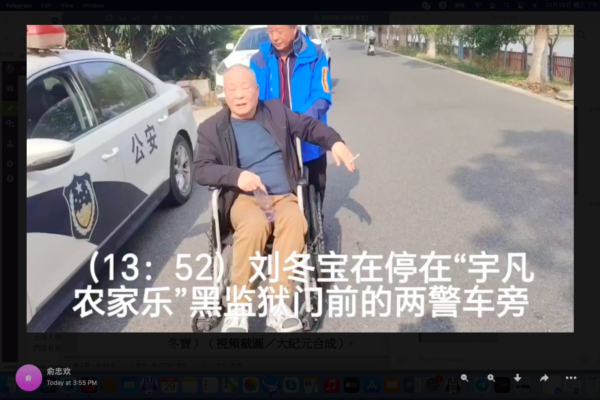
Shanghai’s Jing’an District resident Liu Dongbao was abducted to the Hei Prison on July 26 and was forced to undergo persecution for 92 days, resulting in him being unable to walk. Both the police station and the local police claimed that the abduction was a “government action” and refused to file a case. Liu Dongbao, with the support of 136 fellow petitioners, applied for information disclosure from the district government. However, the response he received was that the application was not considered under the government’s information disclosure regulations.
The response given to Liu Dongbao by the Jing’an District government in an “Notice” stated, “After review, the requested information in the letter belongs to petition information. According to Article 39, paragraph (4) of the Shanghai Government Information Disclosure Regulations, the application is not considered for government information disclosure.” They further informed Liu Dongbao and the 136 individuals that they could file an administrative lawsuit with the Third Intermediate People’s Court if they disagreed.
Prior to submitting the information disclosure request, the spokesperson for the Shanghai Hei Prison, Song Jiahong, had anticipated this outcome. He mentioned, “This ‘Notice’ serves as a government document, its basis being Article 39, paragraph (4) of the Shanghai Government Information Disclosure Regulations. So, what specific content does it entail? Is it ‘the requested content falls under petition information’ or ‘conducting a petition in the form of a government information disclosure request’? Thus, it is not considered for government information disclosure processing.”
Song Jiahong believed that the content of the “Notice” was ambiguous. “There are two facts that need clarification: first, we did not go through the petition process, so how can it be considered a petition? Second, we focused on requesting government information regarding the expenses related to Liu Dongbao’s 92 days in the Hei Prison, which is not considered a petition. The government is trying to use ‘petition’ as an excuse to dodge the issue.”
He also added, “Experienced petitioners often say that it is extremely difficult to win against the government in legal battles, and this is true. District leaders rely on their performance for promotions, and any actions that could hinder their advancement will trigger their resistance. If we sue in the Third Intermediate People’s Court, it is unlikely to be rejected; however, after filing, they probably won’t schedule a public hearing. Having a district leader as a defendant facing 136 plaintiffs is an embarrassing situation that does not align with the current circumstances, and ultimately, they will dismiss our lawsuit using the ‘petition’ lie.”
Liu Dongbao was summoned by the police on July 26 for urging the EU President to pay attention to the human rights situation in China. He was then kidnapped by black security guards at the police station and detained at the Yufan Nongjiale Hei Prison on Chongming Island for 92 days. When he was released on October 24, he had lost the ability to walk due to injuries sustained during his time in the prison.
While in the Hei Prison, Liu Dongbao was violently attacked by black security guards, almost suffering severe injuries. The reason given by the police for not filing a case was again cited as a “government action.” Song Jiahong expressed, “This was a premeditated retaliatory attack, as Liu had participated in advocating for the EU President to pay attention to China’s human rights situation and had also shouted ‘Down with the Communist Party’ on June 6 within the police station. This had intensified the authorities’ resentment towards him. Normally, under the summons procedure, Liu should have been sent to a detention center, but he ended up in the Hei Prison. It’s a classic move by the CCP government to use the black security guards as tools to carry out violent acts.”
A Shanghai petitioner, Ms. Ma, stated, “In a civilized rule of law society, citizens have the right to lodge complaints, demonstrate, criticize the government and officials, and resist unlawful infringements. In a country ruled by law, the prevalence of official and criminal collusion is a defining feature of this era, turning people not into citizens, but into slaves constantly subjected to bullying, exploitation, insult, and brutal oppression.”
“In today’s Shanghai and even across the entire country, the acts of officials and criminals backpedaling, acting recklessly, oppressing the people, and even resorting to brutal slaughter are beyond dark, with no end in sight! In such a country, where the government dares to claim democracy and rule of law, the profound darkness and shamelessness displayed surpasses anything seen in the history of all dynasties, ancient and modern from East to West,” she stated.