
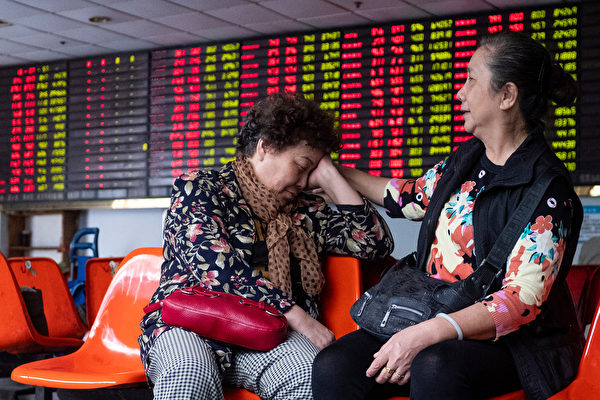
On December 16th, the A-share market experienced a significant drop in trading volume, with the Shanghai Composite Index falling below 3400 points. Amid the continued downturn in the stock market, China’s pension funds are entering the market at an accelerated pace. According to official reports, it is projected that by 2030, the cumulative amount of pension funds entering the market will reach approximately 11.29 trillion yuan, accounting for 28% of the newly added market capitalization of A-shares. Behind this trend is the growing gap in pension funds.
The A-share market witnessed a drop in trading volume on December 16th. The Shanghai Composite Index closed down by 1.11% at 3824.81 points; the ChiNext Index fell by 2.1% to 3071.76 points, and the Shenzhen Component Index declined by 1.51%. Both the CSI 300 and the SSE 50 fell by over 1%, while the STAR 50 Index dropped nearly 2%.
According to the International Financial News, the trading volume of A-shares on that day decreased by 46.3 billion yuan compared to the previous trading day, reaching 1.75 trillion yuan. 4302 individual stocks fell, with 36 stocks hitting the limit down.
The report pointed out that the profit-making effect in the stock market is weakening. However, there is still enthusiasm from leveraged funds, with margin balances in Shanghai and Shenzhen exceeding 2.51 trillion yuan as of December 15th.
Against the backdrop of the ongoing slump in the A-share market, pension funds are being pushed towards the capital market.
According to the China Business News, the “2025 China Pension Development Report” recently published by the Chinese Academy of Social Sciences predicts that by 2030, the scale of China’s pension funds will reach 28.22 trillion yuan, with the cumulative amount entering the market around 11.29 trillion yuan. By then, the proportion of pension funds entering the market will rise to 28% of the newly added market capitalization of A-shares, indicating that nearly a third of the future long-term funds entering the market may come from the pension system.
The report emphasizes that this data is for long-term forecasting and not a one-time or short-term injection.
China’s pension system consists of three parts: basic old-age insurance, enterprise annuities and occupational annuities, and individual pension plans.
According to official data from the Communist Party of China, by the end of 2024, the investment scale of basic old-age insurance funds, enterprise annuities, and occupational annuities had all exceeded 2 trillion yuan, achieving double-digit growth.
By the end of 2023, the number of individuals with pension accounts had surpassed 50 million, but only 20% of them had actually deposited funds, with an average savings of around 2000 yuan per person.
The pension gap in China is growing. As early as March 2011, during the Two Sessions, Zhang Yunling, a member of the National Committee of the Chinese People’s Political Consultative Conference, revealed to Phoenix Online that China’s pension funds had already reached a deficit of 1.6 trillion yuan. In May of the same year, a National Development and Reform Commission official, Zhou Nan, called for “exploring flexible retirement systems” and delaying the retirement age.
In November 2020, the China Insurance Association released a “Third Pillar Pension Research Report,” predicting a pension gap in China ranging from 8 trillion to 10 trillion yuan over the next five to ten years, a gap that is expected to further widen over time.
The International Monetary Fund (IMF) has forecasted that the economic downturn in the coming years will further impact the pension system.
Chinese expert Wang He told The Epoch Times that China’s social security system, especially in terms of old-age insurance, faces structural problems and may struggle to sustain itself without fiscal support. He mentioned that although there are currently surpluses, they may gradually deplete over time.
Facing an increasingly severe pension crisis, the recent Central Economic Work Conference of the Communist Party of China proposed allowing “flexible employees and workers in new employment forms” to participate in employee insurance. Employee social insurance is characterized by high premiums and compulsory contributions.
Chinese capital market expert Xu Zhen recently told The Epoch Times that authorities are considering allowing flexible employees and workers in new employment forms to participate in employee insurance mainly due to the accelerated aging of the population and the growing pension gap, which requires the involvement of flexible employees to ease current financial pressures.
Xu Zhen believes that the current pay-as-you-go system for pension funds, coupled with increasing rates of non-payment among young people and the influx of retirees, could significantly accelerate the pension crisis well before expected.