
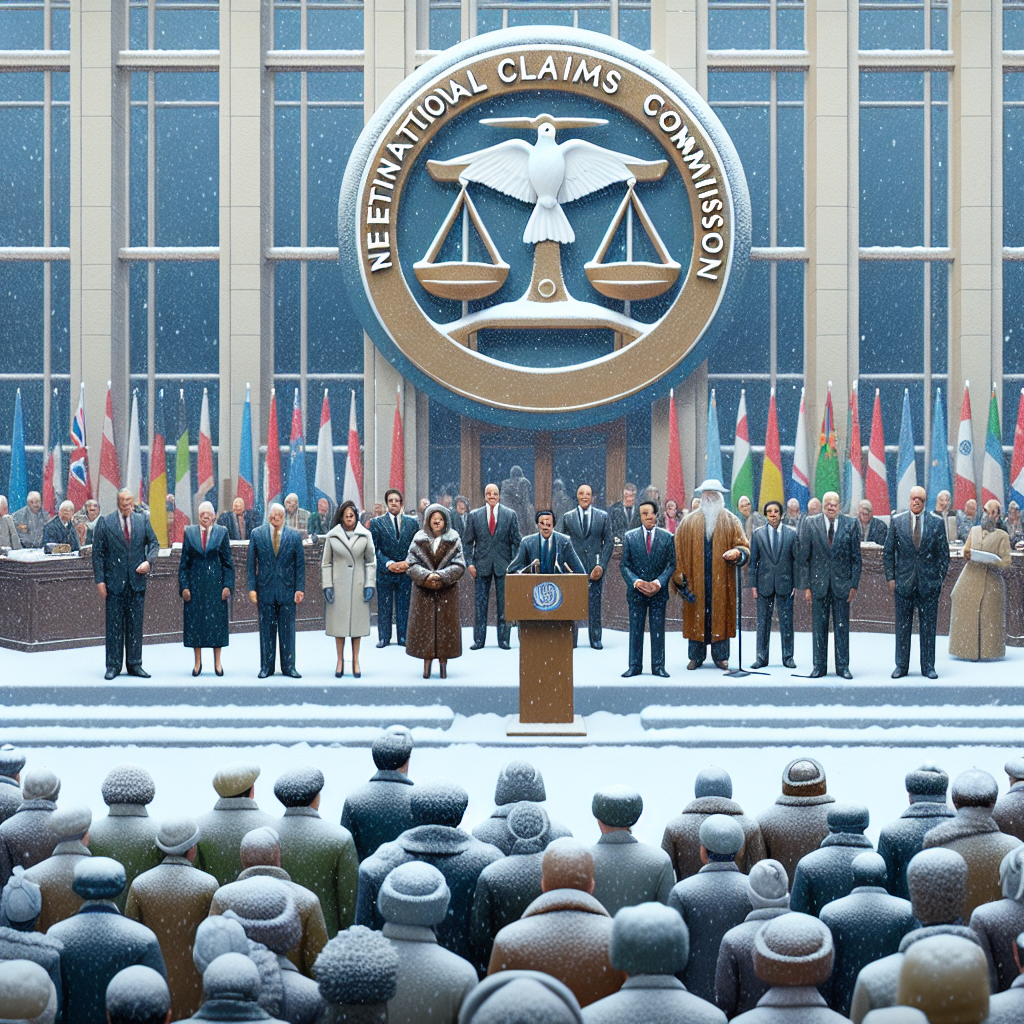
On December 16, 2025, as the United States and Europe intensify efforts to push for a ceasefire negotiation between Russia and Ukraine, multiple European countries announced on Tuesday in The Hague, Netherlands the official launch of the “International Claims Commission” to hold Russia accountable for the war in Ukraine and establish a systematic framework for compensating the massive losses incurred by the conflict.
Viewed as a crucial step for Europe in addressing the issue of “post-war responsibility and compensation” as the Russia-Ukraine war potentially heads towards a ceasefire, the commission is co-hosted by the Netherlands and the Council of Europe, which has 46 member countries. The headquarters of the commission is expected to be based in The Hague, and it aims to process individual, corporate, and national-level claims submitted by Ukraine regarding Russian aggressive actions, with compensation amounts potentially reaching billions of dollars.
Ukrainian President Volodymyr Zelenskyy is set to attend a one-day meeting held in The Hague together with European leaders to collectively kick off this initiative.
The establishment of the “International Claims Commission” marks the second phase of the international compensation mechanism for the Ukraine war, with its core mission being to review, assess, and adjudicate claims cases, and determine compensation amounts based on individual circumstances.
As part of the first phase, the Council of Europe had established the “Register of Damage” in 2023, responsible for collecting and preserving various war damage claims data.
The Council of Europe stated that the register has already received over 80,000 claims applications, including claims from individuals, businesses, organizations, and government institutions within Ukraine, covering bodily harm, property losses, and other violations of international law.
According to the World Bank’s estimation, the reconstruction cost for Ukraine in the next 10 years is approximately $524 billion, which is almost three times the country’s economic output in 2024. However, this figure only includes losses up to December 2024 and does not account for the additional damages caused by Russia’s escalated attacks in 2025 targeting utilities, transportation, and civilian infrastructure.
Currently, over 50 countries and the EU are jointly drafting a convention under the framework of the Council of Europe, which will serve as the legal basis for the commission’s establishment. The convention requires approval from at least 25 signing countries and sufficient funding support for its operations before becoming effective.
Sources informed Reuters that up to 35 countries are expected to sign the convention at the meeting on Tuesday.
The timing of the launch of the International Claims Commission coincides with a critical moment in the U.S.-supported peace negotiations.
On Monday, following talks in Berlin with Ukrainian and European leaders, the U.S. proposed providing Ukraine with security guarantees similar to NATO’s Article 5 as one of the conditions for ending the war. Ukraine indicated willingness to abandon its goal of joining NATO if provided with legally binding security assurances.
However, territorial issues remain the primary hurdle in the negotiations. The U.S. hopes for Ukrainian concessions in the eastern Donetsk region, while Zelenskyy has repeatedly emphasized that Ukraine will not legally or factually recognize Donbas as part of Russia.
Meanwhile, Russia has yet to show willingness to compromise on core territorial demands.
Reuters pointed out that progress in peace negotiations may lead to institutional tensions regarding the post-war compensation mechanism. If future peace agreements incorporate amnesty clauses for wartime atrocities, the European plan to compensate victims may face legal and political challenges.
Allegations against Russia for violations during the war include sexual violence, forced child deportations, and destruction of religious sites.
Regarding funding sources, European officials revealed that frozen Russian sovereign assets by the EU are being considered as a potential option for compensation funds. However, further political and legal negotiations are required for such arrangements.
Russia has not formally responded to the establishment of the Claims Commission but consistently denies war crimes committed by its military during the war.
Meanwhile, the conflict between Russia and Ukraine continues with both sides recently launching drone attacks, indicating that despite diplomatic efforts, the battlefield reality remains intense.
The Ukrainian Air Force reported that from Sunday night to Monday, Russia launched 153 different types of drones at Ukraine, with 133 intercepted or malfunctioned, and 17 hitting their targets.
On the Russian side, the Ministry of Defense announced on Monday that Russian forces destroyed 130 Ukrainian drones at night; between 7 a.m. and 8 a.m. local time, 16 additional drones were destroyed.