
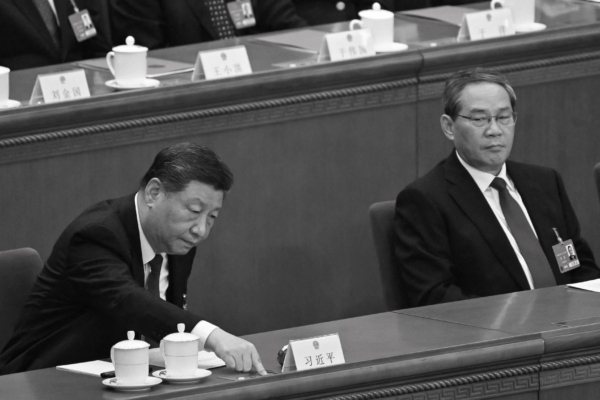
【Epoch Times News, December 16, 2025】Last week, the Beijing Central Economic Work Conference concluded, and the official Chinese Communist Party media recently published a speech by the CCP leader Xi Jinping, revealing rare self-criticism within the party of “impetuous advancement” and blasting local officials for engaging in achievements projects and disorderly behavior. Analysts believe that these issues such as economic padding and unfinished projects have become so severe that they are threatening the stability of the regime.
On the front page of the CCP’s People’s Daily on December 14th, a speech by the CCP leader Xi Jinping at the Central Economic Work Conference was published. In his speech, Xi referred to the emergence of new forms of image projects and achievement-driven projects in the CCP officialdom, criticizing instances of “improperly large development zones in some places, disorderly development of exhibitions and forums in other places,” as well as “falsification of numbers,” false project starts, and “paper economy”…
Xi declared the need to “pursue genuine and solid growth without any padding,” and emphasized the need to seriously hold accountable those engaging in hasty advancement, excessive escalation, and disorderly behavior.
He mentioned the “Fifteen-Year Plan,” emphasizing the need to prevent projects from being completed and then abandoned, and investments from being made only to result in failure.”
In recent years, the prevalence of unfinished projects resulting from excessive construction in the CCP has been widespread, while economic data manipulation has long been acknowledged by the authorities.
Political commentator Li Lin told Epoch Times that this indicates that problems such as economic padding and unfinished projects have become so serious that they are now threatening the stability of the regime, forcing Xi Jinping to shift blame onto lower-ranking officials. However, he stressed that the emergence of new forms of image projects indicates underlying contradictions and shows that Xi’s tactics are not fooling anyone.
The Central Commission for Discipline Inspection of the CCP National Supervisory Commission website revealed on December 30, 2021, that from January to October 2021, a total of 247,000 cases of inadequate implementation of Xi Jinping’s “important instructions and directives” and the “major decisions and deployments of the central government” were uncovered and rectified nationwide. This is seen as a significant manifestation of widespread soft resistance within the officialdom against Xi.
Gong Xiangsheng, a researcher at the Taiwan Institute for National Defense Security, noted that the authorities have rarely admitted to declining investment, often resorting to padded growth figures or simply not mentioning declining external investment in government work reports during the Two Sessions. However, he believes that due to national security concerns, the authorities’ scope for action remains limited, making it difficult to restore investor confidence.
Bloomberg believes that this statement reflects Xi’s focus on the quality of economic growth and the use of fiscal resources, “especially at a time when rising local government debt has constrained the government’s ability to stimulate economic activity through spending.”
On December 15, the National Bureau of Statistics of China released macroeconomic data for November, indicating a comprehensive deterioration in China’s economy in multiple areas.
Among the figures, the total retail sales of social consumer goods amounted to 4.3898 trillion yuan, showing a significant 1.6 percentage point drop from October, with consumer growth slowing for six consecutive months.
According to Central News Agency reports, consumption, a key driver of economic growth, has been weak in China, with retail sales growth plummeting from 8.0% in December 2019 to 1.3% in November 2025. Household consumption in China accounts for about 40% of GDP, much lower than the over 60% levels seen in developed countries.
China’s fixed-asset investment declined by 2.6% in the first 11 months of this year, greater than the 1.7% drop seen from January to October, and is expected to record its first annual decline since data has been recorded since 1998.
Real estate investment saw a 15.9% year-on-year drop from January to November, surpassing the 14.7% decline seen from January to October. The average housing prices in 70 large and medium-sized cities dropped by 2.8% in November, compared to a 2.6% drop in October. The sales area of new commercial housing nationwide was 78.702 million square meters, down by 7.8% annually, with sales revenue amounting to 751.3 billion yuan, marking an 11.1% decline.