
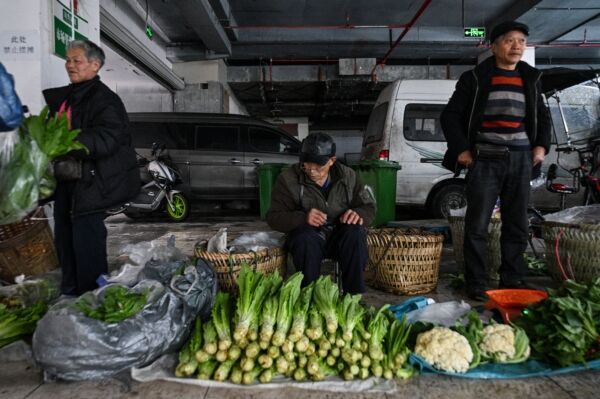
Under the rule of the Chinese Communist Party (CCP), social security has long been criticized for neglecting the needs of the lower-income population. As the economy continues to decline, unemployment rates rise, and the gap in social security funds widens, the just-concluded CCP Central Economic Work Conference has explicitly stated the encouragement of “flexible employees and those in new forms of employment” to participate in employee insurance. Analysis suggests that the pension gap in China is growing, and the CCP needs flexible employees to fill the hole.
The two-day Central Economic Work Conference concluded on December 11th. The conference stated the implementation of a stable job expansion and quality improvement action, stabilizing employment for key groups such as college graduates and migrant workers, and encouraging and supporting flexible employees and those in new forms of employment to participate in employee insurance.
According to “The First Financial,” Zhang Chenggang, Director of the New Forms of Employment Research Center in China, stated that the number of flexible employees and those in new forms of employment has exceeded 200 million. A portion of migrant workers, flexible employees, and those in new employment forms have difficulty directly participating in the traditional unit-based social security system due to unclear labor relations, flexible work arrangements, unstable income, among other reasons, leading to prominent issues of underinsurance, dropping out of insurance, and discontinuation of insurance in this group.
Zhang Chenggang also mentioned that currently, most flexible employees and those in new forms of employment do not entirely lack social security coverage but are covered under the lower level of resident social security that does not align with their income levels and job nature.
Employee social security is mandatory, including pension insurance, unemployment insurance, industrial injury insurance, medical insurance, and maternity insurance, with the majority of costs covered by the employer each month, while employees also bear a portion of the expenses. Resident social security is paid independently based on individual status, including medical and pension for residents.
On December 11th, the topic labeled “encouraging support for flexible employees to join the employee insurance” briefly trended as the second hottest topic on Weibo.
Some netizens expressed opinions such as “It’s not that flexible employees need social security, but that social security needs flexible employees,” “Don’t touch anything that gets encouraged,” “Don’t do anything encouraged,” “In the past, they didn’t allow payment, now they encourage it,” “If unemployed, what will they use for payment,” “Is it a subsidy or mandatory?”, “Can’t afford meals anymore, no job.”
After China News Network officially reported the above content on their official Weibo, a large number of netizens rushed in with comments, leading to the opening of a selected comment section.
The so-called flexible employment is a recent term coined by the CCP, including part-time, freelancers, self-employed individuals, and labor dispatch, among others. It is considered to be essentially a form of precarious employment, akin to semi-unemployment, used to disguise the actual unemployment figures, as was the case in the past with terms like layoff and jobless.
In March 2021, the then Chinese Premier Li Keqiang mentioned the emergence of “flexible employment” in China, involving over 200 million people. According to the National Bureau of Statistics, by the end of 2021, the number of flexible employees had reached 200 million. As of today, the CCP still refers to 200 million as the number of flexible employees. Additionally, a new term, “those in new forms of employment,” has been introduced, referring to individuals engaged in new forms of employment based on internet platforms, such as food delivery riders, express delivery personnel, ride-hailing drivers, and more.
On December 12th, mainland capital market veteran Xu Zhen told Epoch Times that the current “flexible employment,” “part-time employment,” and “insufficient employment” concepts are essentially replacing unemployment. The massive layoffs caused by the state-owned enterprise reforms in the 1980s resulted in a significant amount of unemployment, referred to as “being laid off” rather than unemployment. “In reality, these people have no secure livelihood, struggling day-to-day for survival. Isn’t this unemployment?” Xu asked.
He mentioned that the CCP has developed a rhetoric system within the party culture, confusing concepts, logic, and thoughts, aiming to manipulate public opinion without constraints, fabricating lies to brainwash the people.
Regarding the CCP’s clear encouragement for flexible employees and those in new forms of employment to participate in employee insurance, Xu Zhen stated that the primary reason is the escalating aging population and the increasing pension deficit (including personal accounts being misappropriated), necessitating flexible employees to fill this gap. Currently, the CCP operates a pay-as-you-go pension system, sustainable for a few more years. However, with the persistent increase in young people ceasing payments and the retirement wave approaching, the pension crisis will erupt prematurely, leaving the CCP in a precarious position.
Chinese issues expert Wang He told Epoch Times that China’s employee social security system has significant issues, especially with pensions. “Without fiscal support, this system would have collapsed long ago. It can continue operating currently due to substantial financial subsidies, showing a surplus, but this surplus will soon be depleted. This is why the CCP has taken two measures: extending the retirement age and increasing the number of years for social security contributions – from the previous 15 years to 20 years.”
However, the funds remain inadequate, leading to expansion with more people contributing, including the calculation of these 2 billion flexible employees, a policy pushed in recent years. Wang He highlighted that the high contribution rate for employee social security is not cost-effective, so flexible employees opt for resident social security, paying as low as 100 yuan per year. “After paying for 20 years, the amount one can receive is uncertain. Therefore, many people, especially the younger generation, are unwilling to make these payments,” he stated.
Wang He further explained that the pension insurance for flexible employees and those in new forms of employment requires them to contribute entirely on their own. After 20 years of payment, the eventual payout amount remains undetermined. As a result, many individuals, particularly the younger population, are reluctant to make these contributions.