
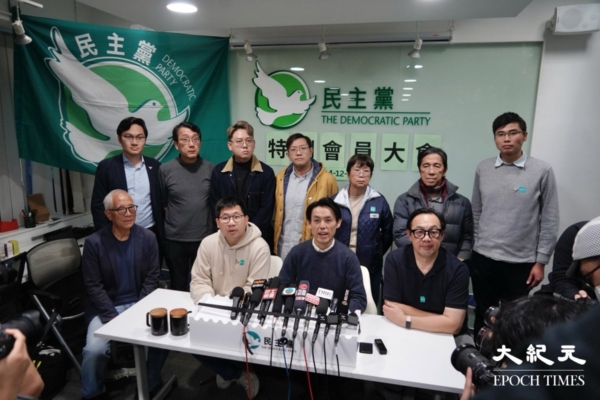
Under political pressure, another group has made its way into history. The Democratic Party held a special membership meeting today (14th), passing a resolution to dissolve and wind up.
The meeting had 121 eligible voters, with 117 in favor of voluntary liquidation, no objections, and 4 blank votes. The party appointed Wai-hang as the liquidator, with the remaining assets donated to the Industrial Accident Victims Rights Association chaired by Chin-shik.
The last chairman of the party, Kenny, and party members held a press conference after the meeting. He stated that over the years, the Democratic Party has witnessed significant changes in the system time and time again. “The changing times have brought us to reluctantly draw an end today,” he said. He mentioned that not every decision made by the party over the past 30 years had the full approval of the citizens, but each one was about finding the best solution under limited conditions.
“After 30 years of ups and downs, the Democratic Party has come to the moment to put an end. But the beliefs and persistence of these 30 years will leave a mark in Hong Kong’s history.”
He also noted that over the years, the Democratic Party has been committed to the well-being of the citizens, advocating for the promised universal suffrage in the Basic Law, providing advice on livelihood issues, and becoming a bridge between the government and the people.
Kenny expressed gratitude to those who had supported and criticized the Democratic Party citizens, volunteers, colleagues, and friends. He expressed his hope that in the future, all citizens would “maintain kindness, honesty, integrity, strive to live each day well, protect themselves and those around them,” and wished every Hong Kong citizen peace, cherish, and goodbye.
Kenny mentioned that supporters and core members are fully aware of the current difficulties. They had tried all means in the past to seek democracy, believing that promoting democracy is different now. “We have made efforts to walk this path. By today, we feel that we can’t proceed further, we have to accept that our abilities can only go this far.” As for moving forward, it depends on each individual. As long as everyone believes that free elections and democracy are important, they will find a way.
At the meeting, party members expressed reluctance. Kenny mentioned that the Democratic Party headquarters on Nathan Road in Prince Edward would vacate by the end of the year and is expected to be cleared by December 31. He did not specifically consider the actual time for liquidation, but if not completed a year later, another membership meeting would be called, and he does not want that situation to arise.
As the last chairman, he said that the Democratic Party has been trying to participate inside and outside the system for the past 30 years, engaging in elections, civil society, believing that the representative system can solve problems, and still believing that disputes can make things clearer. Currently, many things are becoming top-down, less from bottom-up, which is not ideal. He hoped that society would allow spontaneous actions from the bottom up.
He also mentioned that the Democratic Party’s dissolution today does not mean they will “start a new one”, individual members will focus on various organizations on different issues, a choice of their own. But he has no intention to “start another one” if possible, “I will continue to do my best to stay in Hong Kong,” “I don’t know what I can achieve or not. But I believe that I can continue on this path with the people of Hong Kong.”
Former party chairman, Yang, also stated that there is no intention to reorganize or “re-brand,” expressing the commitment to staying in Hong Kong to speak for the powerless.
When asked if there are concerns about risks from national security after the liquidation, Kenny stated that it is something “beyond our control, and if such a thing happens, we can’t stop it, we have no way to predict it.”
Asked if democracy has died, Kenny indicated that if the citizens believe democracy is the way for Hong Kong, they will continue to strive, it is also a promise in the Basic Law, and he believes they should stay hopeful. As for why they had to dissolve instead of continuing their work, Kenny mentioned that dissolution went through many considerations, some of which he couldn’t articulate, but he indicated that “the overall political environment doesn’t make it easy to continue, and the current arrangement is the best for the members and committee.”
Regarding suggestions for the Hong Kong government, Kenny has been advocating for a more open-minded approach to different opinions from the government, which is essential for the functioning of society.
Kenny advised that for the remaining organizations, they should do their part wholeheartedly, with honesty, integrity, and kindness in their hearts, many issues would not turn into problems. He also cited the example of the fire at Amoy Plaza, stating that if people had acted with the aforementioned qualities, the disaster could have been prevented.
The Democratic Party was founded with the belief of “democratic return.” Vice-chairman, Yang, said that the dissolution of the Democratic Party reflects a regression in Hong Kong from a free society to an authoritarian one. The past success of Hong Kong relied on rule of law, a semi-democratic political system, civil society, press freedom, and respect for individual freedoms. He still believes that if the “one country, two systems” could be implemented openly, it would still be feasible for Hong Kong.
Yang did not consider “democratic return” as a complete failure but rather as “halfway there.” He pointed out that in the past, the central government was relatively open in implementing “one country, two systems,” but the dissolution of the party represents a turning point. He hopes that the central government sees the current effects this has brought about, moving towards openness, which would lead to a better future for Hong Kong. He also hopes that the government respects the citizens, especially the demands of the younger generation, “We must not lose hope for democracy.”
Regarding the dissolution, Yang mentioned that there is no sentimentality. The efforts made with the people of Hong Kong for democracy, freedom, and the rule of law had “tangible results.” Over 60% of the citizens supported the democratic camp, and they will continue to strive for a hopeful tomorrow. He indicated that the democratic aspirations are deeply rooted in the hearts of the citizens, and under pressure, these demands will not disappear.
Former chairwoman of the Democratic Party, Liu, and founding member Lee also attended the earlier special membership meeting today. Liu stated that the Democratic Party had been actively working for Hong Kong, so it was hard to accept such an ending, finding it “quite odd.” She mentioned that Hong Kong’s freedom has been shrinking, and she hoped it wouldn’t diminish further.
Lee was tearful after the meeting, expressing regrets over the dissolution of the Democratic Party. However, as the central authorities did not listen to other voices, and with increased pressure on the Party’s committee, he reluctantly supported the dissolution, mentioning he had never thought he would face such a situation.
Established in 1994, the Democratic Party, originally formed from the Hong Kong Alliance founded by Martin, Johnson, and others in 1990, merged with the Meeting Point in October 1994, becoming the largest party in the Legislative Council. In February of this year, the party announced the start of the dissolution process, holding a special membership meeting in April, officially authorizing the Central Committee to follow up on the dissolution matters.
Since its establishment three years before Hong Kong’s return to China in 1997, the Democratic Party has been a prominent opposition party in Hong Kong. In the past, the party often won major victories in the overall Legislative Council elections and advocated for democratic reforms and the protection of freedoms.
Previously, some party members told Reuters that they had been contacted by Chinese officials or intermediaries and were informed to dissolve the party organization, or they would face severe consequences, including possible arrests.