
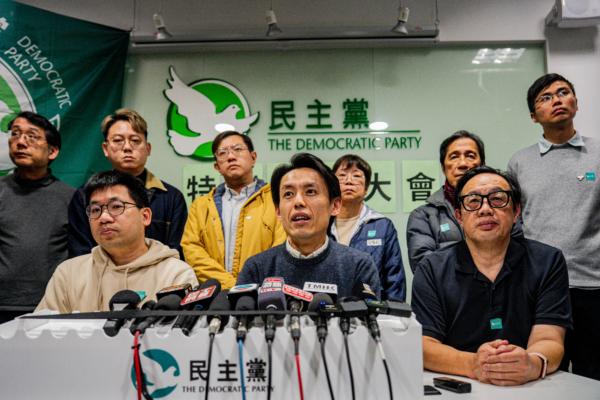
In Beijing, under the continuous tightening of political space in the name of national security for many years, the longest-standing pro-democracy party in Hong Kong – the Democratic Party officially announced its dissolution on Sunday (December 14). This marks another opposition party exiting the political stage in Hong Kong, symbolizing the end of the era of moderate democratic participation that has lasted nearly thirty years since the handover of Hong Kong sovereignty.
Democratic Party Chairman Lo Kin-hei stated after a special membership meeting that there were 121 votes participating in the decision, with 117 in favor of dissolution and 4 abstentions. He said during the meeting, “It has been our greatest honor to walk with the people of Hong Kong for thirty years. We have always put the well-being of Hong Kong and its citizens first.”
Several senior party members had previously revealed to Reuters that they had been approached by Chinese Communist Party officials or intermediaries who exerted pressure to demand the Democratic Party’s self-dissolution, warning of serious consequences, including possible arrest if they did not comply. The Hong Kong Liaison Office did not respond to requests for comments on this matter.
Established in 1994 by figures like Martin Lee, known as the “Father of Hong Kong Democracy”, the Democratic Party has been the most influential pro-democracy party in Hong Kong both before and after the handover of sovereignty. It has long been leading in legislative council elections and has been a driver for democratic reforms and the preservation of freedoms.
Since the 2019 “anti-extradition bill” protests, Beijing imposed the so-called “National Security Law for Hong Kong” in 2020, resulting in the arrests of a large number of pro-democracy figures, disbandment of civil society groups, and shutdown of media outlets. The Democratic Party also faced severe setbacks with several of its key members including Wu Chi-wai, Albert Ho, Helena Wong, and Lam Cheuk-ting being detained or sentenced.
In 2021, Beijing further reshaped Hong Kong’s electoral system, requiring all candidates to be pro-Beijing, consequently, the Democratic Party was unable to field candidates in legislative council elections. In the recent Legislative Council elections where the Democratic Party also could not run, it was completely excluded from the political stage at the institutional level.
Former Democratic Party Chair Emily Lau expressed deep regret over the dissolution, questioning why an organization that had done so much for Hong Kong had to end in such a manner. She pointed out that Hong Kong has never had genuine democracy and raised concerns that the “One Country, Two Systems” framework is continuing to shrink.
With the exit of the Democratic Party, there are no longer significant opposition parties in Hong Kong. The Civic Party dissolved in 2023, and the League of Social Democrats announced in June this year that it would cease operation.
The dissolution of the Democratic Party reflects the restructuring of Hong Kong’s political landscape under Beijing’s dominance towards a singular direction, making it difficult for dissenting voices to find space within the system.
The day following the announcement of the Democratic Party’s dissolution, the founder of the widely watched Next Digital media, Jimmy Lai, will also face the verdict in his national security case, drawing more attention to the future political environment in Hong Kong.