
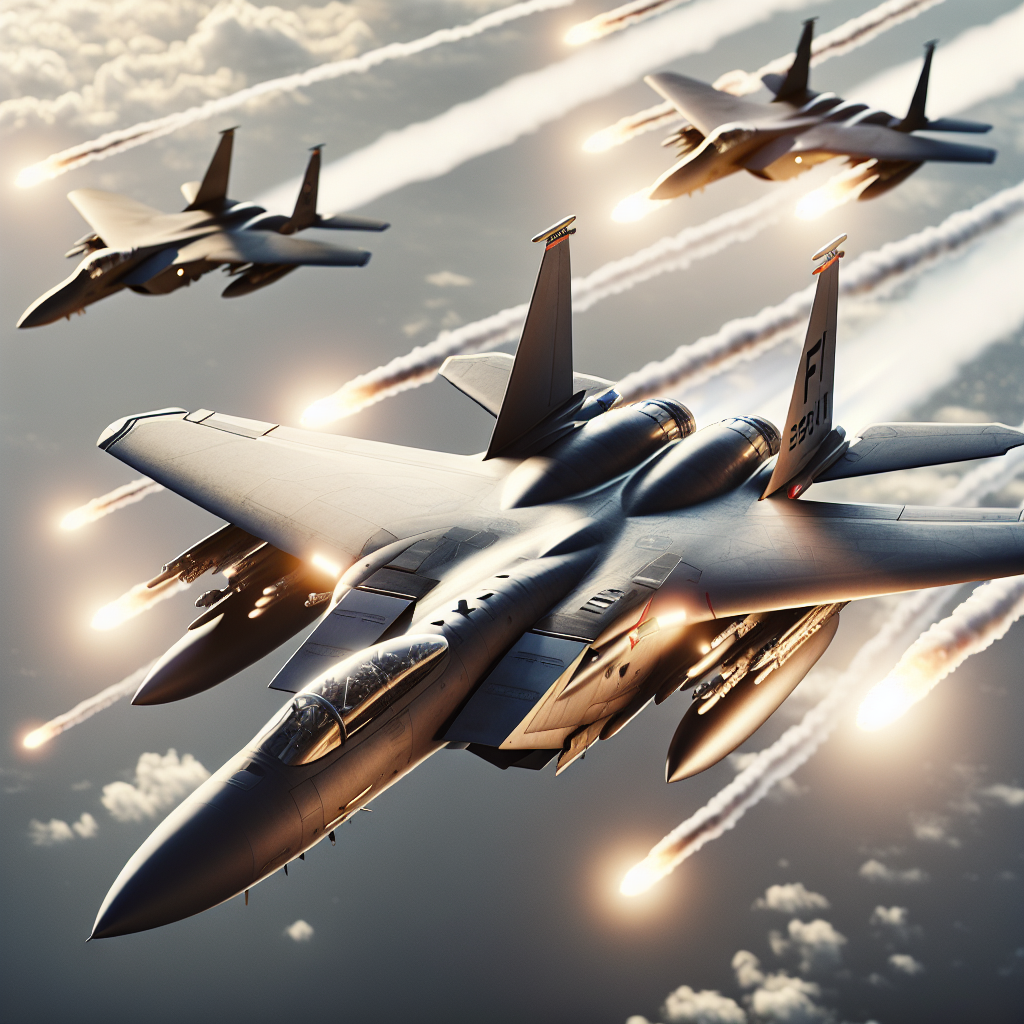
The F-15EX “Eagle II” fighter jet has proven that, despite being considered older compared to fifth-generation fighter jets, it remains indispensable in high-end air combat. This aircraft boasts powerful firepower, surpassing that of fifth-generation stealth fighters. Should there be a prolonged conflict between the US and China, the F-15EX’s formidable firepower suppression capabilities could provide the US military with a significant advantage.
The F-15E is a fourth-generation fighter that has been soaring through the skies for decades. The latest variant, the F-15EX “Eagle II,” has officially entered service with the US Air National Guard in Oregon, aiming to deploy a high-capacity strike and weapon-carrying platform. This move is part of the US Air Force’s efforts to address combat capability gaps and to find a relatively affordable supplement to the F-35 fighter.
The F-15EX is the latest upgraded version of this platform, initially introduced in the 1970s as an air superiority fighter before evolving into the versatile “Strike Eagle” multi-role fighter. Equipped with the AN/APG-82 active electronically scanned array radar and EPAWSS electronic warfare system, the F-15EX has an effective payload of approximately 29,500 pounds. It is designed for missions that require long-range strike capabilities rather than high maneuverability fighter tasks. The delivery of the F-15EX aims to carry and launch various beyond visual range weapons, serving as a high-capacity missile carrier supporting stealth aircraft and bomber platforms.
The “Eagle II” retains the range, twin engines, and effective payload of the F-15E but incorporates modern sensors and equipment, making it capable of fulfilling current combat missions. It represents a long-range, high-capacity branch in the “Eagle” series.
On November 21, as four US Air Force F-15EX “Eagle II” fighter jets flew over Eglin Air Force Base in Florida, US Air Force Secretary Troy Meink sat in the rear seat of the leading aircraft, emphasizing the US military’s regard for this aircraft. This flight allowed Meink to personally understand the testing and evaluation processes that shape the future of the Air Force’s combat forces.
As the US shifts its focus to high-end conflict scenarios, continuous firepower and breaking through anti-aircraft systems are equally crucial, making the role of the F-15EX increasingly important.
Based on the “Advanced Eagle” airframe, the F-15EX is equipped with modern avionics, including the AN/APG-82 active electronically scanned array radar, infrared search and track sensor, and a new electronic warfare system (EPAWSS). The aircraft also features redesigned airframe structures and fly-by-wire flight control system.
These upgrades are essential in transforming a half-century-old fighter jet into a high-performance modern combat aircraft.
Powered by two F-110-GE-129 or GE-132 engines, each providing 29,000 pounds of thrust, the F-15EX can reach a top speed of Mach 2.5. It has a range of 1,200 miles and a service ceiling of 60,000 feet. With an almost 30,000-pound effective payload capacity, it is the largest among active US fighter jets, enabling it to carry multiple beyond visual range air-to-ground missiles in a single mission.
In today’s era where firepower is crucial, this aircraft continues to demonstrate its value.
Although the F-15EX may be older, it could potentially address a challenge currently faced by the US Air Force and Navy, at least in the interim.
Unlike low-observable aircraft with smaller internal weapon bays, the F-15EX can carry a large number of long-range weapons externally, while benefiting from advanced sensors and modernized defensive systems.
In an environment where China rapidly expands its naval vessels and missile arsenals, the US urgently needs to enhance its long-range strike capabilities. However, platforms capable of launching beyond visual range weapons are limited. The F-15EX’s sacrifice of stealth capabilities in exchange for formidable firepower fills this gap.
This aircraft offers more internal and external payload space than any other active US fighter jet and has repeatedly demonstrated its ability to deploy air-to-air missiles under test conditions. It even plans to integrate long-range air-to-ground missiles such as the AGM-158C LRASM.
Such upgrades will further enhance the aircraft’s capacity to conduct beyond visual range strikes against ships and surface targets.
As US strategic planners prepare for future conflicts with China and the Trump administration’s policy of “peace through strength,” the rapid launch of a large number of missiles is particularly crucial, serving as a deterrent force.
While the US possesses stealth fighters like the F-22 “Raptor” and F-35 “Lightning,” the production rate of stealth aircraft is still constrained by research and development, cost, and industrial limitations, resulting in a lag in constructing platforms capable of carrying long-range weapons.
Platforms like the F-15EX can serve as a complement to the US Air Force’s firepower. From a strategic perspective, the F-15EX enables the US Air Force to build a mixed fleet consisting of various complementary aircraft, indicating that although the modern trend is towards stealth, complete stealth may not be necessary.
In combat, a mixed force can use F-35 fighters for detection and targeting via sensor fusion and reduced emissions, while F-15EX jets can conduct long-range air-to-air salvo or beyond visual range strikes from safer off-board positions.
Modern warfare requires both precision strikes and firepower suppression. While the F-15EX “Eagle II” is not a new aircraft model, it can provide the required firepower suppression capability.
With its robust combat capability, high sortie rates, and high missile output capability, the F-15EX will help counter Chinese J-10, J-11, and J-16 fighters in terms of quantity.
The cost of a single F-15EX is comparable to that of an F-35A, but its mature airframe and systems result in significantly lower operating costs.
On November 21, under the leadership of Air Force Secretary Troy Meink, a formation of four US Air Force F-15EX “Eagle II” fighter jets flew over Eglin Air Force Base for the first time. This flight aimed to familiarize Meink with the tactical, technical, and procedural developments of the F-15EX being developed and improved by the 53rd Wing, including weapon performance, next-generation survivability, and next-generation radar, sensors, and network capabilities.
This flight not only highlights the US Air Force’s importance attached to this aircraft but also demonstrates how the F-15EX transitions from a testing platform to a frontline tool of US airpower.
Strategically, the demonstration in the skies over Eglin Air Force Base showcases how the F-15EX integrates into the US force posture in the Southern American continent corridor and the Indo-Pacific region.
In July of this year, the US Air Force’s 18th Wing, stationed at Kadena Air Base in Japan, confirmed the arrival of the F-15EX fighters, indicating that these aircraft would undergo integration and adaptation training at Kadena Air Base.
Kadena Air Base is a pivotal hub of US airpower located on Okinawa Island in the southwest of Japan. It forms part of the US strategy of the “First Island Chain,” aimed at restricting Chinese military activities in the Western Pacific in the event of conflict.
Kadena Air Base is also the closest US airbase to Taiwan (600 kilometers), considering China’s persistent threats of using force to take over Taiwan. The Pentagon plans to replace its existing 48 F-15C/D fighters with 36 new F-15EX fighters at Kadena Air Base, creating a high payload, high sortie-rate platform to directly support the US and its allies against China and North Korea.
(Some content in this article was referenced from a report by National Security Journal)