
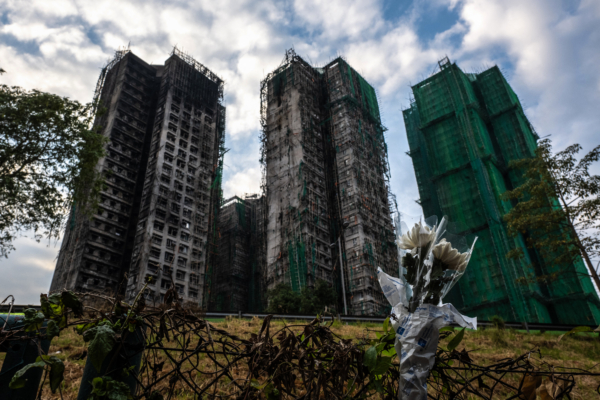
Hong Kong’s Horace Garden Level 5 fire has resulted in the loss of 160 lives, marking it as one of the most severe accidents in recent years. United Nations High Commissioner for Human Rights Volker Türk expressed deep concern over the Hong Kong government’s use of stringent national security laws to suppress demands for accountability and investigation into the fire.
He called on the Hong Kong government to withdraw the case and described the systematic erosion of human rights in Hong Kong, urging authorities to protect civic space. Türk issued a statement on Tuesday (December 9) offering condolences to the affected residents, emphasizing the importance of maintaining space for discussions and debates on issues concerning public interests during this tragic time.
In response to demands raised by Hong Kong residents, including the establishment of an independent inquiry commission to investigate engineering supervision negligence, holding government officials accountable, and continuous support for the affected residents, Türk highlighted the right of Hong Kong people to demand truth and accountability to ensure just compensation for the hundreds of victims and prevent such tragedies from recurring.
Authorities have provided assistance programs for affected residents, announced measures to remove hazardous materials from construction sites and revise fire safety regulations. An independent review commission has been established, and criminal and anti-corruption investigations related to the fire have been initiated, yet a comprehensive investigative commission with full powers has not been set up.
Calls from Hong Kong residents include demands for the establishment of an independent investigative commission to hold accountable those responsible for engineering oversights, urge government officials to take responsibility, and continue supporting the affected residents. However, reports indicate that Hong Kong’s stringent national security laws are being used to suppress individuals who publicly voice demands. Türk expressed deep concerns over the Hong Kong government’s use of these laws and urged authorities to drop related cases.
Türk further called for the abolition or significant revision of the National Security Law’s provisions to ensure full compliance with the International Covenant on Civil and Political Rights binding on Hong Kong. He reiterated that the national security laws imposed by the Chinese Communist Party in Hong Kong and the provisions of the National Security Law that came into effect in 2024 under Article 23 of the Basic Law were not in line with international human rights laws applicable to Hong Kong, particularly violating the principles of necessity and proportionality for restrictions on rights.
Türk pointed out that the cumulative effects of security-related laws reflect a systemic erosion of human rights in Hong Kong, including freedom of speech, association, and assembly. Hong Kong used to have a vibrant civil society where public policy debates were common, and press freedom was guaranteed. However, the framework of these laws allows for extended pre-trial detention, denial of bail, non-jury trials, asset freezing, increased surveillance measures, and extraterritorial application in cases with broad and often vague definitions of crimes.
He added, “The public’s support for the victims of the fire demonstrates the depth and resilience of Hong Kong’s civic spirit.” As part of the ongoing dialogue between the UN Human Rights Office and the Chinese authorities, Türk assured that they would continue engaging with Hong Kong authorities on these issues.
Following the fire, a “Tai Po Horace Garden Fire Concern Group” page was initiated for the Tai Po fire, launching a petition with four major demands, including the establishment of an independent investigative commission. On November 29, the National Security Department arrested one of the petition initiators, Miles Kwan, a Chinese University student, alleging him of “intentional incitement.” The National Security Office in Hong Kong issued a statement on the same day condemning the “anti-China and destabilizing acts of stirring up hatred against the government.” The next day, the National Security Department personnel arrested former district councilor Cheung Kam-hung.
On December 2, a civil group organized a “Public Forum on Hong Kong’s High-rise Maintenance Policy” to discuss support for disaster victims, the establishment of an independent investigative commission, government engineering supervision, and tendering issues. However, the forum was abruptly canceled, and Civil Human Rights Front chairperson Jimmy Lai and commentator Wang On-yin were “invited for a meeting” by the National Security Department. On the 6th, Wang On-yin was arrested by the National Security Department on charges under Article 88 of the National Security Law for “not obstructing investigations into crimes harmful to national security” and faced an additional charge of “knowingly publishing materials with seditious intent.” The case was brought before the West Kowloon Magistrates’ Court on Tuesday, with Wang On-yin applying for bail but was remanded until a further hearing in January next year.
Furthermore, Hong Kong held Legislative Council elections on December 7. Türk expressed concerns over the changes to the electoral system, reducing the proportion of directly elected seats to less than 20% of all council seats and systematically excluding opposition candidates through a review process.
Türk stated, “The forced dissolution of major political parties has effectively eliminated organized opposition forces.” He emphasized, “Political diversity not only promotes diversity and equality but also provides necessary checks and balances for democratic accountability within public institutions.” He believed that repealing measures that restrict political participation and suppress dissent will create an opportunity for Hong Kong to restore meaningful civic space.