
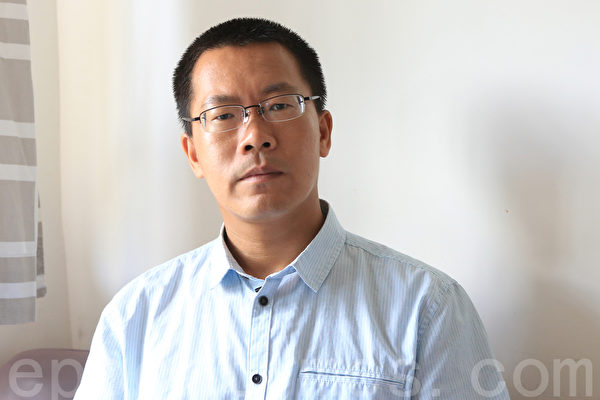
Prominent Chinese human rights lawyer Teng Biao, who is currently living in exile in the United States, recently gave an in-depth interview to the French newspaper “Libération,” analyzing the strict censorship under the Chinese Communist Party (CCP) and the political landscape in Hong Kong. He pointed out that the rule of the Xi regime has evolved into a “high-tech authoritarianism,” with the core goal of using digital technology to achieve “continuous control over every individual’s every move.”
Teng Biao, a doctoral graduate in law from Beijing and a well-known human rights lawyer, is also one of the early advocates of the “New Citizens Movement.”
According to Teng Biao, since the implementation of the “National Security Law” in Hong Kong, the essence of “one country, two systems” no longer exists. He describes Hong Kong as undergoing an “absorptive mainlandization,” where the decision-making processes and public security management are gradually aligning with those of mainland Chinese cities.
Citing the recent Hong Kong fire incident that resulted in at least 159 deaths, Teng Biao mentioned that the authorities arrested and held union activists accountable, reflecting the “typical governance problems of the mainland system: corruption, policy errors, and administrative failures.” He believes that regardless of significant events, the repression of civil society and activists by the CCP authorities will not cease, and the freedom and human rights in Hong Kong continue to deteriorate.
Teng Biao reviewed the development and collapse of civil society on the mainland. He pointed out that since 2013, the Xi regime has initiated a “comprehensive crackdown” on civil society. Thousands of non-governmental organizations have been forced to close or cease operations, tens of thousands of human rights defenders, religious figures, and petitioners have been arrested, and the censorship system has been significantly strengthened. The targets of suppression have even expanded to include Tibetan Buddhism, Uyghur Muslims, entrepreneurs, artists, and others. Today, “organizing protests or writing articles criticizing the CCP is extremely dangerous.”
Despite the harsh environment, Teng Biao and his partners continue to try to maintain activities abroad and in China on less contentious issues such as “domestic violence, the environment, and social rights.” However, they no longer dare to engage in demonstrations or radical artistic actions.
Teng Biao coined the concept of “high-tech authoritarianism” for the current CCP regime. He detailed how the Chinese government utilizes cutting-edge technology to establish an unprecedented surveillance system, including social credit systems, the Great Firewall, big data, artificial intelligence, facial and voice recognition technologies. Teng Biao emphasized that the level of surveillance by the CCP has “reached and in some aspects surpassed— the level of ‘1984’.”
In this system, “police can know your plans before you act and arrest you.” He concluded that the goal of Beijing’s digital authoritarianism is to “control every action of every person at every street corner, every moment.” Nonetheless, he believes that the “Blank Paper Movement” at the end of 2022 proved that people can still find space for resistance even under tight surveillance.
In summary, Teng Biao pointed out that the core logic of all actions of the CCP authorities is to “maintain power and safeguard the party-state system,” but ironically, “their policies are damaging the economy.”