
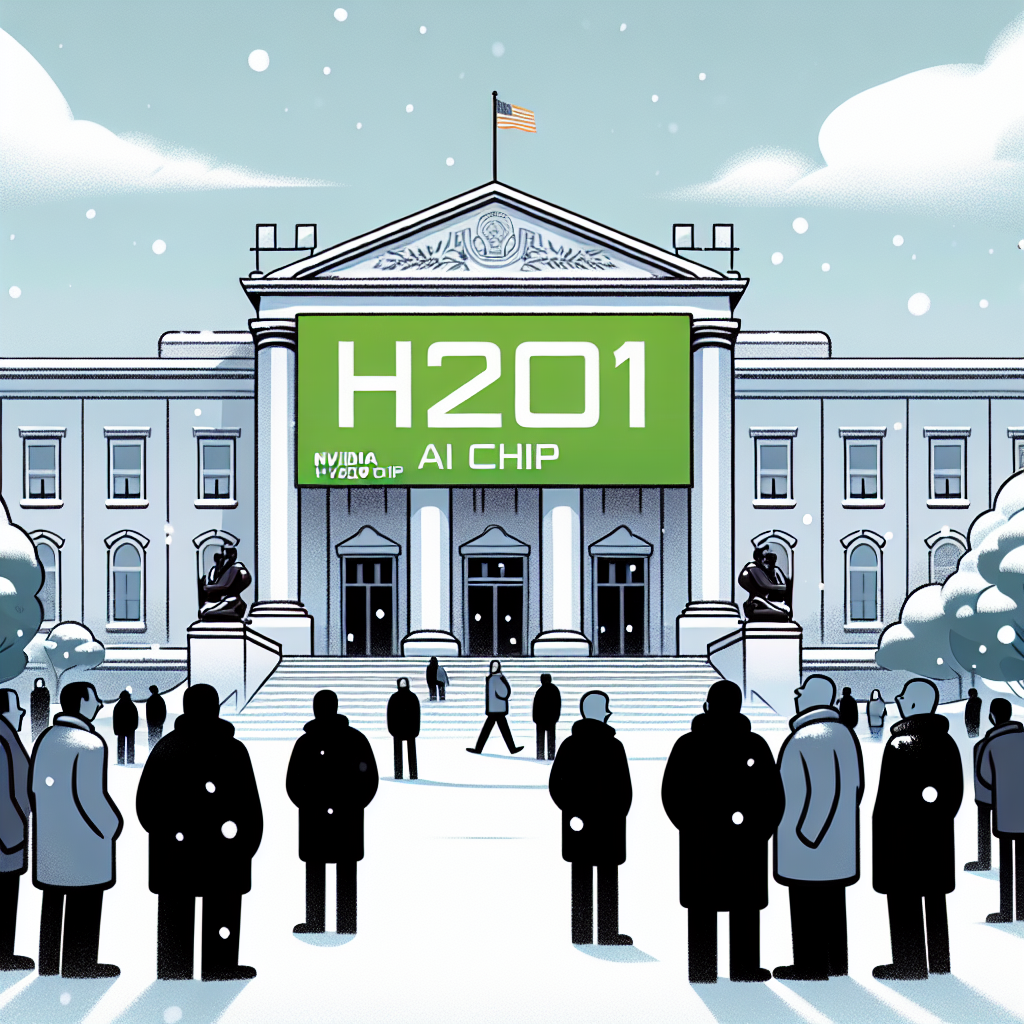
The White House defended President Trump’s approval of Nvidia’s sale of the H200 full-featured AI chip to China on Thursday, December 11, stating that the decision fully complies with national security policies and export control requirements. This move has sparked criticism from some members of Congress who are concerned that it will bolster the military capabilities of the Chinese Communist Party.
White House spokesperson Karoline Leavitt stated at a press conference on Thursday, “The current administration continues to maintain strict export control regulations. We will ensure that Blackwell chips and other advanced technologies remain in the United States. These H200 chips will only be shipped to China after undergoing security checks in the U.S.”
On December 8, Trump announced on the social media platform Truth Social that he had informed Chinese leader Xi Jinping that the U.S. would allow Nvidia to ship the H200 product to approved clients in China. He mentioned that Xi’s reaction was “positive.”
The President also mentioned that exports would take place under the condition of maintaining strong national security. A 25% fee will be levied on sales, and other U.S. chip companies will receive similar permits, but businesses still need to apply for export licenses and obtain approval from relevant agencies.
Prior to this, in response to the U.S. government’s export controls, Nvidia developed the H800 and H20 “downgraded” chips specifically for the Chinese market, corresponding to the weakened versions of the original H100 and H200 chips.
The latest Blackwell series chips produced by Nvidia and the upcoming Rubin chip will be prohibited from being exported to China.
A spokesperson for Nvidia commented on the issue, stating, “We commend President Trump’s decision, which promotes competition in the American chip industry, supports high-wage employment, and manufacturing. Providing the H200 to approved commercial clients reviewed by the Commerce Department is a thoughtful balance for the U.S.”
Trump’s decision has drawn criticism from some members of Congress. Several Democratic lawmakers, including Andy Kim, issued a joint statement claiming that the H200 chip “far exceeds the capabilities of products produced by China,” and allowing the H200 chip to be released will help Beijing enhance weapon efficiency, strengthen cyberattacks, and boost its economic manufacturing sector.
Republican Senator Tim Scott warned, “China will copy and steal AI chip technology, then mass-produce it, ultimately ending Nvidia’s position as a competitor.”
Chinese companies currently primarily rely on the H20 chip. The Trump administration briefly considered banning the export of H20 in April, withdrew the idea, and proposed imposing a 15% fee on sales of H20 in China, but it was never implemented.
After the U.S. relaxed its export policy on H20, Chinese officials, concerned that specially produced chips contained backdoors, summoned Nvidia to China to provide explanations and security assurances. Beijing also urged companies to reduce dependence on U.S. chips and seek alternative domestically produced products.
According to Jensen Huang, CEO of Nvidia, even though Washington relaxed regulatory policies, the company has not received any H20 orders from China.
The controversy over whether to export the full-featured AI chip to China highlights the escalating competition between the U.S. and China in AI.
While the Trump administration emphasizes that this decision is made within the framework of national security and is in line with U.S. economic interests, critics argue that imposing a 25% fee on sales cannot effectively offset the long-term risks posed by exporting the most advanced technological equipment to China.