
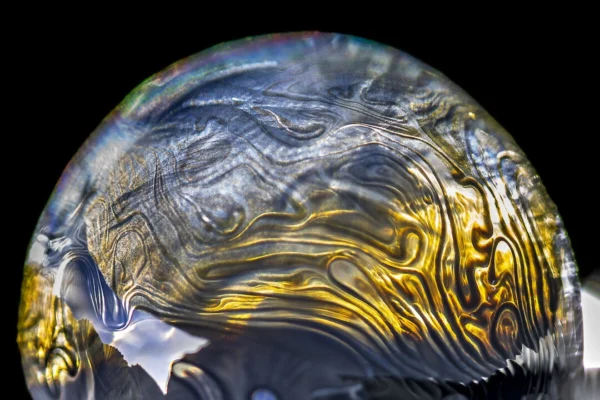
Capturing a frozen bubble may sound easy, but in reality, it is quite challenging. Base chef and photographer Justin Chambers shared how he managed to capture the mesmerizing photos of frozen bubbles in this icy wonderland, showcasing the magical phenomenon.
Some frozen bubbles resemble frozen feathers suspended in time, while others take on geometric patterns or look like miniature discs floating in space.
These beautiful frozen bubbles are extremely difficult to photograph as it requires shooting 20 to 30 shots in temperatures of minus 20 degrees Celsius (minus 4 degrees Fahrenheit) or lower to achieve a satisfactory result.
Even the slightest breeze or changes in environmental conditions can impact these delicate formations.
When Chambers saw a video of someone blowing frozen bubbles in cold regions, he knew he wanted to take on the challenge and turn it into a visual project.
“I tried shooting in open areas, but even a slight breeze could collapse or burst the frozen bubble before it freezes,” Chambers said in a statement.
“Then I tried using snow walls and ice walls, raising a table to the same height as my tripod.”
“Through a lot of trial and error, I eventually mastered the technique of quickly placing my equipment in the right position to capture the photos before everything (including myself) got too cold.”
These photos are the result of a perfect blend of lighting, temperature, and the bubbly mixture.
“During the shooting process, I often encountered freezing hands, damaged lenses, lighting challenges, and focusing issues,” Chambers said.
“I usually have to take 20 or 30 shots to get close to the effect I want.”
Speed is crucial as ice crystals typically form within 2 to 5 seconds after the frozen bubble is blown.
To capture their formation process, Chambers used a large aperture, high-speed macro lens, calling it an “exciting, nerve-wracking, and rewarding” process.
The photographer experimented with shooting during both day and night, each presenting its own set of challenges.
“When shooting at night, I tried out various flashlights (as light sources) with different brightness levels and positioned them at different distances from the bubbles,” he said.
“When shooting during the day, the sun would often be obscured by clouds or not in the desired position as a background, or the light wouldn’t be bright enough to capture the desired image.”
Behind Chambers’ beautiful photos lies the endurance of various hardships.
“My favorite photos are mostly scenes during sunset or sunrise,” he said.
“Every time I see the intertwining colors and crystal structures on the frozen bubbles, I am deeply captivated.”
Chambers approached capturing frozen bubbles as a photography challenge and his dedication shines through in the stunning imagery he has produced.
[Michael Brill/Australian Antarctic Division]
Chambers turned capturing frozen bubbles into a photography challenge.
[Brendan Sainty/Australian Antarctic Division]