
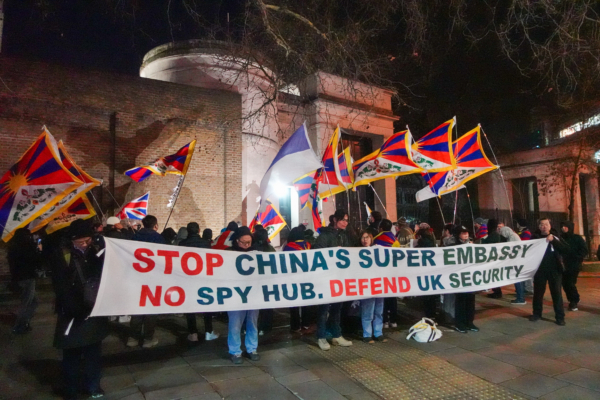
On the occasion of International Human Rights Day on Wednesday, December 10, various groups of Tibetans, Uyghurs, Hong Kongers, Taiwanese, and others in the UK gathered outside the former Royal Mint Court in London where the Chinese government seeks to establish a new embassy. They protested against China’s plans to set up a super embassy there, opposed cross-border repression, called for the release of political prisoners from Hong Kong and mainland China including the former leaders of the disbanded Support Alliance, Lee Cheuk-yan and Chow Hang-tung, and remembered those persecuted and killed under the rule of the Chinese Communist Party, as well as at least 160 people who died in the devastating fire at Hon Fook House in Tai Po.
The rally began at 6 p.m. with about a hundred participants chanting slogans like “Free Hong Kong,” “Free Tibet,” “Free East Turkistan,” “Keep Taiwan Free,” and “Xi Jinping, Shame on you.”
Representatives from various groups gave speeches, with the General Secretary of the Hong Kong Confederation of Trade Unions, Mung Cho-dah, urging the UK government to reject the establishment of a super embassy by the Chinese Communist Party. He emphasized the need to prevent a dictatorship from expanding its influence and persecuting or threatening dissidents living in the UK, stating, “We cannot allow transnational repression to be legalized, as it silences dissenters through fear.”
Mung recalled the tragic fire at Hon Fook House in Tai Po last month that claimed the lives of at least 160 people, attributing the deaths not to an accident but to a man-made disaster. He led a minute of silence in honor of the victims.
He explained that prior to the tragedy, residents of Hon Fook House had raised concerns about fire risks and corruption to the government multiple times, only to be repeatedly ignored by the authorities with low democratic accountability. Under political repression, he noted that “there is no longer a civil society organization that supports them in Hong Kong, no longer an independent media that holds the government accountable, no longer a political party that fights for them. In the end, 160 people died in a fire that could and should have been avoided.”
He also mentioned the innocent lives lost in the 2022 Urumqi fire in Xinjiang due to epidemic control policies, as well as the schoolchildren who perished in the shoddy construction of schools during the 2008 Wenchuan earthquake, urging everyone to “remember all the lives taken by greedy and corrupt authoritarian regimes and continue to fight for the dignity and safety of the living.”
The remarks of Mung Cho-dah prompted a response from the Uyghur representative, who mentioned the 1994 Karamay fire in Xinjiang, where 325 people, including 288 primary and secondary school students aged between 6 and 14, died due to officials prioritizing the evacuation of leaders during the blaze.
She stated that the tragedy in Tai Po resonated with her, emphasizing that such incidents and accidents have been occurring continuously and should not be normalized. She asserted the need to speak out and seek justice for those who perished, framing them not as accidental deaths but as disasters caused by the Chinese Communist Party’s rule.
The representative of the Uyghurs called out the Chinese Communist government as the one committing genocide against their people and other ethnic minorities, with over a million Uyghurs and others being arbitrarily detained in so-called “vocational training centers” that are effectively massive concentration camps. She detailed the forced sterilization and abortion of Uyghur women, the separation of families, and the criminalization of religious practices under a high-tech surveillance network designed to erase their identities.
She warned that if the super embassy plan is approved, it would bolster a regime known for harassing overseas diaspora communities, including Uyghurs, Tibetans, Hong Kongers, and Chinese dissidents living in the UK, tarnishing the UK’s reputation as a defender of human rights. She described the Royal Mint Court not just as a proposed development site but as a moral test concerning human rights.
The Tibetan representative pointed out that the Chinese government has previously set up illegal overseas police stations in various locations, including the UK, to surveil and intimidate dissenters. She stressed that as China expands its influence abroad, repression within Tibet will only intensify, asserting, “We cannot be erased, our identities cannot be erased, our resilience cannot be erased, and our resistance cannot be erased.”
When the Tibetan representative lit a candle for all those persecuted by the Chinese government, she also specifically mentioned the recent lives lost in the Hong Kong fire.
She remarked that International Human Rights Day is a day for reflection on the human rights violations committed by the Chinese Communist Party against Tibetans, Uyghurs, Hong Kongers, Taiwanese, and even their own people, referencing several oppressed Tibetans, including the youngest political prisoner in the world and the 11th Panchen Lama who was abducted by Chinese authorities at the age of 6 in 1995.
Around 7 p.m. towards the end of the gathering, a masked white man draped in the Chinese flag provoked attendees near the event, resulting in multiple police officers surrounding and isolating him. The man, who resembled an individual who disrupted a previous rally outside the London Chinese Embassy on November 9 and demanded the release of Lee Cheuk-yan and Chow Hang-tung, engaged in a confrontation with the officers for about 10 minutes before being handcuffed and moved to a location further from the attendees. The gathering eventually concluded peacefully.
Regarding the current situation in Hong Kong, Mung Cho-dah expressed that in the past, on International Human Rights Day, there would be rallies organized by the Civil Human Rights Front in Hong Kong, which different civil society groups would also participate in. With the dissolution of the Civil Human Rights Front and the difficulty in holding large-scale marches in Hong Kong, the actions in London serve as a continuation of advocating for human rights in Hong Kong.
He expressed concern over the repression of civil society in Hong Kong under the pretext of “Reclamation of Hong Kong” and the lack of accountability for the truth of the fires, reflecting that under the National Security Law, Hong Kong has become a society of white terror.
Mung stated, “It’s not about pursuing a democratic system or universal suffrage now. We’re just talking about major life-threatening incidents and demanding accountability from the government, but they are considered endangering national security. It’s clear that under the National Security Law, any critical voice against the government can be deemed a threat to the country’s security. The so-called national security prioritizes the safety of officials and the party over the welfare of the people.”
He indicated that the situation of labor rights in Hong Kong is appalling, with many independent labor union organizations being forced to disband under the National Security Law, while those that remain operational do so under constant fear. The policy of importing a large number of foreign workers continues to increase the unemployment rate, with workers facing suppression if they try to protest or rally, stating, “No one can be found in the Legislative Council willing to stand up and oppose loudly.” Mung asserted that under the governance of the National Security Law, not only are the rights and spaces of trade union organizations being jeopardized but the livelihoods of workers are directly threatened. The Hong Kong Confederation of Trade Unions will continue to advocate for Hong Kong citizens on the international stage, such as at the United Nations and the International Labour Organization, and will promote foreign experiences in safeguarding platform workers’ rights, like those of food delivery drivers.
(Note: This translation could convolute the original sentiments expressed in the article due to differences in languages and cultural context.)